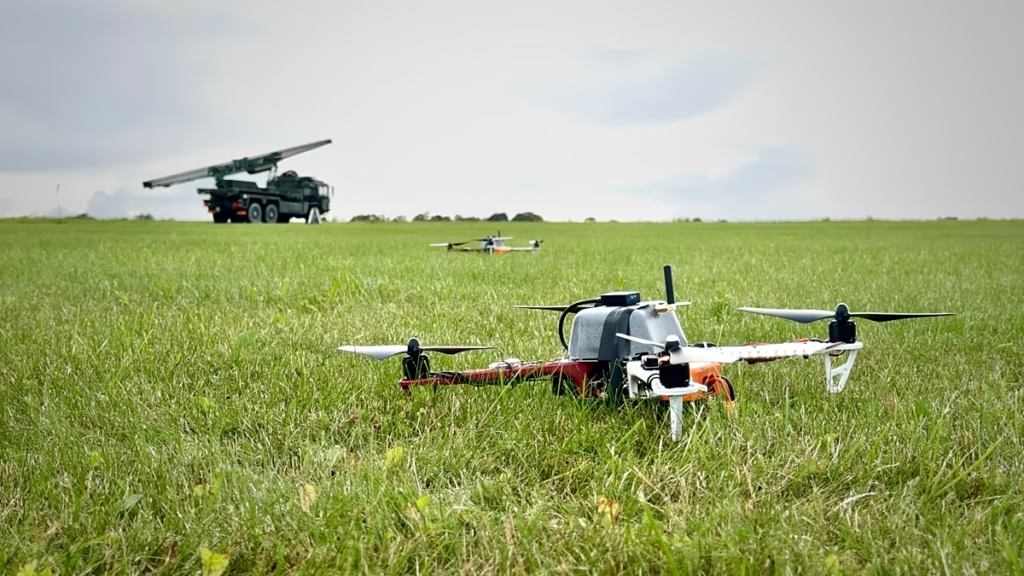
The Baltic defense system against drones is not a response born out of Tehran, but rather an outcome of the Russian full-scale invasion of Ukraine, the threat of sabotage to underwater pipelines, and increased incidents involving drones in northern Europe.
What the war between the United States and Iran has done is speed up an ongoing change in demonstrating how fast an advanced air defense inventory can be depleted when cheap drones are used with missiles.
This difference is important. As stated by Germany on 28 August, Baltic Sea countries are forming an anti-drone task force to enhance information exchanges and joint action regarding hybrid threats. The idea emerged after the meeting in Helsinki in June between Finland, Sweden, Norway, Denmark, Estonia, Latvia, Lithuania, Poland, and Germany where the issue of cooperation in response to drone threats to public safety and critical infrastructure was discussed.
This project is older than the current phase of the Iran crisis. The main reason for its emergence is Russia; the Iran case is just a stress test demonstrating how layering of air defense works on a large scale.
This much was already clear from the Ukraine experience. Ukraine had to improvise acoustic detection systems, mobile artillery units, and ever-cheaper interceptor drones due to the impossibility of firing precious surface to air missiles at every Geran-2 drone.
Iran provides another lesson. It has forced the United States and its allies to protect several nations, military bases, and even a strategic naval strait against a combined challenge from both drones and ballistic missiles. In May, according to testimony Admiral Brad Cooper, commander of U.S. Central Command gave to Congress, American and allied forces had intercepted 1,500 missiles and 6,000 drones since the start of the conflict.
What makes the Iran example important is not the sheer size of the Iranian drone campaign compared to Ukraine. It is the fact that Iran has generated huge demand for high-end interceptors in such a short time when the same Western industrial base and stocks continue to support Ukraine.
This partially explains why Patriot shortages require a deeper analysis. The shortage is not caused by the proliferation of cheap Iranian drones alone. Previous U.S. Patriot transfers to Ukraine have also drawn down some of the American supply, according to the Associated Press.
Read More: Russia Says Europe Should Expect More Drone Incidents After Romania Episode
On top of this, Washington has to make provisions for Israel, the Gulf countries, and its forces deployed in the Middle East. At the same time, Ed Arnold, a senior associate fellow at RUSI, said in an interview with the Associated Press that the withdrawal of the Patriot stockpile for use in Ukraine was planned and reasonable, but the demands of the Middle East caught the country off guard.
According to the estimates by the Center for Strategic and International Studies quoted by Reuters and AP, by July, the United States had spent around 65 percent of its Patriot interceptors, and THAAD stocks had declined by at least 38 percent.
It doesn’t imply that Patriots should be fired at a Shahed regularly. Patriots have proved to be extremely effective against ballistic missiles, which happens to be the very threat that Europe lacks other options to counter effectively. The economic dilemma arises in the context of mixed salvos in which cheap drones exhaust resources devoted to monitoring and low-end defense systems while expensive ballistic missiles compel the defenders to hold expensive interceptors.
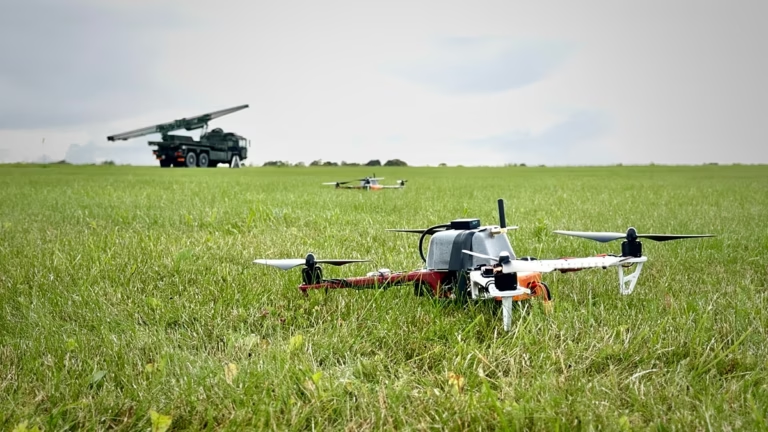
It has been proven that it is possible. According to an RUSI analysis published in March 2026, for example, Robert Tollast, a researcher at RUSI, discussed the employment of inexpensive acoustic sensors, mobile gun units, and inexpensive drone interceptors against Geran-2s in Ukraine.
Read More: Half of the Europeans Fear War With Russia, Survey Finds
Similarly, in the U.S., Mk 45 naval guns and APKWS guided rockets were used against drones, as RUSI has observed that both are less expensive than their targets. In the same analysis, RUSI estimated the Shahed class of drones to cost between $50,000 to $70,000 while noting that the Coyote drone interceptor costs about $100,000.
In other RUSI analyses previously conducted, Jack Watling and Sidharth Kaushal noted that advanced weapons such as the Patriot missile would probably cost between $1.5 million and $5 million per engagement. Therefore, it is obvious that the way to solve the cost-exchange problem is very practical: guns, electronic warfare, guided rockets, and drone interceptors can deal with certain threats, while missiles are kept for suitable targets.
This is an example of Europe backing up that philosophy with cold, hard cash. At the NATO summit in Ankara last July, alliance members pledged some $40 billion of counter-drone funding over the next five years through the Drone Edge program, in addition to the commitment to train five times as many drone operators by 2027.
Additionally, the NATO procurement office has created framework contracts for deployable systems against UAS that integrate radar, electro-optical, electronic warfare and hard-kill intercept capabilities. It is here that the Baltic task force can play its role. The task force itself is a coordination and information sharing body rather than a procurement body, but it can connect these national capabilities so that investments in layered defense function as a regional system.
Read More: EU’s Kallas Says Russia Planning More ‘Sabotage Acts’ Against Europe
This is precisely the kind of situation where a regional structure would come in handy. The ports, airports, pipelines, energy installations and submarine cables are distributed across several jurisdictions, while the hybrid warfare systems like unmanned drones can penetrate those jurisdictional boundaries rapidly.
There is a danger of fragmentation of awareness and delay in attributing the sources using the national framework of approach. A regional structure can combine sensors, intelligence, electronic warfare, and intercept capability into one operational picture.
Thus, the emerging Baltic force is certainly not an instance where Europe is simply following lessons learned in the U.S.-Iran dispute. It is because of the strategic necessities created by Russia and lessons learned in Ukraine. The Iranians have only accelerated the process through their demonstration of the vulnerability of Western stocks of interceptors.
A specific implication of this strategy follows from that: Europe not only requires a greater capability for air defense, but the right cost structure, too. The state of the art capabilities will continue to be necessary for the highly sophisticated threats, such as ballistic missiles, whereas less expensive capabilities, like drones, guns, jamming, and short-range interceptions, can take care of less sophisticated threats. The Baltic states are on the right track in this regard. Iran made it harder to ignore the consequences of not doing so.
*The views presented in this article are the authors’ own and do not necessarily reflect the views of The Diplomatic Insight.*

Uzair Ahmed
Uzair Ahmed is a student of International Relations at National Defence University (NDU), with research interests in deterrence, foreign policy analysis, and international security.