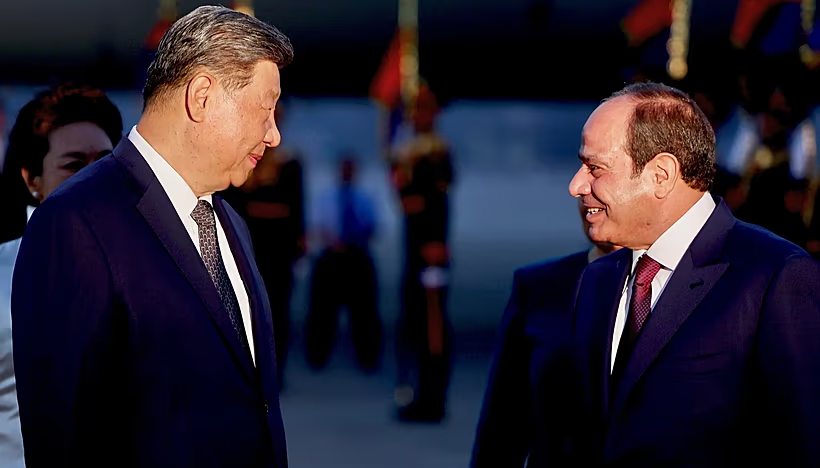
President Xi Jinping’s state visit to Egypt last week came at a moment of special significance: this year marks the 70th anniversary of China–Egypt diplomatic relations. In 1956, Egypt became the first Arab and African country to recognize the People’s Republic of China and establish diplomatic ties with it; in 2014, the bilateral relationship was upgraded to a comprehensive strategic partnership.
The joint statement issued after this visit shows that China–Egypt relations are entering yet another new stage—one defined by political mutual trust grounded in civilizational diversity, partnership based on strategic autonomy, development cooperation shifting toward industrial and capacity building, and increasingly systematic coordination between the two countries on Middle East affairs and Global South governance.
Official narratives on China–Egypt relations often refer to the two countries as “ancient civilizations.” If this is understood merely as long history and cultural heritage, its explanatory power is limited. What deserves more attention is the political meaning behind the civilizational dimension.
Both China and Egypt have long histories as states, and both modern nations emerged after experiences with imperialism, colonialism, and the struggle for national independence. As a result, their political cultures share an obvious common trait: a high sensitivity to national sovereignty, political independence, and the right to choose one’s own development path.
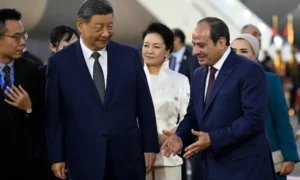
This gives China–Egypt relations a political foundation different from alliances built on ideological homogeneity. China and Egypt differ markedly in political system, religious culture, social structure, and level of economic development, yet neither side tries to erase those differences. On the contrary, the relationship has long rested on recognizing them.
In the latest joint statement, Egypt explicitly affirms that different cultures and civilizations should be respected on an equal basis, while both sides reiterate non-interference in internal affairs, mutual respect, and independent development. Thus one theoretical significance of China–Egypt relations is that they offer a different answer to a long-debated question in modern international relations: does stable international partnership require value convergence, or only agreement on rules and mutual respect?
Read More: Xi Visits Egypt As US-Iran Conflict Threatens Regional Ties
The Western alliance system places heavy emphasis on institutional and values alignment; the China–Egypt model places greater weight on sovereignty, the right to development, and mutual recognition of different political and civilizational traditions. This does not automatically eliminate conflicts of interest, but it does remove a major source of friction—the tendency to treat changing the other side’s domestic system as a central objective of bilateral relations.
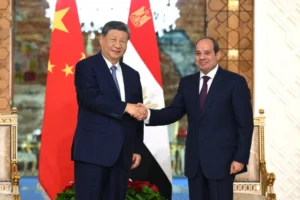
Therefore, if “mutual learning among civilizations” is to mean more than diplomatic rhetoric, it should be understood as a methodology for managing difference: not building international order by eliminating difference, but finding rules for cooperation while accepting difference.
One easily overlooked but highly significant point in the latest China–Egypt joint statement is China’s explicit appreciation of Egypt’s principle of “strategic balance.” This matters greatly for understanding contemporary Middle Eastern politics. For a long period after the end of the Cold War, Middle East international relations revolved largely around a US-led security architecture. In recent years, however, regional countries such as Saudi Arabia, the United Arab Emirates, Turkey, and Egypt have shown a clear trend toward diplomatic diversification.
Seen in this light, the importance of China–Egypt relations becomes clearer.China does not ask Egypt to develop cooperation with Beijing at the expense of its relations with the United States or Europe; nor does Egypt present its relations with China as abandonment of traditional partners.
China–Egypt partnership is therefore not an exclusive alliance, but a non-exclusive strategic cooperative relationship. In terms of international relations theory, this can be understood as “multi-directional hedging” or “strategic diversification” adopted by middle powers in a multipolar environment. By cooperating with several major centers of power at the same time, a country reduces dependence on any single external actor and enhances its own bargaining power and policy autonomy.
This has practical implications for the Global South. The value of a truly multipolar international system lies not necessarily in how many “great-power centers” emerge, but in whether small and medium-sized countries and regional powers enjoy greater room for policy choice.
The second notable change is in the economic sphere. Over the past decade and more, China’s cooperation with Egypt and many Belt and Road partners has often begun with infrastructure investment. Railways, power, ports, industrial parks, and urban development formed the early agenda.
This visit shows that China–Egypt cooperation is moving further into industrial capacity and technological capability building. The two sides proposed deeper alignment between the Belt and Road Initiative and Egypt’s Vision 2030, and explicitly aimed to turn Egypt into a hub for industry, logistics, clean energy, and the digital economy connecting Asia, Africa, and Europe.
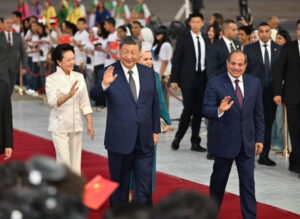
The cooperation list now includes new-energy vehicles, shipbuilding, solar equipment, wind-power equipment, seawater desalination, cloud computing, data centers, the data economy, semiconductors, cybersecurity, space remote sensing, and critical-minerals supply chains. The two sides also stressed local industrialization, technology exchange, and talent development.
This shift deserves close attention. Infrastructure investment addresses the “hard constraints” on economic development; industrial cooperation addresses a more fundamental question—whether developing countries can build endogenous capacities to generate employment, technology, and export earnings on a sustained basis.
The Suez Canal Economic Zone thus acquires new strategic meaning. It is not only an economic zone beside one of the world’s most important shipping corridors; it may also become a key production node linking China’s manufacturing capacity with markets in Africa, the Arab world, and Europe. This reflects a trend of “regionalized globalization”: rather than simply exporting from one country to the world, enterprises increasingly need to build production and supply-chain nodes closer to final markets.
Another structural change in China–Egypt relations is that their discussions now clearly go beyond bilateral economic cooperation. The latest joint statement contains specific positions on Palestine, Gaza, the Red Sea, the Horn of Africa, and Sudan.
The two sides reaffirm that the Palestinian question is the core issue of the Middle East and support a political settlement based on the “two-state solution.” On the Red Sea, they argue that governance and security there are first and foremost the responsibility of littoral states, and that the will of regional countries must be fully respected. They also stress upholding Sudan’s sovereignty and territorial integrity and promoting a Sudanese-led political process. These points indicate that China–Egypt relations are extending from a “project-cooperation partnership” to a “regional-governance partnership.”
Read More: Iran War: Is a New Middle East Order Emerging?
In his talks with President Abdel Fattah El-Sisi, President Xi proposed fostering common security in the Middle East, emphasizing the role of regional countries themselves, political settlement of hotspot issues, strengthening the security foundation through development, and the role of the United Nations and international law.
From this perspective, China’s role in the Middle East is shifting from a traditional “economic stakeholder” toward an attempt to provide regional public goods. Unlike Western countries, its policy objective is not to become a new security hegemon in the Middle East; rather, it seeks more to provide diplomatic mediation, economic development, international mechanisms, and communication channels among different camps.
The China–Egypt joint statement lists “safeguarding the interests of developing countries and the Global South” as one of the pillars for deepening the comprehensive strategic partnership, and emphasizes reform of international financial institutions and greater representation for developing countries in international economic and political decision-making.
This adds a fourth dimension to the relationship. If Global South cooperation merely means forming a new political bloc, its significance is limited. Globally meaningful Global South cooperation should address three more concrete questions:First, whether developing countries can have more options for development finance and industrialization;Second, whether they can gain representation in international institutions more commensurate with their economic and demographic weight;Third, whether they can maintain strategic autonomy in great-power competition instead of being forced into a new camp.
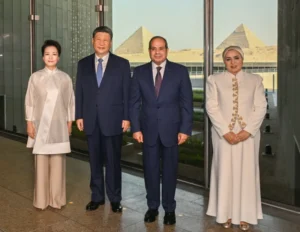
By this standard, China–Egypt relations do provide a valuable case. The relationship combines traditional political mutual trust with large-scale infrastructure; it develops industrial and technological cooperation without demanding a military alliance; it discusses global governance without asking Egypt to cut off cooperation with Western countries. In other words, it attempts to combine development, security, civilizational diversity, and strategic autonomy within one framework of partnership.
For Pakistan’s strategic community, China–Egypt relations are not a case irrelevant to South Asia.Pakistan, too, sits at the junction of Asia, the Middle East, and the Indian Ocean, and has long faced the challenge of balancing great-power relations, national security, and economic development.
The future of the China–Pakistan Economic Corridor must answer the same questions now being addressed by China–Egypt cooperation: how to move from infrastructure to industrialization; how to translate geographic location into supply-chain advantages; how to attract long-term manufacturing investment; and how to expand cooperation with China while maintaining open and diversified international economic linkages.
Therefore, the most useful lesson for Pakistan from China–Egypt relations is not to copy any particular project, but to grasp the broader principle it embodies: Deepening relations with China and maintaining diplomatic diversification are not contradictory. A mature multipolar international system should not force countries to make a permanent binary choice between Beijing, Washington, Brussels, or other centers of power.This may be the most realistic expectation of multipolarity for Global South countries today.Multipolarity does not mean replacing one hegemon with several competing hegemons; it means expanding the strategic autonomy of ordinary nations.
Thus, the significance of President Xi Jinping’s visit to Egypt cannot be measured merely by new investments, cooperation documents, or diplomatic courtesy. Seventy years of China–Egypt relations now pose a more consequential question:Can countries with different political systems, religious traditions, and development paths form long-term strategic cooperation without trying to change one another or forming an exclusive alliance?
The answer given by China and Egypt is, on the whole, yes. The modern interaction between two ancient civilizations thereby acquires new meaning. Civilization is no longer just historical heritage; it becomes a political foundation for recognizing diversity. Strategic partnership no longer means alliance; it means finding common interests amid difference. Development cooperation should not stop at construction projects; it should ultimately build local development capacity.
Perhaps this is the greatest lesson of China–Egypt relations for the future of China–Middle East ties. China’s lasting influence in the Middle East may not come from creating a new sphere of influence. It may come from something else:convincing countries that in a more multipolar world they can develop more partnerships while still preserving their own strategic autonomy.
If this holds true, then the significance of China–Egypt relations extends far beyond Cairo and Beijing. It speaks to the question of what kind of international order Global South countries of the 21st century wish to build.
Ding Jie
Ding Jie is a Senior Research Fellow at the Academy of Contemporary China and World Studies.