
This article is part of a Four-Part Policy Series “Making Pakistan’s Trade Logistics Work” on freight efficiency, multimodal connectivity and digital trade facilitation. Read the first in the series here.
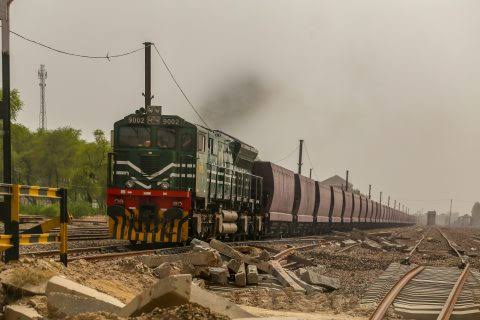
Pakistan Railways moved 8.2 million tons of freight in 2024-25, according to the Ministry of Railways: petroleum, containers, coal, rock phosphate, fertilizer, wheat. It is a sizeable business and a growing one. Freight earned the railway more than Rs31 billion that year, and in 2025-26 revenue of about Rs41 billion exceeded the Rs38 billion budget target by seven per cent.
Yet rail remains a small part of how Pakistan moves goods. Estimates place rail’s share in the single digits and road’s at around 95 per cent, although figures vary depending on whether freight is measured in tons or ton-kilometers, underscoring the need for a consistent national series. A ministry official has said that Railways can run about ten freight trains a day from Karachi to up-country destinations.
This is not a case for building something new. The National Transport Policy 2018 already envisages a primary role for rail in long-haul freight between industrial zones and seaports. The question is how to make existing track attractive to the shippers who today default to the road.
The government is moving in that direction. Pakistan Railways has introduced online freight booking, added freight and cargo trains and begun outsourcing freight wagons. It has already used open auctions to outsource passenger trains and luggage and brake-van operations, and the Minister for Railways has said freight outsourcing under the same model will follow, while noting that the Karachi-Yousafwala coal train alone earns about Rs9 billion a year and should not be disturbed without a better offer. That is a prudent position.
An Auditor General’s audit also identified lost freight earnings of Rs32.71 million when 190 wagons returned empty despite available booking demand, illustrating the cost of weak capacity utilization. Pakistan Railways’ reform roadmap targets raising rail’s freight share towards 20 per cent, alongside ML-1 modernization, but this remains a longer-term objective with financing and feasibility questions; a pilot need not wait for it.
The position also points to where the next gains lie: beyond coal and other bulk traffic, in goods that must keep to a schedule.
A manufacturer in Faisalabad or Sialkot choosing between a truck and a train asks three questions. When will it leave? When will it arrive? What will it cost? For bulk commodities moved under long-standing arrangements, the railway answers these well.
For containerized and general cargo, the answers are harder to find. Publicly available data on the on-time performance of freight services is thin, and tariffs for such cargo are not easy for a new customer to compare with road rates. Where information is missing, the default is the truck. A pilot using existing infrastructure could close the gap in four steps.
First, a scheduled container service on one existing corridor linking a Karachi port-side terminal to an up-country dry port or industrial hub. Fixed weekly departures, published arrival windows and a committed number of wagon slots would give shippers something to plan around.
The Ministry of Railways and Pakistan Railways should lead, with port terminal operators and Pakistan Customs supporting. The corridor should be chosen using Railways’ own volume data, and a 100-day preparation period would be realistic.
Second, transparent tariffs and standard contracts. A published tariff schedule for the pilot service and a 12-month contract with volume commitments would let a shipper compare rail and road on equal terms. Pakistan Railways’ commercial wing would prepare these, with the Ministry of Commerce consulting exporters.
Third, competitive allocation of pilot capacity. Building on Pakistan Railways’ experience with open auctions, a share of the pilot’s slots could be offered transparently to freight forwarders and logistics firms under an appropriate, legally reviewed commercial arrangement. This would test market demand without privatizing any asset.
Fourth, a clean hand-off at both ends. Customs clearance at the inland terminal, and private truckers handling the first and last mile, would allow the rail leg to work alongside road, not against it. The aim is modal integration, not modal substitution.
Any additional rolling stock or terminal works should wait for evidence. The pilot should be sized to existing wagons and track capacity, so that additional spending, if any, is justified by contracted demand and subject to a proper feasibility assessment. Pilot costs should be minimized through existing budgets, with service revenues helping to offset operating expenses.
Success would be measured through on-time departure and arrival against the published window, transit time on the corridor, wagon turnaround days, the share of slots contracted, revenue per wagon, and the pilot corridor’s share of the tonnage of participating firms.
Pakistan has track, wagons and a customer base that already uses rail for coal, fertilizer and petroleum. What it lacks is a service that a manufacturer can book with confidence. Build that on one corridor, publish the results and let evidence decide how far it goes.
*The views presented in this article are the authors’ own and do not necessarily reflect the views of The Diplomatic Insight.*

Mujtaba Arshad
Mujtaba Arshad is a Research Associate at the Centre of Excellence for CPEC, Pakistan Institute of Development Economics (PIDE), Islamabad. He holds an MPhil in Economics from Quaid-i-Azam University, Islamabad, where he secured second position in the Economics Department. His research and policy interests include international trade and investment, industrial development, regional connectivity, and Pakistan’s economic transformation.