
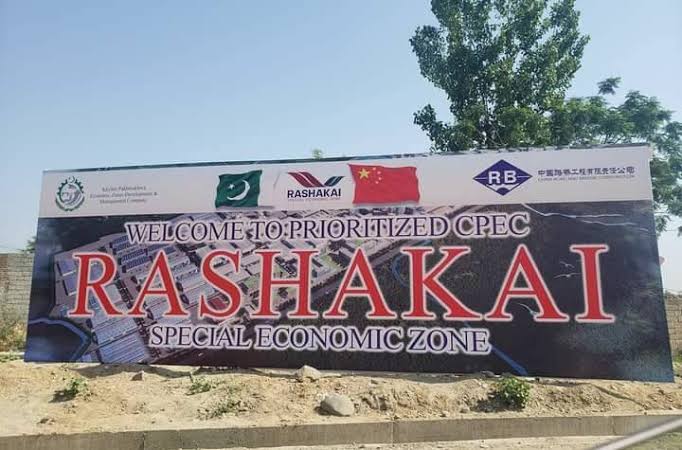
Twenty-two enterprises approved. 93.11 acres leased. PKR 84.614 billion in investment mobilized or committed. On paper, Rashakai Priority Special Economic Zone in Khyber Pakhtunkhwa appears to be attracting substantial industrial interest.
Yet the management assessment by the Khyber Pakhtunkhwa Economic Zones Development and Management Company (KPEZDMC) reports only two operational firms, with nine more under construction, while the status of the remaining eleven is not specified.
More importantly, the assessment provides no validated figures for the number of exporting firms, their products or their destination markets. The gap between attracting investment and delivering measurable industrial and export performance raises a fundamental question: are Pakistan’s special economic zones becoming engines of exports, or are approvals and investment commitments still being mistaken for economic results?
Occupancy looks healthy: 93.11 of Phase I’s 173 leasable acres, or 53.8%, are leased. But leased land is not output. Measured by firms rather than acres, fewer than one in ten approved enterprises is operational, and that is the ratio an investor, a lender or a finance ministry should care about.
This assessment of Rashakai Special Economic Zone is based on management-reported information, with several entries still awaiting verification. It is a case study of one zone, not a representative survey of Pakistan’s SEZs. But it exposes a habit worth examining: we count what is easy to count at the front door of a zone, such as approvals, acres and pledges, and lose sight of what leaves through the factory gate.
Consider the reported PKR 84.614 billion in investment mobilized or committed. The questionnaire does not distinguish between capital pledged and capital actually deployed, while the foreign-domestic investment breakdown remains unverified. Between approval and production lie land development, utility connections, finance and permits, and nobody can steer that journey without tracking it.
Nor is the explanation simply physical. In the management assessment, internal roads, external connectivity, electricity, gas and water are all rated good. The one-window facility, Board of Investment facilitation and provincial government support also receive positive ratings.
Power interruptions still occur monthly, and the weaker marks fall where exporters need most help: warehousing and customs facilities are rated poor, logistics only average. The assessment also says that connection and approval times are case-specific and not centrally validated. A zone may rate its own services generously, but without recorded timelines an investor waiting for a gas connection cannot test that rating.
Exports are where the gap is widest. Management rates the zone’s support for export growth as poor, and ranks access to ports first among export barriers, logistics second and finance third. Finance is also the only challenge scored as critical. The questionnaire records that firms import intermediate goods and produce both intermediate and final goods, but it does not mark direct exporting or supplying exporters.
This does not establish that no firm exports; it shows that the assessment cannot establish the extent of those activities. Supplier linkages, clusters, SME participation and innovation are all rated poor, so the zone may be hosting factories rather than building an industrial ecosystem.
Management’s overall rating of the zone’s export orientation is merely average, which sits uneasily beside its poor rating for export support. Its priority list, covering engineering and steel value chains, automobile components, home appliances, agro-processing and pharmaceuticals, points to where credible export potential may lie. But no sector exports by default: each needs international standards, buyer relationships and reliable delivery schedules.
For an inland zone short of warehousing and customs facilitation, good roads inside the fence cannot offset that handicap.
Linkages deserve particular attention. Technology transfer and university collaboration are rated average, not poor, which suggests a base to build on. A zone becomes competitive when local suppliers, smaller firms and larger investors learn from one another; left unmanaged, each factory remains an island, however modern its machinery.
Four reforms follow, none of them exotic. First, publish a verified performance dashboard: investment realized against committed enterprises by stage from approval to production, employment, output, exports, and the days taken for approvals and utility connections.
Read More: Pakistan, Canada Resume Investment Treaty Talks in Ottawa
A genuinely integrated single window, covering customs, tax authorities, utilities and environmental regulators, should feed it with digitally tracked approvals. Published regularly, it would let policymakers, lenders and prospective investors judge zones on the same facts.
Second, give approved projects structured aftercare, with milestones and timely enforcement, so that a pipeline of approvals becomes a pipeline of factories. Management lists this among its own priorities. Third, close the trade-facing gaps: warehousing, customs and standards facilitation inside the zone, better freight links to ports, and enforceable service standards for utilities.
Fourth, treat finance as an export issue. Targeted credit guarantees and competitive export finance matter most where management reports its sharpest constraint, and predictable incentives would ease the policy uncertainty it rates as serious.
Pakistan has spent years learning how to bring investors to its zones. The next test is whether it can show, in numbers, what those zones send abroad. Until a zone can say what leaves its gates, it is an industrial estate with ambitions, not an export platform.
*The views presented in this article are the authors’ own and do not necessarily reflect the views of The Diplomatic Insight.*

Mujtaba Arshad
Mujtaba Arshad is a Research Associate at the Centre of Excellence for CPEC, Pakistan Institute of Development Economics (PIDE), Islamabad. He holds an MPhil in Economics from Quaid-i-Azam University, Islamabad, where he secured second position in the Economics Department. His research and policy interests include international trade and investment, industrial development, regional connectivity, and Pakistan’s economic transformation.