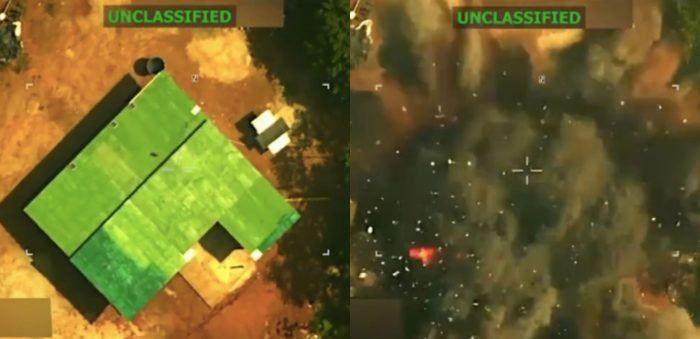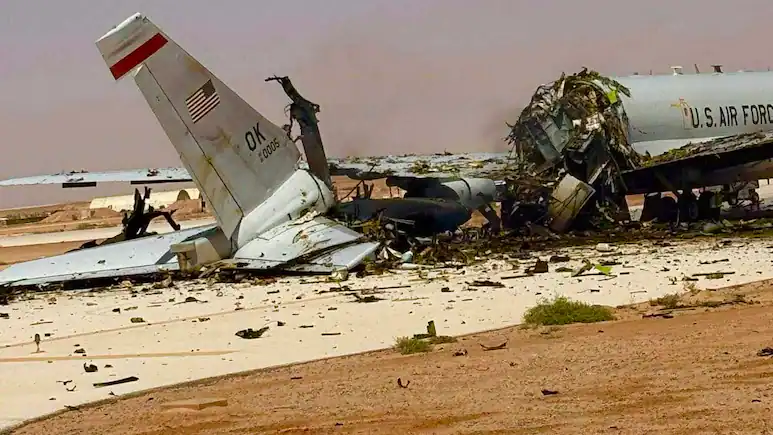
On March 27, 2026, a coordinated Iranian strike on Prince Sultan Air Base in Saudi Arabia, six ballistic missiles and twenty-nine one-way attack drones, destroyed E-3G Sentry serial number 81-0005, a U.S. Air Force airborne warning and control system aircraft. Its rear fuselage was burned through. Its rotating radar dome, the distinctive disc that defines the aircraft’s function, was on the ground.
The Air Force has yet to formally declare it a total loss, but air battle managers who reviewed the images have described the destruction as effectively irreparable. The aircraft, based on the Boeing 707 airframe first launched in the 1950s, entered Air Force service in 1978. Its production line closed in 1992. There is no replacement aircraft available and no production capacity to build one.
One destroyed aircraft should not constitute a strategic crisis. That it does reveals something important about how the United States has structured its military architecture, and what that structure costs when it meets an adversary with patience, resources, and a systematic understanding of where American airpower is most exposed.
The E-3 fleet began 2026 with seventeen aircraft. The Air Force had already retired fifteen of its thirty-one jets in 2023 and 2024, concentrating maintenance resources on the remaining airframes to improve availability rates that had fallen to approximately 56 percent — meaning that on any given day, fewer than ten E-3s were operationally capable. When Operation Epic Fury began on February 28, CENTCOM deployed six of those aircraft to Prince Sultan Air Base, representing nearly 40 percent of the entire fleet concentrated at a single forward location.
Read More:Trump Faces War Powers Deadline Over Iran Military Action
The decision prioritized coverage over survivability. The March 27 strike forced a reckoning with that calculus. Heather Penney, a former F-16 pilot and director of studies at the Mitchell Institute for Aerospace Studies, told Air & Space Forces Magazine that the E-3’s loss was “incredibly problematic, given how crucial these battle managers are to everything from airspace deconfliction, aircraft deconfliction, targeting and providing other lethal effects that the entire force needs for the battle space.”
Kelly Grieco of the Stimson Center, tracking the pattern of Iranian strikes across the campaign, identified what she described as a deliberate counter-air strategy targeting three distinct functional categories: radar and communications infrastructure, aerial refueling tankers, and now the AWACS. “That’s not random,” she said. “That’s a target set derived from an understanding of how U.S. airpower functions and where it is most exposed.”
The strategic significance of the E-3’s loss extends beyond the immediate operational gap. An airborne early warning aircraft operating over the Gulf can detect an incoming Iranian Shahed drone launched 200 miles away approximately 85 minutes sooner than ground-based radar, according to analysis by Peter Layton, a former Royal Australian Air Force officer and fellow at the Griffith Asia Institute.
That warning time is the margin within which missile defense batteries activate, fighter intercepts are directed, and base personnel seek shelter. Compressing it increases interceptor consumption rates, reduces intercept probabilities, and creates the accumulating coverage gaps that Grieco described as “operationally significant even if no additional aircraft are destroyed.”
The loss of one E-3 does not disable American airpower. It degrades the connective tissue through which airpower coordinates — and degraded coordination at operational scale produces exactly the kind of coverage gaps that allowed Iranian missiles to reach the flight line at Prince Sultan despite the presence of Patriot and THAAD batteries at the base.
Read More: US Weighs ‘Short, Powerful’ Strike Options Against Iran
The replacement problem is structural, not merely logistical. The E-3’s successor, the Boeing E-7A Wedgetail based on the 737-700 airframe, was already in troubled development before the war began. The Pentagon moved to cancel the program in its fiscal 2026 budget request, citing cost growth from $588 million to $724 million per aircraft and survivability concerns in contested airspace.
Congress reversed the decision in the fiscal 2026 National Defense Authorization Act and blocked further E-3 retirements until sufficient Wedgetails are in service. But Boeing delayed the E-7A’s first flight test by nine months to May 2027 due to a required critical security architecture change. The first operational aircraft is not expected to reach the Air Force until 2028 at the earliest.
A full fleet of twenty-six aircraft is years further out. The aircraft destroyed at Prince Sultan cannot be replaced from inventory. It cannot be rebuilt from a closed production line. It can only wait for a successor whose delivery timeline predates the war that made its absence visible.
A March 2026 report by the Center for a New American Security warned that proposed alternatives to dedicated airborne battle management, space-based sensors and fighter-based networks, are either longer-term technological prospects, unproven at battle management scale, or highly vulnerable to the same counter-air targeting that destroyed the E-3.
The report recommended treating them as complements rather than substitutes. That recommendation arrives too late for the aircraft destroyed at Prince Sultan but not too late for the force structure decisions that will determine how the United States manages a conflict requiring airborne battle management when its fleet of irreplaceable aircraft is already below the number of B-2 bombers in service.
Iran did not defeat U.S. airpower in this conflict. It demonstrated, with one strike against one aircraft, what happens when force architecture built around high-value irreplaceable platforms meets an adversary that has spent years studying exactly which targets to hit.
The E-3 destroyed at Prince Sultan is not primarily a story about one aircraft. It is a story about what single points of failure cost when they cannot be replaced, and about what happens when the production lines that would allow replacement were closed a generation before the conflict that made them necessary.
*The views presented in this article are the authors’ own and do not necessarily reflect the views of The Diplomatic Insight.

Aleena Saif Ullah
Aleena Saif Ullahis an MPhil Scholar in International Relations at the University of Punjab, Lahore. She can be reached ataleenasaifullah68@gmail.com