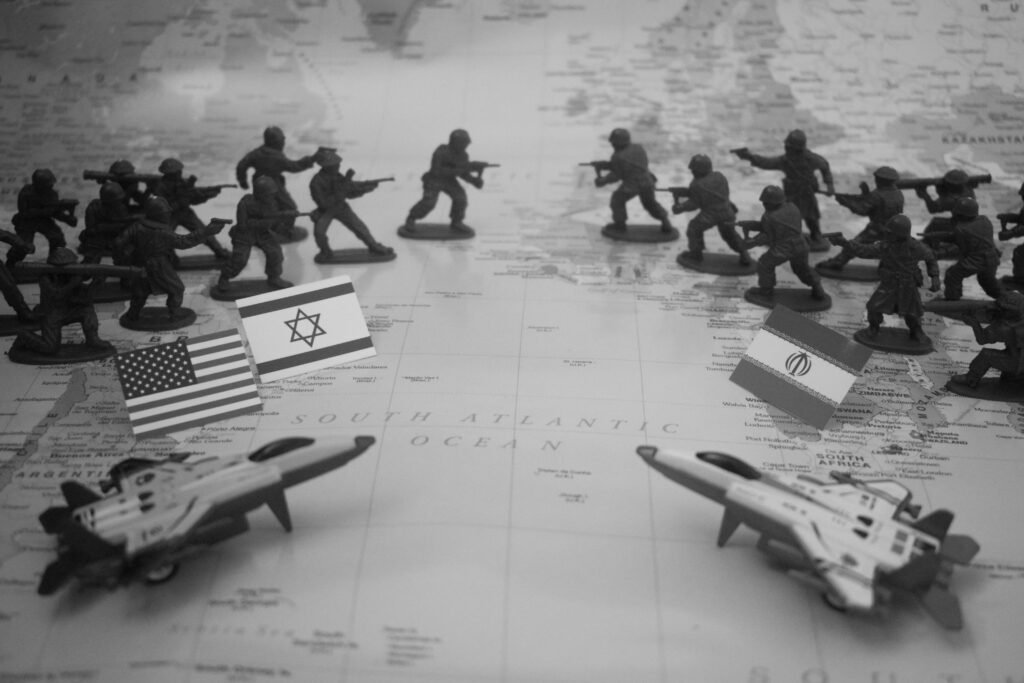
Every military campaign produces a moment when the stronger party realizes that strength alone cannot resolve the problem it is facing. For Israel and the United States, that moment arrived not when Iran retaliated with missiles and drones after the February 28 strikes — that was expected and largely intercepted. It arrived when the decision of how to respond to Iran’s proxy network produced no answer that did not hurt the side asking the question.
Strike Hezbollah in Lebanon and risk a full-scale war on Israel’s northern border. Strike the Houthis and commit to an open-ended naval campaign thousands of miles from home waters. Strike Iraqi militias and fracture the regional coalition Washington spent years assembling. Do nothing and signal that proxy pressure carries no cost.
This is not a dilemma Iran stumbled into. It is a structure Iran built — deliberately, incrementally, over decades — and the events since February 28 have demonstrated that it works even when everything else is going wrong for Tehran.
The proxy network that Iran activated in the days following Khamenei’s assassination is frequently described in Western analysis as a retaliatory instrument — a means of imposing costs on adversaries who struck the Iranian homeland. That description is accurate but incomplete. The deeper function of the axis of resistance is not retaliation. It is architectural.
Hezbollah in Lebanon, the Houthis in Yemen, and the Iraqi and Syrian militias were not built to win wars. They were built to ensure that any adversary contemplating action against Iran would face simultaneous, geographically dispersed threats that could not all be addressed at once and could not safely be ignored. The trap is not the individual proxy. The trap is the geometry — the way the network forces adversaries into a multi-front problem that drains resources, divides attention, and makes every response option carry a cost exceeding the benefit.
This geometry is operating exactly as designed, even under the significant degradation these forces have absorbed. Hezbollah emerged from the 2024 Israeli offensive substantially weakened — its senior leadership decimated, its missile stocks reduced, its operational capacity a fraction of what it was before October 7. The Iraqi militias are fragmented and fighting for institutional survival.
Read More: How Iran Survives? A ‘Beyond Collapse’ Narrative
The Houthis face sustained pressure from multiple naval coalitions. And yet: Israel is still managing a northern front while sustaining operations elsewhere. The U.S. is still maintaining costly naval presence in the Red Sea while supporting Israeli operations and deterring direct Iranian escalation. The trap does not require the proxies to be strong. It requires them to be present — to exist as threats that cannot be dismissed, forcing adversaries to divide finite resources across infinite problems.
A weakened Hezbollah that still fires rockets across the northern border is strategically useful to Tehran not because it can defeat Israel but because it cannot be safely ignored while Israel is fighting everywhere else simultaneously.
The decision trap crystallizes most clearly in the accountability problem that proxy architecture deliberately creates. Traditional deterrence theory assumes a traceable chain of command — a sponsor who can be held responsible for a proxy’s actions and whose calculus can therefore be altered by raising the costs of sponsorship. Iran’s network has been engineered to corrode that assumption. Tehran can credibly claim limited operational control over groups that have developed genuine ideological and organizational autonomy.
The Houthis answer to a Yemeni political agenda that predates Iranian sponsorship and will outlast it. Hezbollah has its own electoral presence, social welfare infrastructure, and Lebanese constituency that operates independently of IRGC direction. Iraqi militias are embedded in the formal security architecture of a sovereign state. This distributed structure is not an accident of history — it is a design feature that makes attribution difficult, retaliation legally and politically complicated, and escalation management nearly impossible.
When Israel strikes a Hezbollah position, it is not striking an Iranian asset. It is striking a Lebanese political actor with its own population, its own territorial base, and its own capacity to reframe Israeli military action as aggression against Lebanon rather than retaliation against Iran.
What makes February 2026 the definitive stress test is the conditions under which the trap is operating. Iran’s central leadership has been killed. Its nuclear and missile infrastructure has been heavily degraded. Its economy is under unprecedented pressure. By every classical measure of state power, Iran is weaker today than at any point since the Islamic Revolution — and the decision trap is fully operational regardless.
Israel and the United States are still navigating the same impossible geometry, still unable to find a response to proxy pressure that does not generate costs exceeding the benefit. This matters beyond the immediate conflict because it answers the question that every state watching from Pyongyang to Moscow to Beijing has been asking: does the investment in proxy architecture survive a catastrophic strike on the center? February 2026 has supplied the answer, and it is not reassuring. The trap was built to survive exactly this scenario. It did.
Read More: The Dangerous Comfort of Escalation in the US-Iran Conflict
The strategic lesson Tehran has demonstrated for any state or non-state actor watching closely is uncomfortable in its simplicity. A state does not need conventional military parity with its adversary. It does not need to win the war at the center. It needs to build, over decades and at relatively modest cost, a distributed network of threats that forces the adversary into a decision architecture where no available response is clean.
The proxy does not need to be strong. It needs to exist in the right place, with enough capacity to demand a response, in enough locations simultaneously that the adversary’s resources and political will are always distributed across more fronts than they were designed to manage. That is the chokepoint doctrine applied not to maritime geography but to strategic decision-making itself — and it is a template that will be studied, adapted, and replicated long after the guns in this particular conflict fall silent.
The deterrence trap Iran constructed does not depend on Iranian strength — it depends on adversary complexity. As long as Israel and the United States face simultaneous, geographically distributed threats with incompatible response requirements, the trap functions regardless of how degraded its components become. That means the trap is not a product of this conflict. It is a feature of the regional architecture that will outlast it — and it is already being studied as a replicable model.
North Korea’s cultivation of asymmetric deterrence, China’s maritime militia operations in the South China Sea, Russia’s Wagner-era proxy deployments in Africa — these are not analogous accidents. They are iterations of the same strategic logic: build distributed, deniable, geographically dispersed pressure networks that force adversaries into decision architectures with no clean exit.
What February 2026 has added to that logic is a proof of concept under the most extreme stress test imaginable — a decapitation strike, years of proxy attrition, economic strangulation — and the trap held. For any state calculating whether the decades-long investment in proxy architecture is worth the cost, Iran has now supplied the answer.
*The views presented in this article are the author’s own and do not necessarily reflect the views of The Diplomatic Insight.

Aleena Saif Ullah
Aleena Saif Ullahis an MPhil Scholar in International Relations at the University of Punjab, Lahore. She can be reached ataleenasaifullah68@gmail.com