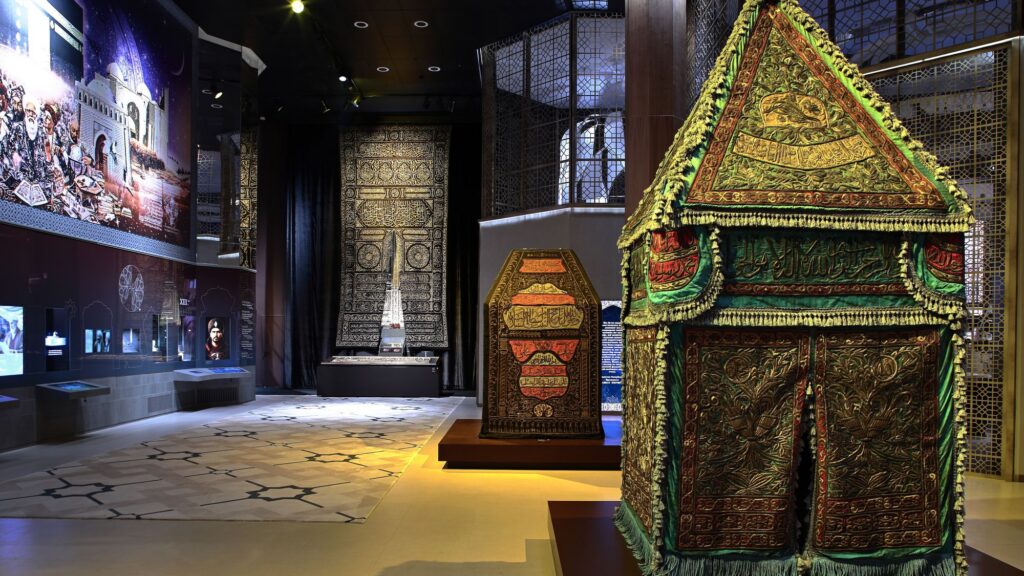
The Islamic Civilization Center in Tashkent represents a significant transformation in the way Uzbekistan preserves and presents its Islamic heritage. It is not designed simply as a conventional museum where historical objects are displayed behind glass.
The Centre combines manuscripts, archives, a library, scholarly research and digital technologies, creating a bridge between physical heritage and digital memory. Its library and collections are being digitized and systematically catalogued, while plans include a digital catalogue of manuscripts.
The Centre has also been compiling a State Register of unique manuscripts, with its ninth volume alone documenting 1,000 manuscripts from the Abu Rayhan Beruni Institute of Oriental Studies, covering subjects from Qur’anic studies and theology to medicine, philosophy, geography and science.
AI is adding another dimension to this preservation effort by changing how visitors encounter history. The Centre uses AI, augmented reality, virtual reality, 3D technologies, interactive screens and immersive projections to make historical knowledge more accessible.
Read More: Islamic Civilization Center: Uzbekistan’s New Cultural Vision for a Connected Muslim World
One particularly striking example is its digital platform featuring avatars of more than 100 great thinkers and scholars who appear on screens and speak about their ideas and discoveries. The exhibition project titled “From Paper to E-Book to Artificial Intelligence” will be organized in the library’s foyer. It will present a practical overview of the history of books from ancient manuscripts to modern AI.
The Centre also uses multimedia installations and digital reconstructions to bring historical periods closer to contemporary audiences. Its “Time Wall” uses holography, installations and projection technologies to present historical events and discoveries, while the Centre also features Humo AI as a digital assistant.
These technologies do not merely decorate historical exhibitions but also create new ways of communicating intellectual history to audiences accustomed to interactive digital experiences.
Yet the most important contribution of technology may be what protects itself from time itself. Ancient manuscripts are vulnerable to deterioration, while repeated physical handling can place additional pressure on fragile materials. Digitization provides researchers and visitors with access to high-quality digital versions without requiring constant handling of originals.
Read More: International Media Forum on Islamic Civilization Opens in Tashkent
The Centre’s library program specifically includes the digitization of rare manuscripts and the creation of electronic catalogues. It is also developing multilingual academic resources and digital services. Importantly, the Centre is already using facsimiles and high-precision copies to present works whose originals remain abroad.
Its Qur’an Hall, for example, presents rare Qur’anic manuscripts in original and facsimile form, with descriptions in Uzbek, English and Arabic. In this way, technology becomes not only a tool of access but an additional layer of preservation.
Digitalization also has the power to take Uzbekistan’s Islamic intellectual heritage beyond Tashkent. A physical manuscript can normally be studied only by those who can access the institution where it is preserved. A digital manuscript, catalogue or multilingual resource can potentially reach researchers, students and educators across borders.
The Centre is already presenting digital versions of rare masterpieces whose originals are held in institutions outside Uzbekistan, including works preserved in Paris, Istanbul, New York, Oxford and Baltimore. Its emerging digital infrastructure therefore connects Uzbekistan’s heritage with international scholarship rather than treating the country’s historical legacy as something confined to a national museum.
Read More: Uzbekistan’s Legacy of Enlightenment
Cooperation with institutions abroad is also expanding, including work on manuscript digitization, data exchange and scholarly research.
Ultimately, the Center’s digital transformation can be understood as a form of cultural diplomacy. Uzbekistan is presenting its Islamic intellectual heritage through technologies that speak to a global, digitally connected generation.
The Centre’s combination of manuscripts, scholarship, AI, immersive exhibitions, multilingual resources and digital cataloguing allows the country to communicate its historical contribution to science, philosophy, medicine, literature and Islamic thought in a contemporary language.
These efforts are significant because cultural diplomacy is not only about preserving a national past but also about creating opportunities for others to engage with that past. The Islamic Civilization Center therefore has the potential to become more than a museum of Islamic history.
It can become a digital gateway through which Uzbekistan uses heritage, knowledge and technology to encourage international scholarship and intercultural dialogue.
Aqsa Fazilat
Aqsa Fazilat is a student of Political Science and Philosophy at Kinnaird College for Women. Her research interest lies in contemporary global politics and political geography.