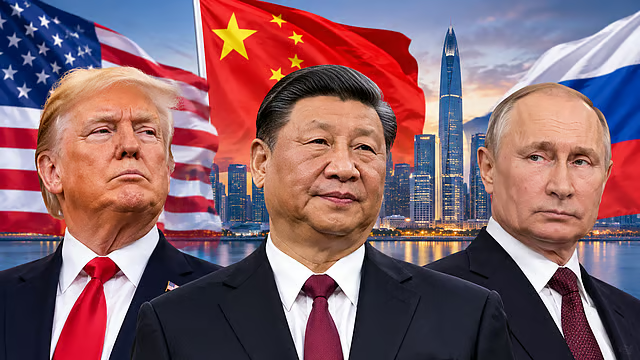
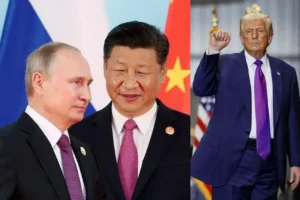
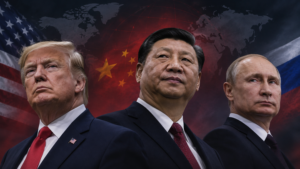
Is the world heading towards another Yalta, where three powerful leaders sit behind closed doors and decide the future of nations that have no seat at the table? The prospect of US President Donald Trump, Russian President Vladimir Putin and Chinese President Xi Jinping meeting in Shenzhen has sent ripples through European capitals and raised uncomfortable questions about the future of the international order. With Russia still at war in Ukraine, tensions between Washington and Beijing continuing to shape global politics, and Europe demanding a voice in any future security settlement, the proposed summit carries significance far beyond an ordinary diplomatic gathering.
For Ukraine, it raises the fear of being discussed rather than heard, for Europe, the prospect of being sidelined, and for Moscow, an opportunity to reassert its position among the world’s leading powers. The shadow of the 1945 Yalta Conference is once again hanging over global diplomacy. But is this the beginning of a new division of the world into competing spheres of influence, or simply an attempt by three powerful leaders to shape an increasingly uncertain international landscape?
The historical comparisons are difficult to ignore. In February 1945, as the Second World War approached its conclusion, US President Franklin D. Roosevelt, British Prime Minister Winston Churchill and Soviet leader Joseph Stalin met in Yalta to discuss the post-war international order. More than eight decades later, the prospect of Donald Trump, Vladimir Putin and Xi Jinping sitting at the same table has brought the legacy of that conference back into international debate.
The symbolism became particularly striking on November 4, when Putin visited an exhibition at Moscow’s Manege Central Exhibition Hall. Accompanied by a group of schoolchildren, the Russian president stopped before a sculpture depicting the three leaders who attended the Yalta Conference. He explained that they had gathered to discuss the future arrangement of the world after the war.
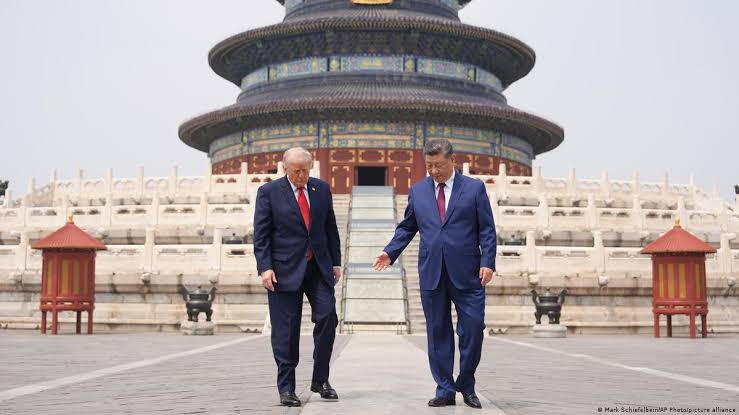
Just a day earlier, discussions about a possible meeting between Putin, Trump and Xi had been publicly acknowledged. The Kremlin subsequently confirmed that the three presidents would meet in Shenzhen on November 19, a development also confirmed by the White House and China’s Foreign Ministry.
Although the circumstances surrounding the proposed meeting are fundamentally different from those of 1945, its potential geopolitical implications have attracted considerable attention. The Yalta Conference took place when the military balance in Europe was rapidly shifting in favour of the Soviet Union. Soviet forces had advanced across much of Eastern Europe, while Germany was approaching defeat. Washington and London needed Moscow’s cooperation to secure the final defeat of Nazi Germany and establish a post-war framework.
Stalin agreed to enter the war against Japan following Germany’s defeat. In return, the Soviet Union secured strategic concessions in East Asia, including arrangements concerning southern Sakhalin, the Kuril Islands, Port Arthur and railway interests in Manchuria. The discussions also addressed Poland, Germany and the future political arrangements of Eastern Europe. Although the leaders formally endorsed principles of national self-determination and post-war cooperation, the subsequent expansion of Soviet influence across Eastern Europe created a lasting controversy over the consequences of the conference.
For many countries in the region, Yalta became synonymous with decisions made by powerful states over the future of smaller nations without their meaningful participation. It also came to represent the emergence of competing spheres of influence that shaped international politics throughout the Cold War.
This historical memory explains why the proposed Shenzhen meeting has attracted comparisons with Yalta. The central concern is not simply that three powerful leaders will meet, but whether their discussions could influence the future of countries and regions that are not represented at the negotiating table.
Ukraine is particularly sensitive to the possibility of a great-power understanding that could determine its territorial and security future without its participation. President Volodymyr Zelensky has warned against turning the proposed gathering into another Yalta. He has rejected the idea of a conference in which major powers negotiate the distribution of international influence while disregarding the sovereignty and interests of smaller states.
Read More: The Billion-Dollar Shield: Why Houthi Drones Still Threaten Saudi Arabia
For Kyiv, the concern is directly connected to Russia’s war against Ukraine. Moscow has repeatedly sought to secure recognition of its territorial claims and establish security arrangements that would limit Ukraine’s future strategic choices. A trilateral meeting could provide Putin with an opportunity to discuss these objectives directly with Washington and Beijing, even if no formal agreement on Ukraine is expected.
European governments have also insisted that they must be involved in any negotiations concerning the future of the continent’s security architecture. German Chancellor Friedrich Merz has argued that questions involving sanctions against Russia, security guarantees and the terms of a possible peace settlement cannot be decided without European participation.
The European Union’s concern is not merely diplomatic. European countries are directly affected by the consequences of the war, have provided substantial financial and military assistance to Ukraine and would be expected to play a central role in implementing any future security arrangement. A settlement negotiated exclusively by Washington and Moscow, with Beijing participating as an influential third party, could therefore create political and security complications for Europe.
However, the current diplomatic landscape is not entirely comparable to 1945. Ukraine remains an independent state with its own government and military, while European countries possess political, economic and institutional influence that did not exist in the same form during the Second World War.
Moreover, this raises another major question: What does each leader want? For Putin, the significance of the meeting extends beyond the immediate question of Ukraine. Since the beginning of the war, Russia has faced extensive Western sanctions and a deterioration in relations with the United States and European countries. A meeting with the US and Chinese presidents would provide Moscow with an opportunity to demonstrate that Russia remains an important participant in international diplomacy. It would also strengthen Putin’s preferred image of a multipolar international order in which Washington cannot independently determine the direction of global affairs.
Read More: Stability or Settlement: Inside the Second Xi-Trump Washington Summit
The symbolic value is particularly important. Sharing a diplomatic platform with Trump and Xi would allow the Kremlin to present Russia as a power operating alongside the world’s two largest economic and military centres, despite the considerable differences in their economic capabilities. For Trump, the gathering offers an opportunity to demonstrate his personal diplomatic influence and position himself as a leader capable of bringing competing powers together.
The US president has indicated that nuclear weapons reduction will be among the subjects he wants to discuss. He has also expressed interest in addressing the wider dangers of nuclear proliferation. The issue has become increasingly relevant following the expiration of the last major US-Russia nuclear arms control agreement in February 2026. Washington has expressed interest in a broader framework that could eventually include China.
However, Beijing has shown limited enthusiasm for joining such negotiations. China’s nuclear arsenal remains substantially smaller than those of the United States and Russia, and its leadership has little incentive to accept restrictions designed around the strategic calculations of two much larger nuclear powers. The three countries therefore approach the meeting with different priorities, making a comprehensive agreement difficult to achieve.
For Xi Jinping, the potential benefits of the meeting are significant, but so are the diplomatic risks. Hosting the presidents of the United States and Russia would reinforce China’s position as a central player in international affairs. It would also demonstrate that Beijing has the diplomatic reach to bring together countries whose strategic interests frequently conflict. Nevertheless, China has reasons to avoid becoming associated with an agreement that could be interpreted as dividing the world into competing spheres of influence.
The historical record offers an important explanation. China itself was not an equal participant in the Yalta settlement. Stalin secured Soviet strategic interests in Manchuria and other parts of East Asia through arrangements made with Washington and London, despite their implications for Chinese sovereignty.
These arrangements contributed to tensions that later complicated relations between Beijing and Moscow. Today, China is considerably more powerful, but it still faces a delicate diplomatic balance. Russia is an important strategic partner, while the European Union remains a major economic and trading partner. Beijing wants to maintain its relationship with Moscow without damaging its economic and diplomatic engagement with Europe. A summit that appears to legitimize Russia’s territorial claims in Ukraine could complicate those objectives and undermine China’s efforts to present itself as a supporter of international stability and sovereignty.
Whether Shenzhen becomes another defining moment in the history of great-power diplomacy or remains a high-profile diplomatic encounter will depend less on the photograph of three presidents sitting together and more on what they decide about the world beyond that negotiating table.

Farkhund Yousafzai is a seasoned journalist and analyst with over a decade of experience in the media industry. He specializes in national politics and international relations and regularly contributes as an analyst to national and international media outlets.