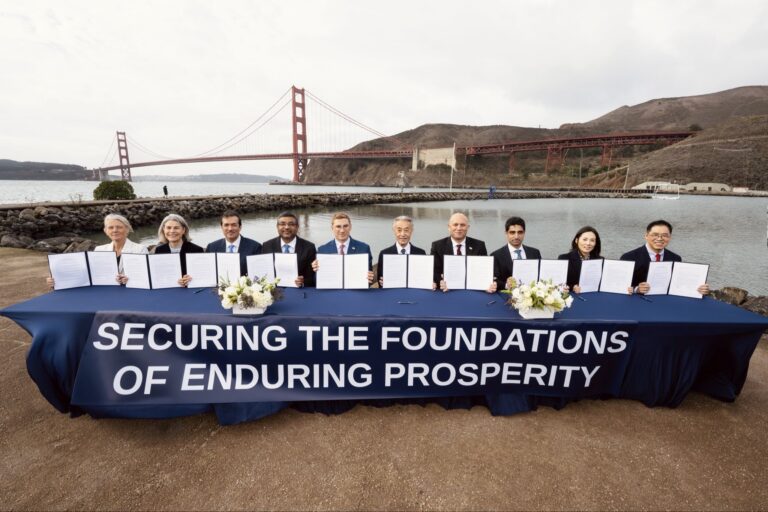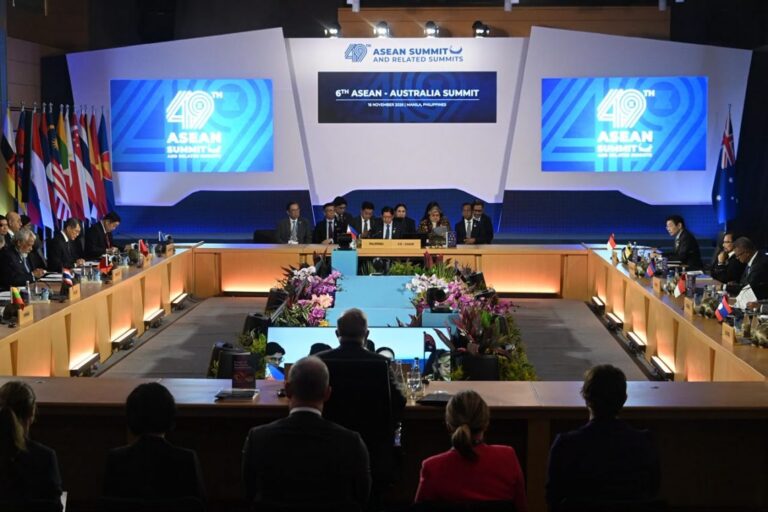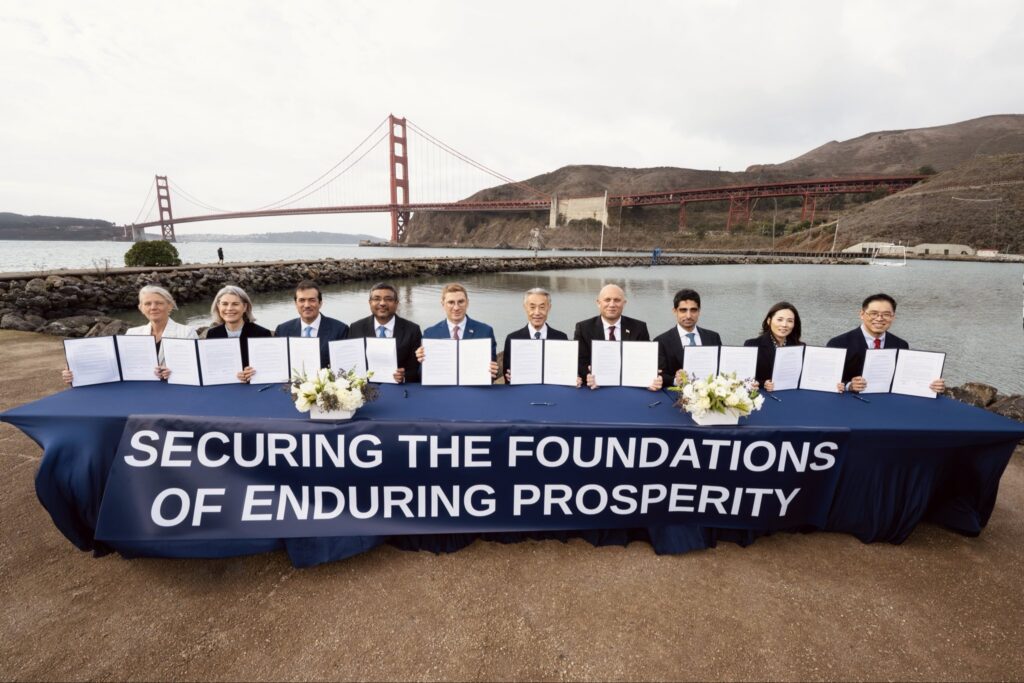
Led by the United States, nine countries signed the San Francisco Declaration on Sunday. The declaration covers an initiative by the US Department of State known as Pax Silica.
The Pax Silica initiative aims to enhance supply chain security in the manufacturing and distribution of silicon-based microchips, an essential component of Artificial Intelligence-enabled computers and devices.
The nine countries involved in the San Francisco Declaration were the United States, Australia, India, Israel, Japan, South Korea, Qatar, Singapore, the UAE, and the UK.
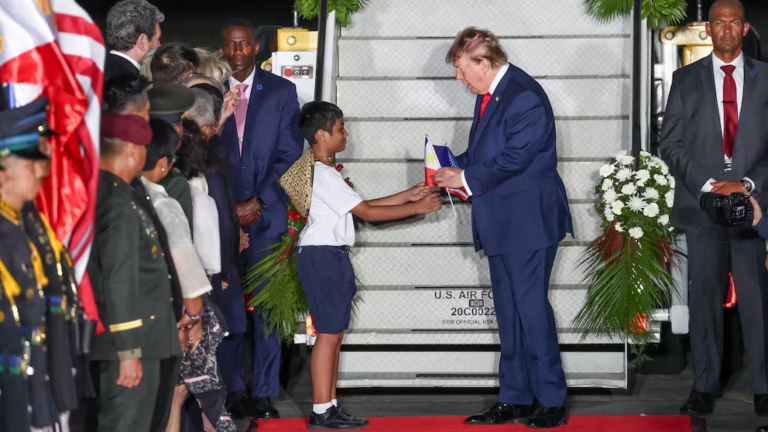
Soon after the declaration was signed, and in the lead-up to Donald Trump’s arrival in the Philippines, however, protests were held nationwide condemning the Pax Silica initiative.
Signed. The United States and nine Pax Silica economies adopted the SAN FRANCISCO DECLARATION, affirming that economic security is fundamental to national security. The declaration sets out our common understanding of the sensitive technologies and critical infrastructure that underpin Super Intelligence (SI) supply chains – from the materials, components, and know-how used to build them to the ports, networks, and energy systems they run on. Defining these foundations together lets us protect them together, because the security of each of us is strengthened by the vigilance of all. Next, our five new working groups will turn common purpose into common practice, delivering concrete results over the next six months. #PaxSilica
https://t.co/FVkpedHq4Y— Under Secretary of State Jacob S. Helberg (@UnderSecE) November 16, 2026
One of the signatories to the initiative, the Philippines, would receive a 1,620-hectare industrial hub dedicated to Pax Silica. However, the industrial hub would displace the indigenous Aeta communities.
Liberal Youth, which is a youth-led political organization in Isabela, Philippines, said that while they support industrialization and technological advancements, these shouldn’t come at the expense of people, cultures, or the environment.
The declaration was signed on the same day that the United States banned the export of AI chips to five countries, including China, Malaysia, and Singapore.
The inclusion of some countries and the exclusion of others in the development of AI seems to be driven more by political than technological motivations.
Adding the Philippines to the Pax Silica agreement would benefit the United States in more than one way; it would serve as an anchor in Southeast Asia while knocking China out of the race.
In the past, there has also been some resistance from European countries, including France, over this initiative. Their resistance stems from the agreement’s language; about what qualifies as sensitive technology and critical infrastructure. The vagueness, they say, may give the US overt control in the future over imposing restrictions.

Syed Ali Akbar Rizvi
Syed Ali Akbar Rizvi is currently an intern at the Institute of Peace and Diplomatic studies. He also works as a Consultant in Karachi for a private firm. He has done a BA in Philosophy from The University of Texas at Austin. His research interests include US foreign policy, geopolitics, diplomacy, history and philosophy. He enjoys traveling, music and creative writing.