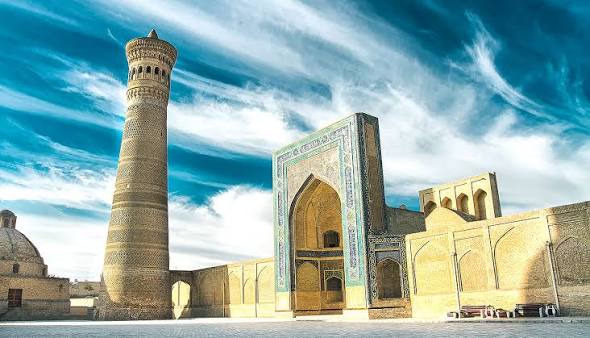
Uzbekistan’s greatest wealth lies not only in the splendour of Samarkand, Bukhara and Khiva, but in the succession of minds that taught humanity how to calculate, heal, observe the heavens, understand faith, govern with justice and give language a civilizational voice.
From al-Khwarizmi, al-Biruni and Ibn Sina to Imam Bukhari, Ulugbek, Navoi, Babur and the Jadids, these figures created a tradition in which knowledge was inseparable from service to society. Under President Shavkat Mirziyoyev, this inheritance is being transformed into the foundation of a Third Renaissance through museums, research centres, specialised schools, reading programmes and cultural diplomacy. Uzbekistan’s legends are therefore not symbols of a distant past. They are active partners in building the country’s future.
That purpose became tangible on 17 March 2026 with the opening of the Center for Islamic Civilization in Tashkent. By 1 June, it had welcomed half a million visitors, including more than 150 foreign delegations. Around 2,000 scholars had joined 810 related projects, while more than 1,000 cultural objects had been returned from abroad. The official record reveals a country converting remembrance into education and confidence.
Muhammad al-Khwarizmi gave algebra a systematic foundation, while the Latin rendering of his name produced the word “algorithm.” Every digital platform and artificial intelligence system relies on algorithms. Uzbekistan’s investment in digital education and emerging technologies is therefore not a departure from its history, but a modern continuation of it.
Ahmad al-Farghani carried the same confidence into astronomy. Abu Rayhan al-Biruni combined mathematics, geography and cultural study with respect for evidence. He sought to understand societies through their languages and beliefs, offering a lesson that remains important for diplomacy: openness can strengthen knowledge without weakening identity.
Abu Ali Ibn Sina, born near Bukhara, united scientific reasoning with responsibility for human life. His Canon of Medicine influenced medical education across Asia and Europe for centuries. His example places the human being at the centre of science and reminds modern societies that learning reaches its highest purpose when it improves people’s well-being.
Uzbekistan’s enlightenment was equally spiritual. Imam Bukhari established a lasting standard for verifying hadith through scrutiny of sources, disciplined scholarship and personal integrity.
In 2026, his reconstructed complex near Samarkand reopened with a 10,000-capacity mosque, museum and research facilities. Visitor capacity rose to 65,000 a day, and more than one million people came during its first month. The complex joins pilgrimage with knowledge, research and moral education.
Imam Abu Mansur al-Maturidi gave reason an important role in explaining faith, offering balance in an age troubled by extremism and religious misunderstanding. Bahauddin Naqshband joined devotion with work, humility and service to society. Together, these scholars reflect an Islamic culture rooted in knowledge, moderation and peaceful coexistence.
The Timurid period joined enlightenment with statecraft. Amir Timur made Samarkand the centre of a powerful state and supported advances in architecture, science and culture. In 2026, Uzbekistan marked his 690th anniversary, reconstructed the State Museum of the History of the Timurids and designated April as Amir Timur Month. The national program connects his memory with statehood, justice and support for knowledge.
Mirzo Ulugbek gave that ideal its most remarkable scientific expression. As both ruler and astronomer, he used the resources of government to support an observatory and a community of mathematicians whose astronomical tables achieved exceptional accuracy. His legacy carries a powerful message for every modern state: national greatness is measured not only by buildings or economic strength, but by investment in the human mind.
Alisher Navoi gave this civilization literary confidence. He demonstrated that the Turkic language could communicate philosophy, love, justice and moral reflection at the highest artistic level. A statesman and public benefactor, he also supported schools, libraries and other institutions. His life united eloquence with service, making him an enduring symbol of Uzbek language, dignity and humanism.
Zahiriddin Muhammad Babur extended that tradition from Andijan. The Baburnama observes landscapes, customs and human character as carefully as it records political power. Plans for a city bearing his name, including a university, museum, library and IT park, connect his memory with education and modern development.
The national story also honours Bibikhanum, Gavharshad Begum, Gulbadan Begum, Nodira, Uvaysi and Anbar Otin as patrons, poets, historians and creators. Their inclusion in the Center for Islamic Civilization gives young Uzbek women visible intellectual ancestors and restores women to their rightful place in the country’s cultural narrative.
Enlightenment in Uzbekistan has never belonged only to manuscripts. It lives in the mahalla, in respect for teachers and elders, in master-apprentice traditions and in hospitality. It is heard in Shashmaqom, performed through Lazgi, spoken through Askiya, narrated by bakhshi and woven into atlas and adras. UNESCO recognition confirms the global value of these traditions, but their deepest importance is domestic: they carry memory into daily life and teach community, discipline and generosity.
The Jadids carried this tradition into the twentieth century. Mahmudkhoja Behbudi, Abdulla Avloni and Abdurauf Fitrat opened schools, published newspapers and used literature and theatre to awaken society. Their conviction that national renewal begins with education informs President Mirziyoyev’s Third Renaissance vision.
That vision is becoming institutional. The National Reading Movement launched in May 2026 treats books as a strategic investment in independent thought. Specialised schools carry the names of al-Khwarizmi, Ibn Sina and Ulugbek. Uzbekistan’s creative economy already employs more than 319,000 people, while new policies support artists, copyright protection, traditional crafts and international exhibitions. The current strategy recognises that heritage can create identity, employment and global influence.
Uzbekistan’s legends belong neither to a sealed past nor to ceremonial memory. Al-Khwarizmi speaks to the digital future. Al-Biruni speaks to diplomacy. Ibn Sina speaks to humane science. Imam Bukhari and Maturidi speak to integrity and enlightened faith. Ulugbek speaks to research, Navoi to language, Babur to cultural observation, and the Jadids to education.
The Third Renaissance will not be built by praising the past alone. It will be built by recovering the habits that made earlier renaissances possible: reading, questioning, measuring, creating and serving society. Uzbekistan’s legacy of enlightenment is ancient, but its true destination is tomorrow.