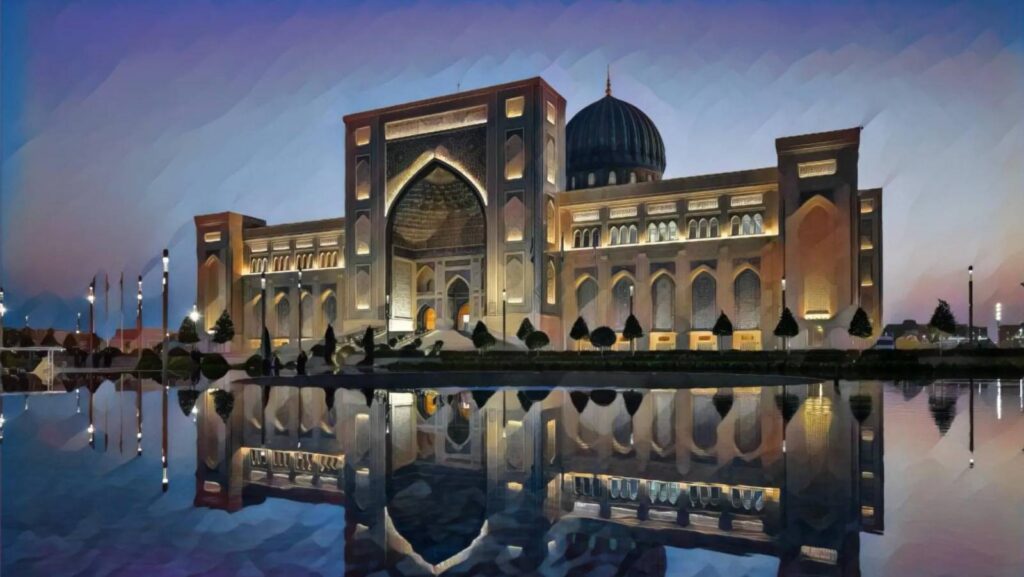
Uzbekistan’s Islamic Civilization Center is much more than an architectural landmark. It is a repository of manuscripts, a guardian of Islamic history and identity. There are different ways to understand the importance of Uzbekistan’s new Islamic Civilization Centre in Tashkent. It can be seen as a museum, or as an institution dedicated to the study of Islamic history.
Uzbekistan’s effort is not only culturally significant but it also reflects a broader vision of bringing the global Muslim world closer through its shared history, heritage, and intellectual traditions. Opened in March 2026 in the historic Hazrati Imam area of Tashkent, the center occupies more than 42,000 square meters and is designed to bring together the history, culture, science and intellectual heritage of the region.
The more important question is why Uzbekistan chooses to place Islamic civilization to represent its culture internationally. The answer begins with Uzbekistan’s own place in the history of the Muslim world. Much of what is now modern Uzbekistan once trained the intellectuals of Central Asian Islamic civilization, producing scholars whose influence travelled far beyond the region.
Uzbekistan’s historical landscape produced figures such as Imam al-Bukhari, Imam al-Tirmidhi and Abu Mansur al-Maturidi, alongside scientists and philosophers including Muhammad al-Khwarizmi, Abu Rayhan al-Biruni, Ibn Sina and Mirzo Ulugbek. Their fields ranged from Hadith and Islamic theology to mathematics, medicine, astronomy and philosophy.The works of these scholars travelled across the Muslim world through institutions of learning, religious networks, manuscripts and generations of scholars.
Read More: CEO of Diplomatic Insight Media Group to Speak at International Media Forum in Uzbekistan
The Center’s significance therefore lies partly in its ability to present this history as something larger than a national story. Uzbekistan can legitimately claim these figures as part of its heritage, but their intellectual legacy belongs to a much wider civilization. This gives Uzbekistan an unusual diplomatic asset. It possesses a history that is simultaneously national and transnational. By bringing these figures, ideas and traditions together, the Civilization Centre can remind Muslims from different regions that their intellectual histories have always been interconnected.
This leads to perhaps the Center’s most important contemporary role that is to translate this national heritage into shared identity. For centuries, the movement of ideas across the Muslim world did not follow today’s national boundaries. Scholars travelled, books circulated and intellectual traditions developed through exchanges between Central Asia, Persia, South Asia, the Arab world and beyond.
Modern political geography has divided many of these historical networks into separate states, but the underlying intellectual connections remain. The Civilization Centre provides Uzbekistan with an opportunity to revive those connections in a contemporary form. Its role is not limited to displaying historical objects. It has research, educational and cultural functions and is intended to become a platform for studying and disseminating Islamic civilization.
The First International Islamic Civilization Forum, held in July 2026, provided an early demonstration of this ambition. The forum brought together more than 300 speakers from around 40 countries and was organized around the theme “The Path of Peace, Tolerance and Enlightenment.” In doing so, the center became a place where shared Islamic heritage could move from historical narrative into contemporary dialogue.
Read More: Tashkent Opens International Media Forum On Islamic Civilization
That dialogue gives the center the potential to become a cultural bridge across the Muslim world. Uzbekistan does not need to position itself as the political leader of Muslim countries for its heritage to have diplomatic value. Its strength is different. It can serve as a meeting point between regions that have historically been connected but are often separated today by geography and politics. The July forum itself extended beyond Tashkent to Samarkand and Termez, linking three major sites of Islamic and Central Asian intellectual history.
This model could develop into something much larger. It can open the doors for joint research between universities and Islamic institutions, digitization of manuscripts, academic exchanges, conferences, exhibitions and cultural programs involving countries from South Asia, the Middle East, Southeast Asia and Africa. The forum’s final declaration proposed a Global Forum on Islamic Civilization, a unified digital registry and library, and an international award and foundation dedicated to Islamic civilization.
This is also where Uzbekistan’s project becomes a form of Islamic cultural diplomacy. Conventional diplomacy is usually conducted through governments, negotiations and political interests. Cultural diplomacy operates differently. Uzbekistan’s approach is particularly interesting because it seeks to foreground an understanding of Islam associated with knowledge, peace, tolerance and enlightenment.
President Shavkat Mirziyoyev first placed the idea behind the center on the international agenda in his 2017 address to the United Nations General Assembly, where he emphasized the role of Islam in promoting peace, human values, knowledge and enlightenment and rejected attempts to associate the religion with violence. Nearly a decade later, that idea has acquired a physical institution and an international program.
Read More: Uzbekistan’s Legacy of Enlightenment
The 2026 forum similarly emphasized peace, tolerance and enlightenment while calling for cooperation to counter ignorance, extremism, xenophobia, Islamophobia and distorted perceptions of Islamic civilization. Uzbekistan is attempting to build connections through the intellectual achievements and humanistic traditions that Muslim societies share.
The Muslim world is enormously diverse, and unity cannot mean presenting one country’s historical experience as representative of all Muslims. If the center becomes primarily a monument to Uzbek achievement, its influence may remain limited to cultural branding. But if it becomes a genuinely open platform for scholars, researchers, museums, universities and religious institutions from across the Muslim world, its significance could be much greater.
This effort continues with the International Media Forum “Islamic Civilization: A New Perspective. New Discoveries,” taking place from 24 to 29 August 2026 in Tashkent and Samarkand. Bringing together international media, scholars, filmmakers, and cultural institutions, the forum seeks to present Uzbekistan’s Islamic heritage to global audiences through documentaries, digital media, technology, and new forms of cultural storytelling.
Its focus on figures such as Al-Khwarizmi, Ibn Sina, Imam al-Bukhari, Amir Temur, and Babur further places Uzbekistan’s history within the wider story of Islamic civilization. Uzbekistan is, in effect, asking a powerful contemporary question: that a shared civilization once connected the Muslim world through knowledge, can that same heritage help reconnect it today? The answer will not be found in the building itself, but in the networks, conversations and cooperation that grow around it.
Aqsa Fazilat
Aqsa Fazilat is a student of Political Science and Philosophy at Kinnaird College for Women. Her research interest lies in contemporary global politics and political geography.