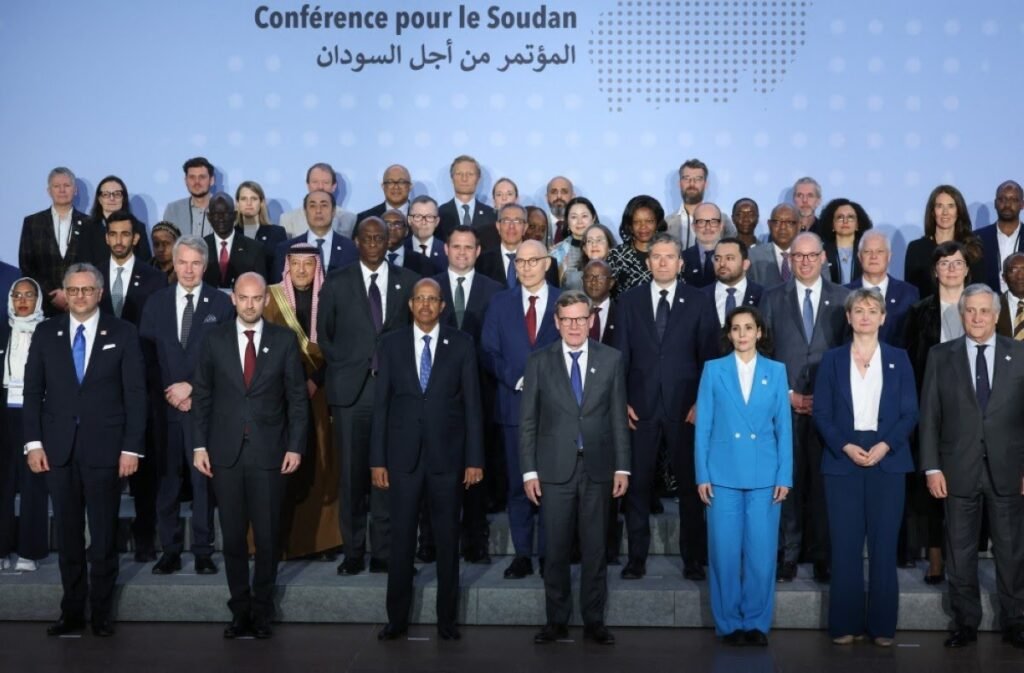
Berlin (TDI): German Foreign Minister Johann Wadephul announced that the third International Conference for Sudan produced pledges of more than 1.3 billion euros equivalent to 1.53 billion dollars, in humanitarian aid.
The German government hosted the event with the European Union and the African Union in Berlin on Wednesday. Officials from more than 60 states and 50 Sudanese and international NGOs attended the meeting.
Many foreign ministers also joined the discussions and the conference aimed to mobilize aid and revive diplomatic efforts for a ceasefire in Sudan. Neither the Sudanese Armed Forces nor the Rapid Support Forces sent representatives.
Read More: What Is Happening in Sudan and Why It Is Not Getting the Attention It Deserves
The war between the Sudanese army and the paramilitary Rapid Support Forces entered its third year on April 15, 2026. Aid groups describe the conflict as the world’s worst humanitarian crisis. Millions of people have fled their homes.
Widespread hunger has left large parts of the population relying on food assistance. Many state institutions are close to collapse. Wadephul thanked donors for the pledges.
He said, “They help to alleviate the suffering of the people in Sudan, they help to save lives, and they show that this conflict has not been forgotten.”
The conference pursued to refocus global attention on Sudan. Recent coverage has shifted toward the war in Ukraine and the conflict in Iran.
A Laboratory of Atrocities
Humanitarian affairs chief Tom Fletcher told the conference that Sudan is an atrocities laboratory. He cited sieges of cities such as El Fasher in Darfur, the denial of food, the use of sexual violence as a weapon of war, and the targeting of schools and hospitals.
Fletcher reported that drones have killed 700 people this year alone. He added that 130 humanitarians have been killed over three years. He said, “I often have to call the families of those who died, and they always ask, did our family members die in vain?”
Around 34 million people, two thirds of Sudan’s population, require humanitarian assistance and 14 million people have been displaced. Nineteen million people face hunger and some 10 million children are out of school.
Sudan Conference kicking off in Berlin.
34m people need humanitarian aid after three years of senseless war.
Tests for today: can we get measurable progress towards peace, end arms flows, and fund humanitarian community’s response plan?
Sudan needs action, not words. pic.twitter.com/4tWNVw9AfL
— Tom Fletcher (@UNReliefChief) April 15, 2026
International Crisis Group President and CEO Comfort Ero stated that the Berlin conference sends an important signal. she said, “Sudan is not being forgotten. Yet the sad tragedy is that an end to the war looks as far away as ever”.
British Foreign Secretary Yvette Cooper reiterated the need for humanitarian support. She called for every possible pressure on the warring parties to reach an urgent ceasefire.
She said, “We need to ensure that every possible pressure is put on those warring parties to reach the urgent ceasefire that we desperately need to see”.
A semblance of normality has returned to parts of Khartoum since the army retook control last year. Reconstruction has begun. Markets have reopened and national secondary school exams took place this week.
Around 1.7 million people have returned to the capital. Tens of thousands of unexploded bombs still remain.
Quad-led peace talks involving the United States, Saudi Arabia, the United Arab Emirates and Egypt have stalled.
United States Senior Advisor for Arab and African Affairs Massad Boulos noted Washington contributed 579 million dollars in aid in 2025.
He announced a further pledge of 200 million dollars this year. Boulos said the United States is working with both sides toward a three-month humanitarian truce.

Muhammad Usman Hashmi is a researcher in International Relations, focusing on climate diplomacy, global governance, and political economy in the Global South. He has contributed to policy dialogues with the Foreign Policy Community of Indonesia and serves as a Senior Research Fellow at the International Council on Human Rights, Peace and Politics. He is also associated with Rethinking Economics Islamabad, contributing to research on development and sustainability.