Islamabad (TDI): Pakistan and Qatar have taken a major step toward expanding their economic partnership by signing a protocol that formalizes commitments worth $3 billion in new investments through the Qatar Investment Authority (QIA) and other designated entities.
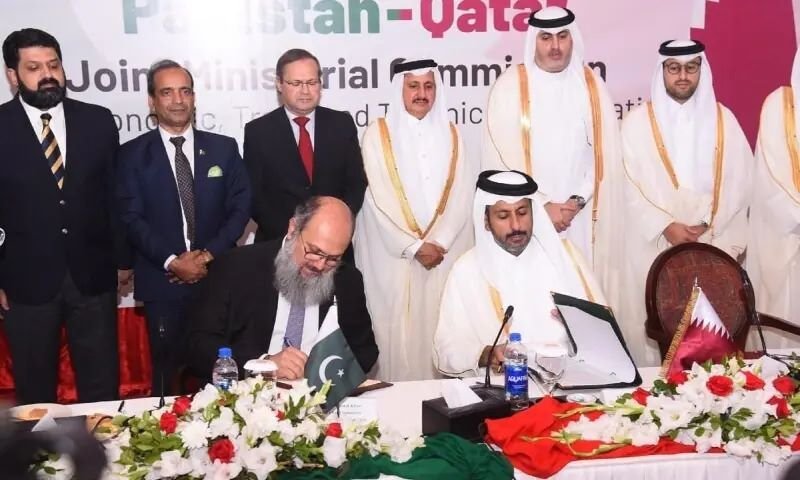
The agreement was signed during the three-day Sixth Session of the Pakistan-Qatar Joint Ministerial Commission (JMC) on Economic, Trade, and Technical Cooperation, which concluded on Thursday. Commerce Minister Jam Kamal Khan and Qatar’s Minister of Commerce and Industry Sheikh Faisal bin Thani bin Faisal Al Thani signed the document on behalf of their respective governments.
According to an official statement, the protocol reinforces the Qatari Amir’s earlier pledge to channel $3 billion into Pakistan’s economy. It outlines a plan for closer coordination between the QIA and Pakistan’s Special Investment Facilitation Council (SIFC) to simplify investment procedures and attract Qatari capital to key sectors. The SIFC will act as the central platform to fast-track investment opportunities and policy facilitation.
The two countries also reached agreements in several other sectors, including transport, health, education, culture, media, and labour cooperation, marking a new phase in bilateral relations.
In the transport sector, the sides agreed to explore collaboration on public transport infrastructure, such as rail, metro, and bus systems, with a focus on green technologies, including electric and hydrogen-powered vehicles. Pakistan invited Qatari participation in major road projects like the Kharian–Rawalpindi Motorway (M-13) and the Karachi–Hyderabad Motorway, offering both public-private partnership options and direct investment.
Read More: Pakistan, Qatar to Strengthen Cooperation in Agriculture
They also discussed plans for new memorandums of understanding on land transport and port development. In civil aviation, both sides decided to hold bilateral consultations between their respective aeronautical authorities in early 2026 to deepen cooperation in the sector.
Education and health were also prominent on the agenda. The two sides discussed the draft Second Executive Program (2025–2028) to expand collaboration in higher education, research, and technical training. An MoU between Qatar’s Ministry of Education and Pakistan’s National Vocational and Technical Training Commission (NAVTTC) is also under consideration to support technical skills development.
In the health sector, both countries agreed to activate an existing MoU through a joint working group, focusing on exchange programs between Hamad Medical Corporation and Pakistani medical professionals. The plan includes joint initiatives in medical research and efforts toward mutual recognition of pharmaceuticals and medical devices.
Cultural and media cooperation also received attention. The two governments agreed to mark a “Year of Culture”, featuring joint projects in film, museums, and heritage. The agreement also aims to simplify visa procedures for artists, students, and professionals engaged in exchange programs.
Agreements were signed between the Qatar News Agency and the Associated Press of Pakistan (APP) to enhance cooperation in news exchange, joint productions, and journalist training. Similarly, Pakistan Broadcasting Corporation and Qatar Radio will work together on new cultural programming.
In technology and communications, both countries pledged to collaborate on e-government systems, smart city development, and digital transformation. The partnership between the Qatar Science and Technology Park and Pakistan’s Special Technology Zones Authority (STZA) will focus on promoting innovation and supporting tech startups.
Read More: Pakistan, Qatar Vow to Deepen Ties Across Sectors
Labour cooperation also remained a key theme, with both sides agreeing to accelerate work on a new MoU on workforce management, updating the 1987 employment agreement. Qatar expressed interest in hiring more skilled workers from Pakistan to meet its growing labour market needs.
In their closing remarks, Ministers Jam Kamal Khan and Sheikh Faisal reaffirmed their shared commitment to expanding trade and investment ties. They emphasized the importance of building on existing relations to create joint ventures and unlock new opportunities for sustainable economic growth.