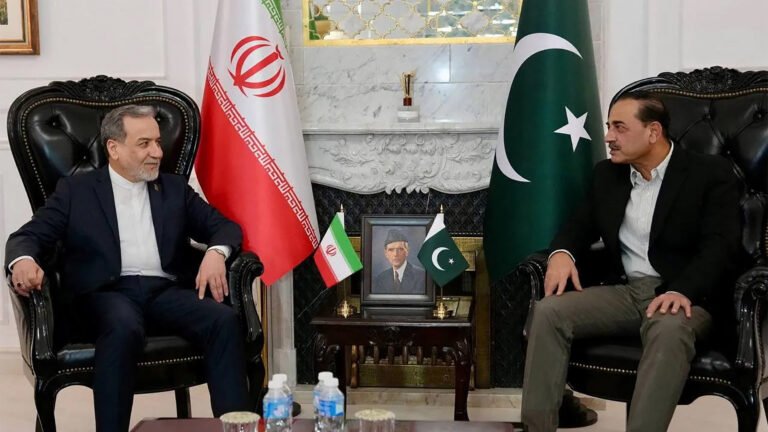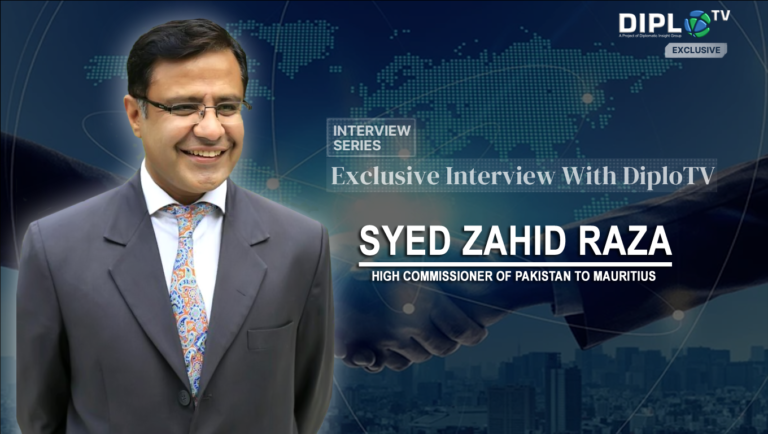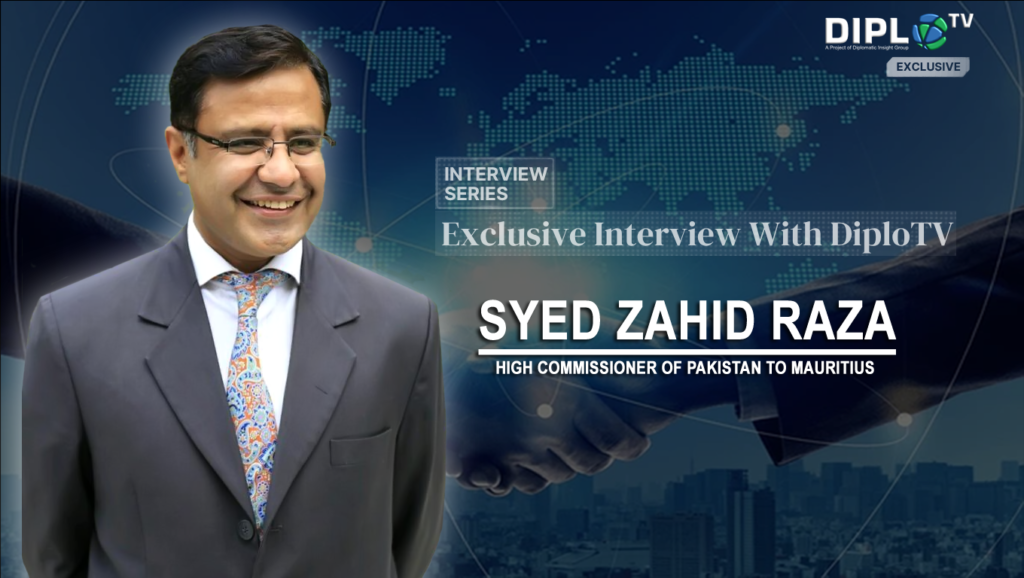
In this exclusive episode of ‘Conversation With a Diplomat’ by DiploTV, Syed Zahid Raza, High Commissioner of Pakistan to Mauritius, reflects on his personal journey from civil engineering to diplomacy, the realities of public service, the lessons learned through decades in the Foreign Service of Pakistan, and the values that have guided him throughout his career.
To watch the full video, click the link below:
TDI: There is always more to a person than professional titles. Before we discuss your diplomatic career, could you tell us about your personal journey and where it all began?
Syed Zahid Raza: I come from a middle-class family in Lahore. My father worked for Telephone Industries of Pakistan, which manufactured telephones and communication exchanges. I attended a public school in Lahore and later studied at Government College Lahore, where I completed my F.Sc. in Engineering.
Like many students at the time, I aspired to pursue either engineering or medicine, so I enrolled in the civil engineering program at the University of Engineering and Technology, Lahore. After graduating, I worked for a highway and road consultancy firm involved in an Asian Development Bank project that focused on farm-to-market roads in Pakistan.
After working there for about six months, I decided to pursue a different path and prepare for the civil services examination. In a way, I retained the word “civil” in my career transition—from civil engineering to civil services. I appeared in the CSS examination in 1996. The results were announced in 1998, and I was initially allocated to the Information Group, where I worked in the External Publicity Wing of the Ministry of Information. Later, I appeared in the CSS examination again and joined the Foreign Service of Pakistan.
TDI: Moving from civil engineering to diplomacy is quite a significant shift. What motivated that decision?
Syed Zahid Raza: During my student years, I was actively interested in public affairs and student politics. Like many young people, I had strong ideas about improving society and contributing to positive change. I felt that civil service would provide a broader platform to serve the public and participate in shaping the system.
At that time, it was quite common for engineers and doctors to enter the civil services. While professional careers in engineering and medicine offered opportunities, many people believed the civil service provided greater scope for public service and career development. For me, it was a conscious decision to pursue a path where I felt I could contribute more directly to society.
TDI: Looking back after nearly three decades in public service, how do you view the system today compared to the expectations you had as a young man?
Syed Zahid Raza: When we are young, we often have idealistic expectations about how things work. Once you become part of the system, you realize that reality is more complex. There are different dynamics, different stakeholders, and various constraints that are not always visible from the outside.
Over time, I learned that meaningful change requires perseverance and conviction. There will always be obstacles, challenges, and frustrations. Bureaucracy, by its nature, involves procedures and processes, and some degree of red tape is unavoidable. However, what you can do is work within the system to make things easier for people and remove unnecessary hurdles whenever possible.
The key is to remain committed to your principles while understanding the realities of the environment in which you operate.
TDI: Do you ever wonder what life would have been like if you had remained a civil engineer?
Syed Zahid Raza: I think everyone occasionally reflects on the roads not taken. When I look at many of my engineering classmates, some settled abroad, some achieved remarkable professional success, and others pursued entirely different careers.
However, I believe life is not about constantly comparing yourself with people who may be ahead of you in certain areas. There will always be people who have achieved more financially, professionally, or intellectually. At the same time, there are many people who have had fewer opportunities than you.
Life is not a single race. We are all running in different lanes. My lane happened to be public service. I changed lanes once, but I do not feel the need to change again. I am satisfied with the choices I made and grateful for the opportunities Allah provided me. Becoming an ambassador and representing Pakistan around the world is a privilege for which I remain thankful.
TDI: Coming from a middle-class background, what was your CSS journey like? How did you deal with uncertainty and self-doubt?
Syed Zahid Raza: The CSS examination was very different when I appeared for it. The subject groupings, marking system, and overall structure were not the same as they are today.
One of the most important decisions was choosing the right subjects. I selected subjects based on genuine interest rather than scoring trends. History had always been my favorite subject, so I chose it despite knowing it might not be among the highest-scoring options. I also selected Geography because I had studied it previously and enjoyed it.
Another subject I chose was Punjabi. That decision was influenced by my growing interest in Punjabi poetry and Sufi literature. Studying Punjabi literature opened an entirely new world for me. It changed my perception of the language and revealed its richness, depth, and beauty.
Preparation required discipline and focus. I studied seriously for approximately six to seven months before the examination. Like every candidate, I faced uncertainty, but persistence and consistency were essential.
TDI: Your interest in languages and literature is fascinating. What draws you to them?
Syed Zahid Raza: I believe every person should cultivate an interest in something beyond their professional field. Whether it is literature, poetry, music, painting, sculpture, or another art form, these interests enrich life.
I have always been passionate about languages and literature, especially Urdu literature. During my diplomatic career, I studied Arabic and spent several months in Kuwait for language training. I also picked up some Persian and became interested in Turkish while serving in Istanbul.
What fascinates me most is understanding the origins of words, how languages influence one another, and the connections between cultures through language. Even today, I remain interested in learning more languages and exploring their histories and similarities.
TDI: Among all the languages you know, which one is your favorite?
Syed Zahid Raza: Without any doubt, Urdu.
The flexibility of Urdu is extraordinary. It has absorbed influences from Persian, Arabic, Turkish, and many other languages while developing its own unique character. The way Urdu adapts words, creates expressions, and blends different linguistic traditions is truly remarkable.
I have even encountered words of Urdu origin in languages such as Bahasa Indonesia, which demonstrates how interconnected languages and cultures can be.
TDI: You have traveled extensively and met world leaders, senior officials, and influential figures. How does life look from that perspective after so many years?
Syed Zahid Raza: When you first join the Foreign Service, everything feels exciting and new. Traveling abroad, meeting people from different cultures, and representing Pakistan on the international stage can be fascinating.
I have had the opportunity to meet many prominent personalities, including King Charles, presidents, prime ministers, business leaders, and cultural figures. Initially, such experiences can feel extraordinary. However, over time, they become part of the profession.
What matters most is not simply meeting influential people but understanding them and learning from those interactions. The real value lies in the insights gained and the relationships built.
One unique aspect of the Foreign Service is that it offers exposure to international developments, negotiations, agreements, and policy discussions that most people never see. It provides a broader perspective on how countries interact and how diplomacy functions behind the scenes.
TDI: What do you miss most about Pakistan when you are abroad?
Syed Zahid Raza: There are many things.
One of the most significant is the continuity of relationships. In Pakistan, we grow up surrounded by family, cousins, childhood friends, and familiar communities. Abroad, diplomats often have to rebuild their social circles every few years as they move from one country to another.
Our children experience this even more intensely. They often do not have the same lifelong friendships or extended family connections that many people in Pakistan enjoy.
I also miss spending time with family members, particularly parents. As they grow older, there is always a feeling that you should be spending more time with them. While technology helps us stay connected, it cannot replace physical presence.
Sometimes, I simply miss sitting with friends and family without any agenda—just enjoying each other’s company.
TDI: Many people imagine diplomacy as a glamorous profession. Is that perception accurate?
Syed Zahid Raza: Not entirely.
While some countries offer a higher quality of life and better facilities than Pakistan, diplomatic life also comes with significant challenges. You may be posted to countries where conditions are difficult, where education systems differ substantially, where healthcare facilities are limited, or where working conditions are challenging.
Technology has also transformed the profession. In the past, once office hours ended, work generally stopped. Today, diplomats are effectively on duty around the clock. News travels instantly, and governments expect immediate analysis and reporting. You must constantly monitor developments and remain prepared to respond.
Technology has brought tremendous benefits, but it has also increased the demands of the profession.
TDI: After nearly three decades in public service, what is the one quality you believe every diplomat must possess?
Syed Zahid Raza: Integrity.
Integrity is essential in every aspect of life—your work, your personal conduct, and your family life. Diplomats encounter opportunities, privileges, and temptations that can distract them from their responsibilities. Maintaining integrity requires constant self-awareness and discipline.
The Foreign Service offers opportunities and benefits, but it also demands sacrifices. Living abroad, raising children in different cultures, and balancing professional responsibilities with personal values can be challenging. Integrity helps ensure that you remain focused on your duty and responsibilities.
TDI: Finally, what message would you like to share with young people who aspire to join public service?
Syed Zahid Raza: Every individual has different aspirations and motivations. Some may choose the police service, some may choose administrative service, and others may choose diplomacy. Each path has its own challenges and rewards.
If your goal is to serve the country, you must be prepared for sacrifices. Government service is not the quickest route to financial prosperity. You will often see friends in the private sector earning more money and achieving material success more rapidly.
Public service requires patience. It requires managing expectations and understanding that the rewards are often different from those found in the private sector.
Most importantly, if you choose this path, do so with conviction. Challenges will come. Difficult decisions will arise. People will have expectations that you cannot always fulfill. However, if you remain committed to serving honestly and doing what is right, you can make a meaningful contribution.
One person can make a difference if they genuinely believe in serving others and remain committed to that purpose.

Established in December 2008, The Diplomatic Insight is Pakistan’s premier diplomacy and foreign affairs magazine, available in both digital and print formats.