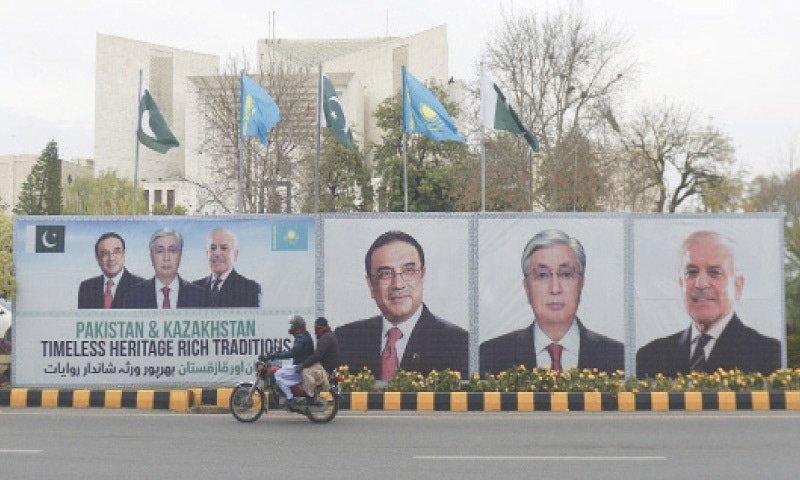
The relationship between Pakistan and Kazakhstan has entered a transformative era, evolving from standard diplomatic ties into a high-priority strategic alliance. In 2026, the bilateral narrative is characterized by a project-oriented approach, moving beyond symbolic gestures toward concrete economic and infrastructural integration.
This shift is further sealed by the landmark state visit of President Kassym-Jomart Tokayev to Islamabad on February 3-4, 2026 – the first presidential visit in 22 years. This visit will lead to a comprehensive review of bilateral ties, focusing on transforming centuries-old cultural affinities into a robust framework for trade, regional connectivity, and shared security.
The significance of this visit is underscored by the timeline of presidential exchanges. President Tokayev’s arrival marks his first-ever state visit to Pakistan. The last presidential visit from the country occurred in December 2003, when the first President of Kazakhstan, Nursultan Nazarbayev, visited Islamabad to sign major investment protection agreements.
While prime ministerial visits and sideline meetings at Shanghai Cooperation Organization (SCO) and Economic Cooperation Organization (ECO) summits have been frequent in the intervening two decades, the absence of a standalone presidential state visit since 2003 had created a “diplomatic gap” that the current visit has now decisively closed.
Both nations, acting as significant middle powers, are now leveraging their unique positions; Kazakhstan as a resource-rich leader in Central Asia and Pakistan as a maritime gateway to the Arabian Sea, to create a win-win scenario in a turbulent Eurasian landscape. The current presidential visit is set to effectively institutionalize the “Southern Pivot” of Kazakhstan’s trade strategy; transitioning it from a landlocked nation to a “land-linked” power through Pakistan’s deep-sea ports.
Read More: Kazakhstan Becomes the Chair of Central Asian Nuclear-Weapon-Free Zone for 2026
By reviving this top-level executive dialogue, Islamabad and Astana are honoring their foundational bonds as well as are actively re-engineering the geo-economic map of South and Central Asia for the 21st century.
Diplomatically and politically, the two nations have institutionalized their engagement through the Joint Intergovernmental Commission (JIGC) and Bilateral Political Consultations (BPCs). The current political climate is one of mutual reliance. Pakistan views Kazakhstan as a pillar of stability in Central Asia, while Kazakhstan regards Pakistan as a critical middle power and a nuclear-armed security stabilizer.
Economically, the two countries are aggressively pursuing a target to elevate bilateral trade from the current $239 million to $1 billion in the immediate future, with a long-term potential estimated at $14 billion. A centerpiece of this economic agenda is the finalized Pakistan-Kazakhstan Transit Trade Agreement (TTA), which simplifies customs and allows landlocked Kazakhstan direct access to the warm waters of the Arabian Sea via the ports of Gwadar, Karachi, and Qasim.
To address the persistent information gap between their business communities, recent forums in Karachi and Islamabad have brought together hundreds of companies. Furthermore, Pakistan and Kazakhstan are pioneering a unique industrial synergy in the leather sector. By linking the Kazakhstan Leather Association with the Pakistan Tannery Association, they aim to utilize Pakistan’s world-class tanning expertise to process Kazakhstan’s abundant raw hides, which previously faced significant wastage.
A defining development of this year is Kazakhstan’s strategic decision to dual-track its export corridors, balancing the established Middle Corridor (Trans-Caspian Route) with the revolutionary Trans-Afghan Railway. In a significant development in January, Kazakhstan offered to fully finance the rail link through Afghanistan, positioning the project as a “mutually beneficial investment” rather than aid.
This corridor, spanning roughly 687 kilometers through the Afghan territory, is designed to link the Central Asian rail network to Pakistan’s Chaman border and onward to the national grid. This project is designed to slash cargo delivery times tenfold and provide landlocked Central Asia with a permanent “Southern Pivot” to the Indo-Pacific.
Read More: Kazakhstan’s Tourism Sector Attracts Over KZT 1.2tr in Investments
While the Middle Corridor secures Kazakhstan’s wealth through European trade, the Trans-Afghan Southern Corridor secures its growth by unlocking South Asian markets. These routes are now viewed as complementary rather than competitive, providing Kazakhstan with a geopolitical safety valve and positioning Pakistan as the indispensable “land bridge” for the region.
While the security situation in Afghanistan remains a complex variable, both Islamabad and Astana are increasingly viewing connectivity as a tool for regional stabilization, operating under the mantra that trade creates incentives for peace. Simultaneously, Pakistan’s National Logistics Corporation (NLC) has already operationalized regular truck convoys to Kazakhstan under the TIR system, significantly reducing transit times for perishable goods.
In the areas of technology, the partnership is embracing the future through “Digital Diplomacy.” Both nations are aligning their National AI Policies, with Kazakhstan emerging as a digital hub for Central Asia and Pakistan contributing its vast pool of over 100,000 IT professionals.
Latest agreements have seen the inauguration of specialized academic centers, just a day before the arrival of the Kazakh President in Pakistan’s capital city, such as the Satbayev Centre at NUST and the Al-Farabi Centre at Quaid-i-Azam University, to facilitate joint research in Artificial Intelligence, fintech, and e-commerce. These institutions will serve as academic hubs and symbols of philosophical communion, reviving the intellectual legacy of Al-Farabi and Iqbal to bridge the historical gap between South and Central Asian thought.
Security and defense cooperation have also matured, with a focus on counter-terrorism and disaster response. Pakistan’s extensive experience in hard terrain warfare has become a valuable resource for Kazakhstan, leading to increased collaboration in military training and the potential procurement of Pakistani-made defense hardware. This is complemented by shared efforts within the Shanghai Cooperation Organization (SCO) and the Regional Anti-Terrorist Structure (RATS) to address the threats of organized crime and regional instability.
Read More: Kazakhstan’s Reform Moment and the Logic of Stability
As the two middle powers continue to navigate a world buffeted by great-power competition, their burgeoning alliance represents a stabilizing force in the heart of Eurasia; proving that natural connectivity, once restored, is an unstoppable engine for prosperity.
In culture and education, the people-to-people pillar has been revitalized through “Digital and Academic Diplomacy.” The two countries have just signed eight major MoUs between leading higher education institutions, including NUST, Quaid-i-Azam University, and Satbayev University of Kazakhstan. These MoUs will facilitate faculty and student exchanges, with over 1,000 Pakistani students currently contributing to the medical and technical sectors in Kazakhstan. This intellectual communion is complemented by a simplified visa regime for businessmen and tourists, as well as increased direct flight connectivity between Almaty, Lahore, and Karachi.
The strategic convergence between Pakistan and Kazakhstan in 2026 marks the end of an era of geographic isolation and the birth of a “Southern Pivot” that is re-engineering the geo-economic map of the region. By decisively closing a 22-year diplomatic gap with the landmark state visit of President Kassym-Jomart Tokayev, both nations have signaled that they are no longer peripheral players in a great-power game. Instead, they have emerged as the primary architects of their own regional destiny.
The commitment to the Trans-Afghan Railway and the full operationalization of the Transit Trade Agreement (TTA) represent more than infrastructure projects. They represent a permanent maritime bypass for landlocked Central Asia and a massive injection of logistical lifeblood into Pakistan’s deep-sea ports.
Ultimately, this relationship serves as a powerful engine for South-Central Asian integration, built on a foundation of mutual trust and shared prosperity. By merging Kazakhstan’s immense natural resource wealth and forward-thinking multi-vector policy with Pakistan’s strategic maritime access and vibrant, IT-savvy workforce, these two middle powers have created a stabilizing corridor of hope that bridges the volatile gaps of the past.
As the $1 billion trade target nears reality, the message to the world is profoundly positive: the historically validated connectivity between the Indus and the Steppes has been restored. This partnership is a cornerstone of a more resilient, interconnected, and flourishing future where the possibilities for cooperation are as vast as the landscapes that connect them.

The writer is a researcher and Managing Editor at The Diplomatic Insight.