Paris (TDI): Senior United States and Chinese officials are seeking to finalize a framework for expanded trade in agriculture and other sectors following two days of negotiations in Paris, as both sides attempt to lay the groundwork for the upcoming summit between Donald Trump and Xi Jinping, later this month.
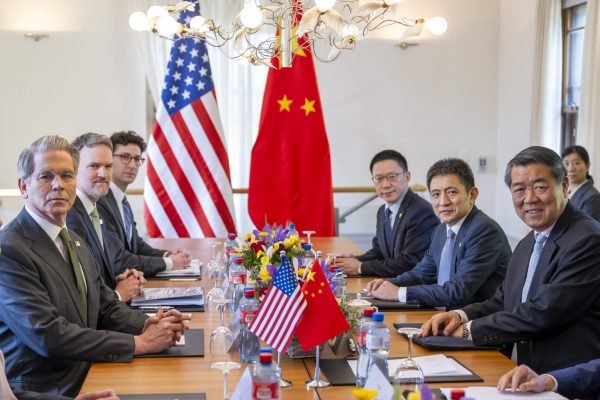
The talks, held at the headquarters of the Organization for Economic Cooperation and Development, were led by US Treasury Secretary, Scott Bessent, and Chinese Vice Premier, He Lifeng.
Officials discussed a range of potential “deliverables” that could be announced in the upcoming meeting between the two presidents, sources familiar with the discussions told Reuters.
Negotiators focused heavily on expanding Chinese purchases of US agricultural products. Beijing signaled openness to buying more American poultry, beef and other crops beyond soybeans, while reaffirming its commitment to purchase about 25 million metric tons of US soybeans annually over the next three years under a trade truce reached in late 2025.
Beyond agriculture, the two sides explored the creation of new mechanisms to manage economic relations between the world’s two largest economies.
Read More: China Says US, Israel Must Stop Attacks on Iran for De-escalation to Happen
One proposal under discussion is a joint “Board of Trade” designed to identify sectors where bilateral commerce could expand without threatening national security or supply chains. A separate “Board of Investment” would address specific cross-border investment disputes as they arise.
US officials raised concerns about limited access to Chinese-produced rare earth materials such as yttrium, which are essential for manufacturing jet engine turbines and other aerospace components.
Washington has also encouraged Beijing to increase purchases of US aircraft from Boeing as well as American energy products including oil, coal and natural gas.
Despite the “remarkably stable” discussions in Paris, the planned summit may experience delays, because of the highly volatile situation in the Middle East, triggered by US-Israel joint strikes on Iran on February 28.
Disruptions to shipping through the Strait of Hormuz have complicated global economic conditions and diplomatic priorities, with shocks reaching the far corners of the world.