United Nations (TDI): Pakistan has responded strongly to remarks made by India during a United Nations Security Council (UNSC) debate on the protection of civilians, saying that India stands exposed by terrorism, occupation, aggression, repression and disregard for international law.
The exchange took place during a UNSC debate focused on the protection of civilians, where India’s Permanent Representative to the UN, Harish Parvathaneni, accused Pakistan of failing to meet international humanitarian obligations, targeting civilians, and maintaining what he described as a “long-tainted record of genocidal acts,” according to Indian media reports. He also referred to allegations linked to the Afghan Taliban regarding a hospital attack in Kabul earlier this year.
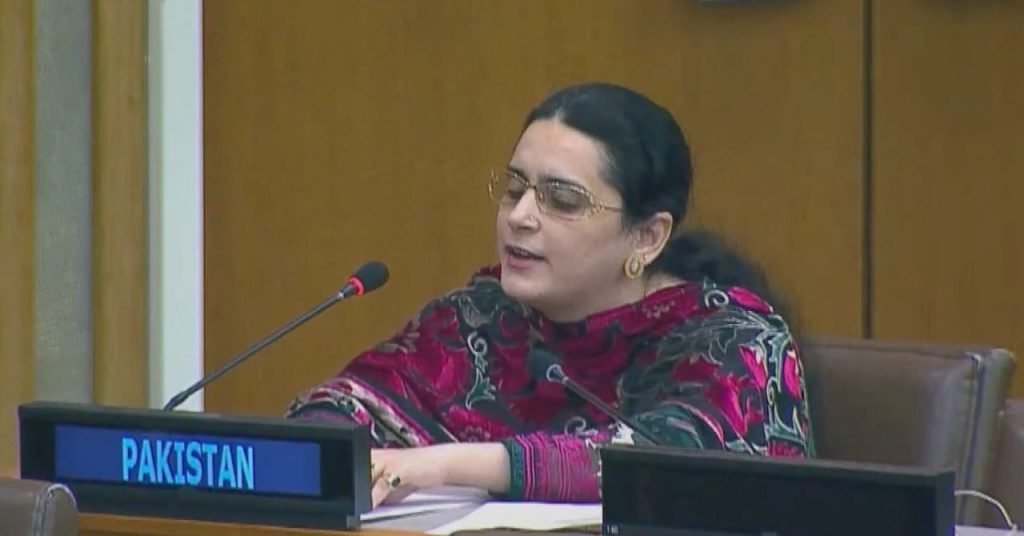
In response, Pakistan’s representative to the UN, Saima Saleem, rejected the Indian allegations and said New Delhi was attempting to present itself as a victim while ignoring its own conduct.
“India once again came to this Council wearing the mask of a victim, but the world can see the face behind that mask,” she said.
Read More: RSS Leader, Ex-Indian Army Chief Call for Continued India–Pakistan Engagement
She added that the reality was of a state that “exports terrorism abroad, occupies people by force, persecutes minorities at home, weaponized water, commits aggression in the region, and then lectures others on the protection of civilians.”
Saleem said Pakistan has repeatedly raised concerns over Indian state-sponsored terrorism, arguing that such activities have resulted in the loss of civilian lives in Pakistan.
She said that groups such as the Tehreek-i-Taliban Pakistan (TTP), Balochistan Liberation Army (BLA), and Majeed Brigade have been involved in attacks inside Pakistan, claiming these networks are supported and facilitated from across the border in Afghanistan.
She further stated that Pakistan’s counter-terrorism operations are precise, deliberate and professional, targeting militant infrastructure, training camps, and support networks used to launch attacks against Pakistani civilians, security forces, and infrastructure.
“These operations are directed solely against terrorists and their infrastructure, not against the brotherly people of Afghanistan or civilian facilities,” she said, adding that allegations from the Taliban authorities and echoed by India form part of a disinformation campaign.
Read More: Pakistan Grants 2,800 Visas to Indian Sikhs for Baisakhi Festival
Saleem also said India was “disappointed” that its efforts to use militant proxies against Pakistan had been disrupted by Pakistan’s counter-terrorism operations.
Turning to Kashmir, she said India could not deny its occupation of the region, adding that civilians face killings, detentions, dispossession, and restrictions on political rights, including the right to self-determination.
She also raised concerns over the treatment of minorities in India, saying that discrimination and violence against Muslims and other groups had become increasingly normalised.
Referring to water-sharing arrangements, she criticized India’s decision to hold the Indus Waters Treaty in abeyance, calling it a violation of international norms and a threat to Pakistan’s water and food security.
“A state that threatens the water, food security and livelihoods of millions of Pakistanis cannot speak of civilian protection,” she said.
Concluding her statement, Saleem said Pakistan remains committed to peace, dialogue, and peaceful dispute resolution in accordance with the UN Charter.
“Pakistan stands for peace, dialogue, peaceful settlement of disputes and adherence to international law. India stands exposed by terrorism, occupation, aggression, repression and disregard for international law,” she said.