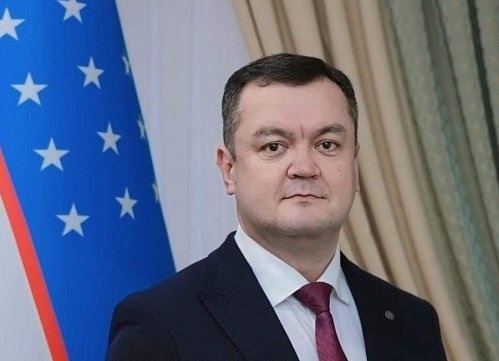
When Alisher Tukhtaev arrived in Islamabad on October 6, 2024, he was not just stepping into a new role. He was coming back to diplomacy, having spent over 25 years working within Uzbekistan’s most important institutions; from the president’s office to the Ministry of Foreign Affairs.
On October 29, 2024, he handed over his credentials to President Asif Ali Zardari, officially starting his role as Uzbekistan’s Ambassador Extraordinary and Plenipotentiary to Pakistan. In just under two years, he has seen two major state visits, watched bilateral trade rise by more than 120%, and placed the Uzbekistan-Pakistan relationship on a path that would have seemed hopeful just a few years ago.
Before coming to Pakistan, he worked as an adviser to the Foreign Minister of Uzbekistan. This position put him right in the middle of important diplomatic decisions. He succeeded Oybek Usmanov, who assumed responsibilities as Uzbekistan’s ambassador to Afghanistan.
Read More: Uzbek Envoy Emphasizes Vision for ‘Third Renaissance,’ Hails Pakistan as Strategic Ally
Ambassador Tukhtaev speaks Russian, English, and Persian; languages that reflect both his education and his family background, as Persian has been part of life in his homeland, Bukhara, for more than a thousand years. He has also been given high honors by the government of Uzbekistan for his outstanding work throughout his career.
Tukhtaev was born in Bukhara, a city that has long been a center of Islamic civilization, the Silk Road, and Persian literary traditions. It is a fitting origin for a diplomat whose career has always been influenced by geography and a mix of cultures.
He studied at Tashkent State University of Law, one of Uzbekistan’s leading academic institutions, and then built a career that took him to the top ranks of the Uzbek government. He held key roles in the president’s administration, the Ministry of Foreign Affairs, and the Institute for Strategic and Regional Studies.
He also served in the Uzbekistan Cotton-Textile Clusters Association, first as a consultant and then as deputy chairman; giving him experience in trade, industry, and economic policy that sets him apart from other diplomats.
First Months in Pakistan
Tukhtaev arrived in Pakistan with a clear mission: to strengthen a relationship that had real potential but had not yet been fully realized. The two countries share a common Islamic heritage, historical ties from the Silk Road, and significant economic opportunities. However, they were missing the necessary structures, transportation links, and commercial momentum to turn this shared history into real results.
His first major official action, presenting his credentials to President Zardari in October 2024, set the tone. The meeting was more than just a formality. Both sides agreed on the goal of increasing trade between the two nations to $1 billion in the near future. They also talked about restoring direct flights between Tashkent and Lahore, and discussed ways to simplify the visa process for Pakistani citizens.
Just weeks later, flights between Tashkent and Lahore resumed, which marked a practical success early in his time there, showing clear commitment. He then quickly engaged with various government ministries in Islamabad.
In December 2024, he met with Defense Minister Khawaja Muhammad Asif to strengthen military cooperation and reaffirm their shared commitment to bilateral ties based on historical and religious bonds. He also met with the Minister for Housing and Works to explore collaboration in green building, water recycling, and sustainable urban development, areas where Uzbekistan’s own progress could offer useful examples for Pakistan.
He led a nine-member delegation to Karachi to look into investment opportunities at the Karachi Port Trust and South Asia Pakistan Terminals.
Read More: Uzbekistan’s Private Airline Centrum Air Launches Direct Lahore-Tashkent Flights
Two Historic State Visits
The most important accomplishments during Tukhtaev’s time have been the organization and success of two major state visits. These events show the highest level of diplomatic efforts between the two countries.
The first was when Pakistani Prime Minister Shehbaz Sharif officially visited Uzbekistan in January and February 2025. The visit covered a wide range of topics. Both leaders talked about political discussions, regional connections, trade and economic ties, energy, agriculture, and shared infrastructure projects.
Most importantly, President Shavkat Mirziyoyev and Prime Minister Sharif signed a Joint Declaration and a Protocol to set up a Strategic Partnership Council. This is a formal structure meant to manage and strengthen their relationship in the future.
The second visit, and perhaps even more significant in history, was when President Mirziyoyev traveled to Pakistan in February 2026. It is not very common for an Uzbek president to visit Pakistan, and this visit showed just how much the relationship had improved under Tukhtaev’s leadership.
During the visit, many agreements and treaties were signed in different areas, helping to grow their economic, cultural, and connectivity ties at the same time.
Read More: Zardari Awards Nishan-e-Pakistan to Uzbek President Mirziyoyev, Highlights Connectivity, Cooperation
$2 Billion Trade Target
If there is one number that defines Tukhtaev’s economic mission in Pakistan, it is $2 billion, the target he has publicly set for annual bilateral trade turnover, up from a base that, while growing quickly, still has a long way to go.
The progress so far is promising. In 2024, bilateral trade surpassed $400 million. In the first half of 2025 alone, trade reached $253.7 million, a 123 percent increase compared to the same period the previous year.
By September 2025, Uzbekistan had become Pakistan’s largest trading partner in Central Asia, with $320 million in trade recorded in just the first seven months of the year. Over 130 joint ventures with Pakistani investment were already operating in Uzbekistan.
Tukhtaev has driven this growth through an active commercial diplomacy campaign. Trade exhibitions under the “Made in Uzbekistan” and “Food Fest Uzbekistan” banners were held in Lahore, Islamabad, and Karachi, leading to more than $120 million in trade agreements.
Read More: Pakistan, Uzbekistan Chart Five-Year Roadmap to Boost Trade
Uzbekistan-Pakistan Trade Houses have been set up in both Lahore and Karachi. A Preferential Trade Agreement (PTA), currently under review, is being expanded from 17 to 100 product categories to strengthen commercial ties.
Banking cooperation to support mutual payments is also moving forward, addressing one of the most persistent challenges in bilateral trade between two countries not fully connected through correspondent banking networks. At an address marking Uzbekistan’s 34th Independence Day in September 2025, the ambassador framed the relationship in terms that go beyond trade numbers.
He described Uzbekistan’s economy as growing at over six percent annually, with GDP reaching $115 billion and expected to surpass $130 billion, as a “new era” under President Mirziyoyev’s leadership. He highlighted $48 billion in foreign exchange reserves, $26 billion in exports, and $130 billion in attracted foreign investment as signs of a country undergoing real economic transformation that is creating meaningful opportunities for Pakistani partners.
“Uzbekistan is open for business and travel,” he told Pakistani media directly, inviting entrepreneurs, tourists, and cultural ambassadors to engage.
Tourism, Culture, and People-to-People Ties
Beyond economics and infrastructure, Tukhtaev has put a lot of effort into building the softer parts of relations between the two countries, the human connections that last longer than any single political event.
When he first arrived, there were only two flights a week between Tashkent and Islamabad. He helped bring back flights between Tashkent and Lahore, which added four more weekly flights, making a total of six flights each week between the two countries.
He always said that increasing air travel isn’t just about tourism; it’s also a way to bring in investors, students, cultural groups, and business people. This helps strengthen every other part of the relationship.
Read More: Uzbekistan Keen to Boost Tourism Ties With Pakistan: Envoy
Another project he supported was the “Central Asia Tour 2025,” where 16 Pakistani bikers traveled through Pakistan, Afghanistan, Uzbekistan, and Tajikistan. He called this a symbol of warm people-to-people ties.
He also pointed to shared celebrations like Nowruz, youth forums, cultural events, and government visits as proof that the relationship is more than just business, it’s truly human.
In interviews, he talked proudly about the shared history of Islamic learning that links cities like Bukhara, Samarkand, and Tashkent with Lahore, Multan, and Peshawar. These cities are connected through centuries of Sufi teachings and Persian poetry.
Ambassador Alisher Tukhtaev’s Vision
Tukhtaev has consistently expressed his vision for the relationship between the two countries, and his goals remain clear and ambitious. His main focus includes working together economically, especially through infrastructure projects like the UAP railway and Uzbekistan’s access to Pakistani ports.
He also wants to increase trade and investment, aiming for $2 billion in business activity. He supports stronger cooperation in international groups such as the SCO and OIC, and he wants to bring people closer through tourism, education, and cultural exchanges.
Tukhtaev has also shown interest in new areas of collaboration. During his meetings with Pakistan’s housing and urban development ministry, he discussed possible cooperation in green building and water recycling. His visit to Karachi Port looked into maritime investment opportunities, something no previous Uzbek ambassador had explored so thoroughly.
In his own words, the vision is simple: “We want to increase the amount of trade between our countries, carry out big investment and infrastructure projects, and improve business connections between entrepreneurs from both nations.”
Read More: ‘New Uzbekistan’ Residential Complex Proposed in Islamabad
Looking ahead, he says, “I am sure that with the support of the leaders of Uzbekistan and Pakistan, and because of the friendly feelings between our people, we will be able to raise our bilateral relations to a completely new level.”
Alisher Tukhtaev is, in many ways, the product of a specific historical moment, the rise of a new, confident, and outward-looking Uzbekistan under President Mirziyoyev, which is trying to turn its central location in Eurasia into real strategic and economic power. His background covers law, strategic studies, industrial policy, and foreign affairs.
In Pakistan-Uzbekistan relationship, the numbers are improving. The framework for cooperation is being set up. Flights are running regularly. Trade offices are open. A railway study has been signed. And the President of Uzbekistan has visited Pakistan, a clear sign of how important this relationship is in Tashkent’s strategic plans.
For a diplomat from Bukhara; a city that was once the center of Islamic learning and a meeting point of different cultures, there may be something fitting about spending this part of his career working to rebuild one of Central Asia’s most important bilateral ties; one agreement, one visit, and one flight route at a time.

Hafiza Manzoor
Hafiza Manzoor is a work in progress. She has a curiosity to understand the world and improving herself along the way. She can be reached at hafizamanzoor44@gmail.com