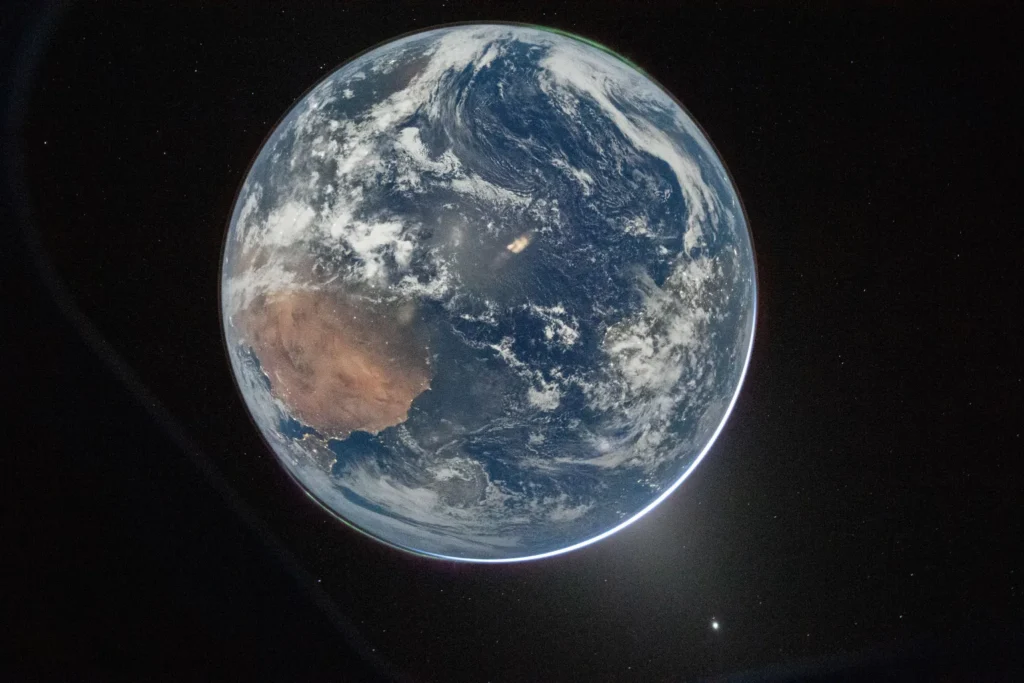
Imagine being inside a spacecraft that is about the size of a minivan, pressing your face against the window, and watching your whole world, every mountain, every ocean, every person you’ve ever loved, shrink into a bright, glowing ball floating in an endless black space.
This is not a scene from a science fiction movie. It is exactly what Reid Wiseman, Victor Glover, Christina Koch, and Jeremy Hansen saw last month as they traveled aboard NASA’s Orion spacecraft on the most daring human mission into deep space in more than 50 years.
Artemis II, which launched on April 1, 2026 (yes, it was April Fools’ Day, and no, it wasn’t a joke), sent four astronauts on a 10-day journey around the Moon before returning them to Earth with a splashdown off the coast of San Diego.
It was the first time humans had returned to the Moon’s vicinity since 1972. While the mission had a lot to do with the Moon, the most astonishing thing it showed was actually our planet.
Here is Earth’s story, on International Mother Earth Day, as seen through the eyes of four humans who traveled far enough to see the round celestial oasis and could not help but marvel at it.
Day One to Day Three
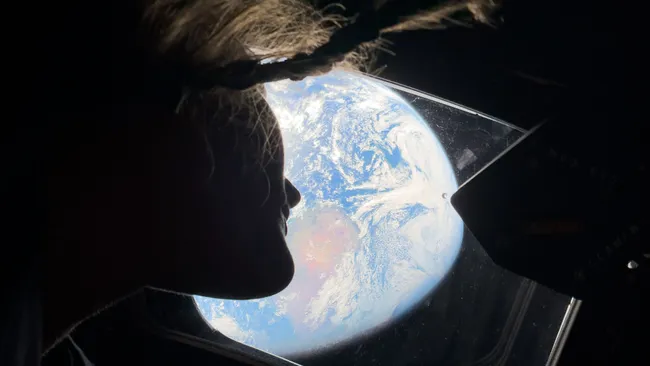
The Orion spacecraft, named Integrity by its crew, launched from Kennedy Space Center in Florida. Within a few hours, the astronauts were watching Earth slowly disappear into the distance, and they had a view that billions of people on Earth will never see up close: a beautiful image of their home planet shining like a sapphire against the dark of space.
The very first images sent back from the crew showed Earth passing in front of the Sun, with two auroras visible at the top right and bottom left, and zodiacal light glowing at the bottom right.
Think about that for a moment. The very first photo they chose to send to us showed Earth doing something most of us have never seen. Not a city. Not a coastline. The whole planet, lit up in green auroras, as if it were showing off.
One can only imagine what it feels like to take that picture and know that every single person who has ever lived, and all those who will live in the future, except for yourself and your three crewmates, lives inside that glowing sphere.
As Integrity moved through deep space toward the Moon, Christina Koch began to notice something more than just the Earth’s beauty; she also saw how much darkness surrounded it. That thought seems simple at first. But when you really think about it, it feels different.
We often talk about how big and complicated our world is, but when you’re far away, it looks like just a tiny, lonely light in an endless, uncaring dark.
Koch, who once spent 328 days continuously on the International Space Station and holds the record for the longest single spaceflight by a woman, is used to looking down at Earth. But even she said this view was something completely new.
From the ISS, you can spot individual cities, lakes, and weather patterns. But from where Artemis II was heading, you could see the entire planet in one look. It’s the same Earth, just a completely different experience.
Day Six: Earth Does Something No Human Has Ever Seen Before
This is where it gets really cinematic. On April 6, the crew arrived on the Moon and started a seven-hour flyby of the far side. During this flyby, they recorded impact craters, ancient lava flows, and surface cracks on the Moon, and also captured a rare in-space solar eclipse, where the Moon completely covered the Sun for almost 54 minutes of total darkness.
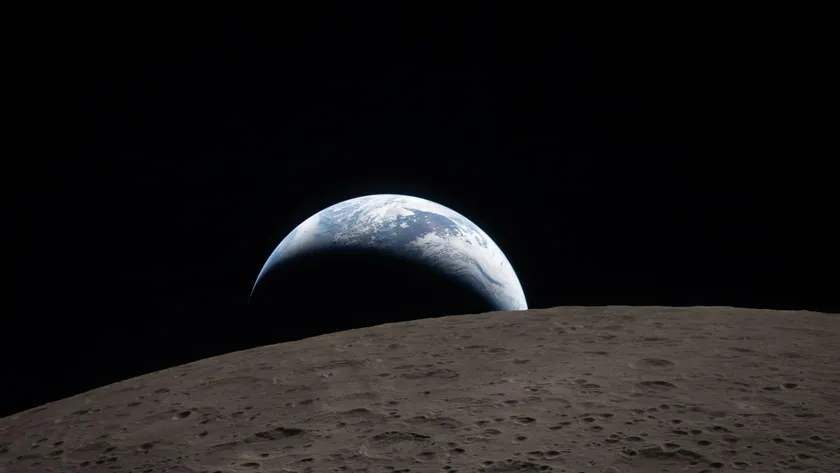
NASA says that alone would be enough to make anyone’s mind spin. But the image that will probably last longer than any of us is the Earthset. A crescent-shaped Earth slipped behind the Moon’s rough edge, with the clearly defined lunar surface in front and Earth delicately floating in space beyond it, with Australia and Oceania in daylight while the rest was in darkness.
Live Science describes it as an image so beautiful it almost feels like it was made up. A few seconds after the photo was taken, the spacecraft’s Integrity passed behind the Moon and went completely silent, cutting off all communications with Mission Control for 31 minutes.
Read More: Artemis II Astronauts Return in Historic Splashdown After Moon Voyage
Commander Reid Wiseman later talked about how it felt to watch Earth disappear. “I’m actually getting chills right now, just thinking about it, my palms are sweating,” he said. “It is amazing to watch your home planet disappear behind the Moon.”
Live Science also shared that the four crewmates took a moment together and shared maple cookies that Jeremy Hansen had brought from Canada. Live science, four humans, 250,000 miles from home, watching their world vanish behind a rock covered in craters, eating Canadian maple cookies. That might be the most human thing anyone has ever done in space.
The Overview Effect: Why This Changes You
There’s a known experience among astronauts called the overview effect. It’s a mental and emotional shift that happens when you see Earth from space.
It is a sudden, deep realization that borders don’t matter, that oceans don’t belong to any country, and that the thin blue line of our atmosphere is the only thing keeping all living things from the emptiness of space.
It sounds like something you might see on a motivational poster, but astronauts say it’s one of the most powerful moments of their lives.
Wiseman said simply, “Human minds shouldn’t have to go through what these just went through.” He meant it as a compliment to the experience, the kind of beauty that’s almost too much to handle.
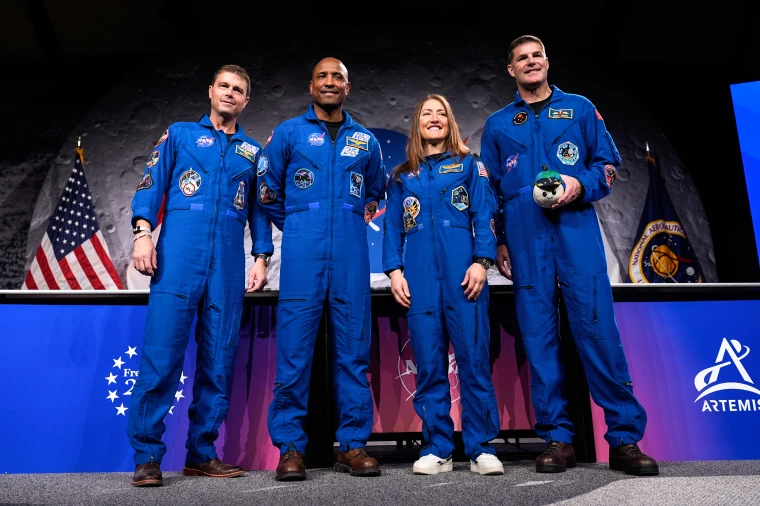
The four crewmates shared something no one else on Earth has ever felt, watching their home planet set like the sun behind the Moon, from farther away than anyone has ever been.
At their farthest point, the crew traveled 252,760 miles from Earth, about 4,105 miles more than Apollo 13, setting a new record for the farthest any human has ever gone from our planet. From that distance, Earth isn’t a landscape or a view from a window. It’s a beautiful, glowing, irreplaceable dot.
Yet that dot holds everything: every rainforest, every coral reef, every city lit up at night, and every quiet countryside at sunrise. It holds 8 billion people going about their Tuesday.
It holds history, music, and arguments about dinner. It holds everything that has ever mattered to anyone. Floating against that endless black, it looks both incredibly small and amazingly precious at the same time.
Coming Home
On day ten, the spacecraft splashed down in the Pacific Ocean, with a total distance traveled of 694,481 miles, or just over 1.1 million kilometers. NASA Navy divers opened the hatch and found four smiling astronauts. Reid Wiseman said it was “the most special thing that will ever happen in my life.”
But here’s the thing. The real gift of Artemis II wasn’t just what the crew saw of the Moon. It was what they showed us about ourselves. Earth isn’t something we take for granted. It’s not just background scenery.
From far away, it’s the most remarkable object in the known universe; a wet, living, spinning miracle wrapped in a paper-thin atmosphere, asking only that we take care of it.
Artemis II went to the Moon and returned with pictures of the Moon, yes. But the image that will stay with people is the one of our small blue world quietly setting behind the lunar surface, as four humans floated in a tiny capsule and shared cookies in the dark.
Take care of the pale blue dot. Nobody else is going to do it for us.

Hafiza Manzoor
Hafiza Manzoor is a work in progress. She has a curiosity to understand the world and improving herself along the way. She can be reached at hafizamanzoor44@gmail.com