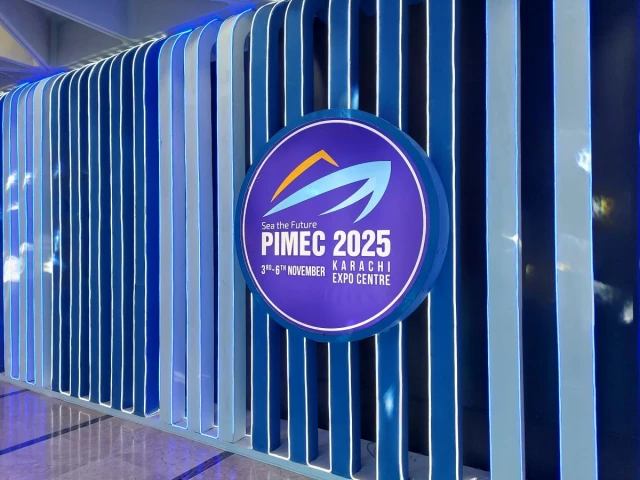
After a buzzing inauguration ceremony and opening of exhibition on Monday, the second day of Pakistan International Maritime Expo and Conference (PIMEC) returned with the same enthusiasm, as visitors and exhibitors hit the floor.
The inaugural session of the International Maritime Conference (IMC) also kickstarted in parallel, under the auspices of National Institute of Maritime Affairs (NIMA), and with a chief guest address by Pakistan’s Finance Minister Aurangzeb. The minister reaffirmed Pakistan’s unwavering commitment to advancing maritime development and harnessing the potential of the Blue Economy as a catalyst for sustainable economic growth.
Themed “Harnessing Blue Economy Potential for Sustainable Development,” the first session featured insights from Kamran Nasir, Dr. Aneela Saad Khan, Dr. Hassan Daud Butt, and others on innovation and partnerships. The second session, led by Vice Admiral Raja Rab Nawaz, propelled the discussion further on challenges along the way.
Some other highlights from the day included the visit of Governor Sindh Kamran Khan Tessori, who turned to stalls and pavilions and appreciated the exhibitors for their effort. By evening, foreign dignitaries and other guests were hosted at the Chief Minister House for a reception by the CM, Murad Ali Shah.
Deputy Chief of Naval Staff Vice Admiral Raja Rab Nawaz, in his media talk during the second day, emphasized that the Navy continuously monitors regional developments and is ready at all times.
Read More: Ahsan Iqbal Calls Pakistan a ‘Maritime Bridge’ Between East and West at PIMEC 2025
“We are constantly observing and staying vigilant about what is happening around us,” said the Deputy Naval Chief. “Our monitoring efforts are ongoing, and we maintain a high state of readiness.”
He also highlighted the upcoming induction of new submarines into Pakistan’s naval fleet, which he believes will play a pivotal role in enhancing national and maritime security. “The addition of these submarines will contribute significantly to maintaining maritime security and ensuring the free movement of trade in the region,” he stated.
On the exhibition floor, Gwadar Development Authority (GDA) captured the interest of visitors and investors with its model Smart Port City Master Plan 2050 display. Deputy Director Town Planning Abdul Razaq is leading the GDA delegation at the event. “We aim to highlight the city’s rapid development, geo-economic importance, and the immense opportunities offered through the Blue Economy,” the GDA said about its pavilion and what it brings along.
This year marks the second edition of PIMEC, drawing 150 local and 28 international exhibitors, with delegates from 44 countries, including the UK, Saudi Arabia, China, Egypt, and Turkiye.
Iran’s delegation is participating in the exhibition for the very first time. Headed by Captain Dariush Eskandari, landed at Jinnah International Airport on Monday where they were welcomed by Pakistani representatives and Colonel Mohammad Mohsen Shahabi, Iran’s military attaché in Islamabad.
Read More: TDI Joins Hands With PIMEC as the National Media Partner
The Iranian contingent is presenting the country’s latest achievements in defense and naval technologies through a national pavilion, underscoring Tehran’s advancements in indigenous military and marine industries.
Likewise, a “Made in Uzbekistan” stall has been set up by endorsement of Uzbekistan Trade Center (UCTC) and the Chamber of Commerce and Industry of Uzbekistan; who have brought this variety of Uzbek products to PIMEC, to attract business, get more exposure, and create avenues for regional trade; including textiles, yarn, food products, beverages, jams, house cleaning as well as personal care products.
On the inauguration day, Planning Minister Ahsan Iqbal addressed the participants as the chief guest while Saudi Arab’s Minister of Transport and Logistic Services, Saleh Al Jasser, was the guest of honor.
In his address, Iqbal said Pakistan’s geographical position, where South Asia, Central Asia, the Middle East, and Africa converge, gives it immense strategic potential. Yet, he noted, the maritime industry contributes less than one percent to the national GDP, far below the global average of 4–7 percent in other maritime economies.
He pointed out that Pakistan possesses a 1,000-kilometre coastline, an exclusive economic zone of 290,000 sq km, and abundant offshore resources in renewable energy, fisheries, and minerals. The minister linked maritime growth to the government’s “Uraan Pakistan” vision, aimed at turning Pakistan into a $1 trillion economy by 2035, anchored on the 5Es framework, Exports, e-Pakistan, Equity and Empowerment, Environment and Climate Change, and Energy and Infrastructure.
“The seas have again become the arteries of global commerce, energy, and communication,” he said. “Those who manage them wisely are shaping the next wave of global prosperity.”

Established in December 2008, The Diplomatic Insight is Pakistan’s premier diplomacy and foreign affairs magazine, available in both digital and print formats.