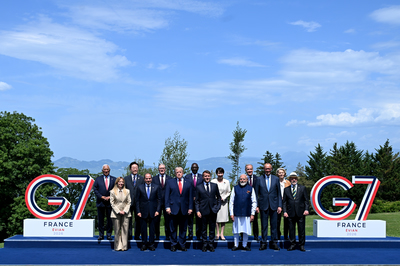
The G-7 Summit took place at Évian-les-Bains, France, from June 15-17, 2026 at a critical time in global politics. The choice of Évian-les-Bains as the host location was very symbolic. Notably, the town was the first place in France to host a G-7 or G-8 leaders’ Summit twice.
This town previously hosted the 29th G-8 meeting in 2003 as well. There were historical parallels between this meeting in Évian and the summit in 2003, when Western powers faced intense disagreements over the Iraq War.
However, the 2026 Summit took place against a different set of problems than the previous one. Back in 2003, there were disagreements over military intervention and international security. Nevertheless, as G-7 countries struggled with more complicated geopolitical, economic and strategic issues, the fundamental theme of intra-Western tensions remained relevant.
The Summit also served as a test of France’s leadership and diplomatic clout during its G-7 presidency at a time of global uncertainty and intra-Western divisions. This Summit in France provided an opportunity to French President Macron to highlight problems like industrial overcapacity, underinvestment, excessive debt, regulatory flaws, and low levels of private investment in developing nations as major threats to global economic stability and identified the reduction of global economic imbalance as a top goal.
Read More: G7 2026: Test of Western Leadership and What It means for Global South
Moreover, Macron attempted to facilitate constructive dialogue between the US President Trump and the other Western leaders related to shared priorities. He also sought to strengthen collaboration between the G-7 and top emerging economies especially those in the Global South.
Macron contributed to the development of a more cooperative environment by gaining widespread participation from emerging economies and avoiding the public confrontations that had marked some earlier Summits. In this way, Macron tried to maintain dialogue and multilateral cooperation during a period of political fragmentation.
The Summit also demonstrated the G-7’s evolving role in contemporary global affairs. During this Summit, the leaders discussed Ukraine, Iran, global economic growth, artificial intelligence (AI), critical minerals, and development finance. Among these issues, Ukraine topped the agenda. G-7 leaders reiterated their “unwavering support” for Ukraine’s freedom, sovereignty, and territorial integrity.
Additionally, they promised more interceptors, long-range capabilities, air defense systems, and assistance for Ukraine’s domestic defense sector in order to strengthen this commitment. The leaders decided to facilitate license agreements that would allow Kyiv companies to manufacture air defense systems and long-range missiles domestically.
These actions demonstrated the G-7’s understanding that Kyiv’s long-term security rests on both the advancements of its own defense capabilities and outside military support. Simultaneously, the commitments made at Évian brought attention to the continuing gap between statements of support and their actual implementation.
Rather than relying solely on symbolic displays of unity, Ukraine needs military support, financial resources, and coordinated diplomatic pressure on Moscow following more than four years of conflict. In this regard, G-7 leaders recognized the renewed US commitment to supporting Kyiv and determined that Moscow had demonstrated “no serious willingness” to negotiate a meaningful peace settlement.
Although the Summit’s rhetoric and goals showed a noteworthy degree of unity, the timely execution of these promises will ultimately determine how effective they are.
Moscow’s geopolitical position would be strengthened and the conflict would last longer if financial and military assistance were delayed. On the other hand, if these pledges are carried out successfully, the Évian Summit can be regarded as a moment when the G-7 reaffirmed its commitment to Ukraine at a critical stage in the conflict and transformed political solidarity into significant action.
In addition to Ukraine, the Summit covered the conflict’s wider geopolitical and economic consequences especially in the energy sector. In this context, G-7 leaders targeted Moscow’s main source of income, oil & gas exports, in an effort to put more pressure. The G-7 signaled that it was prepared to tighten sanctions on Russia’s energy sector after the US and Iran reached a deal to reopen the Strait of Hormuz.
They described the current situation as a suitable time to adopt further measures. This decision’s timing was important from a strategic standpoint. G-7 leaders assessed that limitations on Russian energy exports could be implemented with a lesser risk of disrupting global energy supplies or causing a dramatic increase in oil prices, given the possibility of larger Iranian oil supplies returning to international markets.
This approach demonstrated an attempt to strike a balance between geopolitical goals and concerns about the stability of the world economy. It also showed the G-7’s ongoing reliance on economic statecraft as a key tool for assisting Kyiv and influencing Moscow’s actions.
But as with the pledges made over Ukraine, the success of these actions will ultimately rely on how well they are carried out and whether or not member states are prepared to maintain a coordinated sanctions regime in the long term.
Another sensitive issue discussed at the Summit was Iran. The Summit gave G-7 leaders a chance to support efforts toward regional de-escalation. President Trump and President Macron later approved the draft framework, which was seen as a step toward easing pressure on the world’s energy markets and reducing instability in West Asia.
Despite the agreement’s widespread support among G-7 states, leaders continued to recognize its shortcomings. Important issues are still unresolved including Iran’s nuclear program, missile capability, and regional influence. As a result, even if the G-7 had good reason to support the framework, its long-term viability requires reliable verification systems, precise implementation guidelines, and sustainable diplomatic engagement.
The Summit also addressed long-term economic and technology issues in addition to security issues. G-7 leaders acknowledged the increasing significance of critical minerals, AI, development finance, and economic imbalances for both strategic competitiveness and economic stability.
The leaders pledged to reduce reliance on any one source of permanent magnets and rare earths to less than 60% by 2030. It reflects worries about supply-chain vulnerabilities and the growing significance of critical minerals for AI infrastructure, defense systems, and green technologies. At the same time, leaders stressed the importance of sustainable and resilient development partnerships.
The Summit’s side meetings, which went beyond the official agenda, demonstrated the ongoing diplomatic significance of G-7 meetings. The meeting between Trump and Modi, in particular, garnered a lot of attention because it was their first official face-to-face meeting after a prolonged period of tense bilateral ties. The talks between them centered on commerce, tariffs, and maritime security.
Read More: G7 Backs US-Iran Deal, Supports Ukraine and Calls for Stronger Indo-Pacific Security
More broadly, the G-7 acknowledged that close engagement with emerging and developing economies is necessary for effective global governance. It is evident from meetings with leaders from India, Brazil, Egypt, Kenya, and the Republic of Korea, The G-7 aimed to strengthen its credibility and show a more inclusive approach to handling today’s global issues by inviting these partners in Summit talks.
Taken together, the Évian Summit demonstrated the strengths and limitations of the contemporary G-7. In an era of global fragmentation, President Macron termed the Summit a “success” and a sign of “renewed” cooperation. Significant agreements were made at the Summit related to critical minerals, AI, energy security, Ukraine, Iran, and engagement with emerging economies.
However, the summit’s significance will depend more on how decisions are carried out than on their declarations. The G-7 still has a significant amount of diplomatic, military, and economic might, but effective leadership requires consistency, credibility, and tangible outcomes.
The Summit may be remembered as a significant step toward tackling current global problems if the promises expressed at Évian are turned into meaningful actions. If not, it will serve as just another example of “lofty” rhetoric without real, long-lasting change. To sum up, the Évian Summit’s success will be determined by its results rather than its declarations.
*The views presented in this article are the authors’ own and do not necessarily reflect the views of The Diplomatic Insight.
Muhammad Abubaker
Muhammad Abubaker is currently working as Research Associate at Strategic Vision Institute (SVI), Islamabad.
- Muhammad Abubaker
- Muhammad Abubaker