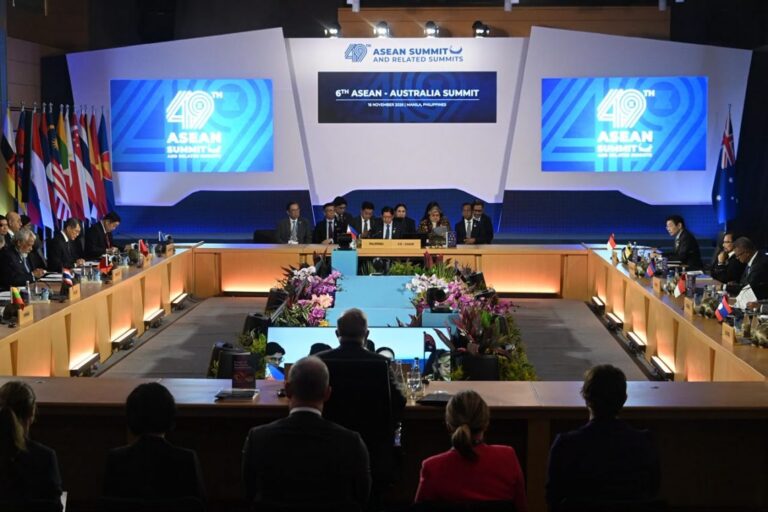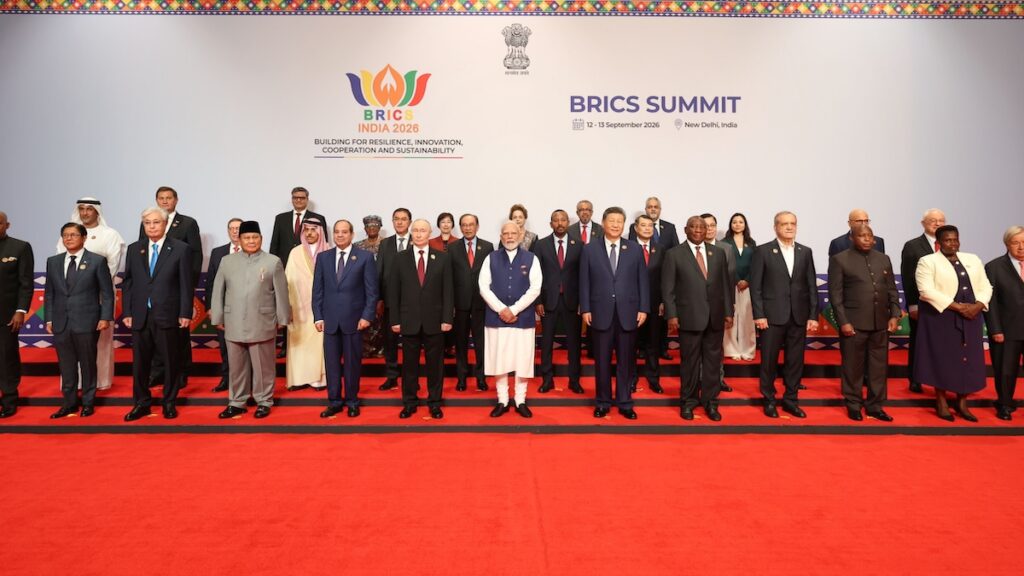
The 18th BRICS Summit was held in New Delhi on 12-13th September 2026 under India’s presidency that brought together leaders of an expanded 11-member bloc at a time of global turbulence. Since its formation as BRIC in 2006, the grouping has evolved considerably.
South Africa joined in 2010, and the grouping later expanded to include Egypt, Ethiopia, Iran, the United Arab Emirates, Saudi Arabia, and Indonesia. Today, BRICS represents nearly half of the world’s population and about 40% of global GDP. These figures give the grouping considerable political and economic weight.
Therefore, the Summit should be judged neither by excessive praise nor by dismissing BRICS as merely a ‘talk shop’. Its real significance lies in what the expanded grouping could agree on, what it couldn’t, and whether its consensus-based framework could translate collective ambitions into meaningful action.
The significance of this question becomes clearer when BRICS is viewed in the context of changes in the international system. The grouping has acquired greater importance as emerging economies seek a stronger voice in institutions that have traditionally been shaped by the major Western powers.
The IMF, World Bank, WTO, and UNSC have all faced criticism over the limited representation of developing countries in global decision-making. Against this backdrop, BRICS offers a platform through which its members can advance common interests on issues such as trade, finance, and development.
Its economic weight, demographic scale, and resource base adds to its influence. At the same time, initiatives such as local-currency trade and financing through the New Development Bank reflect efforts to reduce dependence on Western dominated existing financial arrangements. Yet this does not make it an anti-Western alliance.
Rather, it reflects the growing demand for a more balanced distribution of influence in global affairs. This demand has become more relevant amid geopolitical conflicts, disruptions to energy & supply chains, and rising protectionism. Therefore, BRICS can play an important role in shaping debates within the Global South.
However, its expansion also exposes the limits of collective action. The grouping brings together democracies and authoritarian states, energy producers and consumers, and countries with competing regional interests. Its growing membership may increase its weight but it also makes consensus more difficult to achieve.
In this context the 18th Summit was an important test of BRICS’s ability to maintain consensus amid mounting geopolitical tensions. As the meeting revealed the grouping faced division among its members as well as pressure from conflicts, trade disputes, and competing strategic interests.
In this backdrop, the adoption of a joint leader’s declaration was a significant achievement. It demonstrated that BRICS could still find common ground but the careful language of the declaration also exposed the limits of that consensus.
These limitations were also evident in the way the Indian Prime Minister Modi presented the Summit. New Delhi sought to use the Summit to showcase its diplomatic stature and position itself as a bridge-builder within the Global South.
Modi described developing countries as “rule-shapers” and stressed that BRICS was “not against anyone”, while calling for prioritizing partnership over confrontation. A deeper analysis of this narrative reveals that India’s presidency also highlighted the limits of its claim to inclusive Global South leadership.
Pakistan’s membership bid remains stalled under the consensus-based system, despite support from key BRICS members. Moreover, the Summit allowed India to advance its diplomatic priorities while balancing its ties with the West, Russia, and other major powers.
Therefore, its diplomatic success should be measured not only by the visibility it generated but also by whether BRICS can move beyond carefully negotiated consensus towards substantive outcomes.
The declaration itself reflects the difficult balancing required to preserve consensus among such a diverse membership. Its language was carefully framed to accommodate competing perspectives. On Middle East, it expressed deep concern over the escalation and called for maximum restraint, and urged the protection of civilians and nuclear facilities under IAEA safeguards.
It also stressed the need to keep trade and energy flows uninterrupted, while avoiding direct attribution to any party. This cautious approach helped members with differing positions to find some common ground. On Ukraine, the declaration emphasized dialogue and diplomacy while opposing unilateral sanctions not authorized by the UNSC.
However, Palestine received support for a ceasefire, humanitarian access, a two-state solution based on the 1967 borders with East Jerusalem as its capital, and full UN membership. The declaration also criticized unilateral tariffs and non-tariff measures, and reaffirmed support for multipolarity, multilateralism, and reform of global institutions.
India’s influence was more visible in the language on terrorism particularly the reference related to Pahalgam attack of April 2025. The declaration condemned the attack and called for a zero tolerance policy towards terrorism, cross-border movement, financing, and safe havens.
Yet, more than a year after the incident, New Delhi has failed to publicly present conclusive evidence that could substantiate the allegations vis-à-vis Islamabad’s calls for a credible and impartial investigation, arguing that allegations should be supported by verifiable evidence.
Additionally, the Summit’s achievements remained modest. The adoption of a joint declaration despite sharp differences among the members preserved the appearance of ‘unity’ and kept dialogue open.
Moreover, stronger language on Palestine reflected longstanding position on the Global South. Other initiatives on local-currency settlements, digital infrastructure, AI, health, critical minerals, and development provided continuity to the BRICS agenda.
India’s efforts to bridge differences among the members also contributed to keeping the forum functional. Yet, the limitations were more revealing than the so-called forward movement. On major geopolitical crises, the declaration relied heavily on general language and avoided assigning responsibility where members held conflicting positions.
This has exposed a structural weakness of BRICS that it can agree on broad principles but struggles to translate them into collective action where core interests diverge.
Similarly, no major new financial mechanism or effective response to trade restrictions emerged while efforts towards reducing dependence on the dollar remained gradual. The expansion of BRICS has added economic weight but it also made cohesion more difficult.
The Summit also provided space for members to advance their individual interests. Chinese President Xi Jinping’s visit to India, his first since 2019, reflected the gradual improvement in India-China relations following years of tensions. The two sides emphasized managing differences, maintaining peace along the border, and strengthening cooperation.
Moreover, China’s acceptance of the Pahalgam-related language also demonstrated its willingness to compartmentalize bilateral and wider strategic interests. Similarly, Russia used the Summit to reinforce its position on sanctions and maintain its diplomatic relevance. In addition, each member state approached the Summit through its own national priorities.
China promoted a larger BRICS role in global governance while advancing cooperation in areas such as AI, digital development, and trade. India used the Summit to scale up its diplomatic profile and promote initiatives on digital infrastructure, AI, health, and counter-terrorism.
Meanwhile, Iran and UAE protected their respective interests through carefully negotiated language while maintaining bilateral engagement. Other members focused mainly on development, representation, energy, and security. These divergent priorities help explain why the summit produced continuity rather than a major collective breakthrough.
As a whole, the Summit was more a test of BRICS’s resilience than a moment of transformation. It succeeded in preserving unity in the face of significant geopolitical differences. The outcomes reinforced the grouping’s emphasis on multipolarity while maintaining practical tracks in payments, technology, and development finance.
The Summit also confirmed that BRICS remains primarily a forum for dialogue and selective cooperation rather than a cohesive actor capable of responding collectively to major crises or reshaping global institutions in a decisive manner.
Nevertheless, the Summit remains relevant for the future trajectory of BRICS. The creation of a continuity mechanism and expansion of practical cooperation suggest that enlargement does not necessarily lead to immediate paralysis.
However, the same diversity that gives BRICS greater economic and political weight also constrains its ambitions. Consensus requirements, competing national priorities, and the influence of dominant members can limit collective action.
New Delhi, under the Modi government, through this Summit kept the BRICS moving forward but it did not resolve the simmering tensions between inclusiveness and national interests, or between ambitious rhetoric and limited implementation.
If BRICS is to contribute meaningfully to a more balanced international order, future presidencies will need to place greater emphasis on clear membership principles, workable mechanisms, and substantive cooperation.
Therefore, the success of the grouping will depend less on Summit optics or carefully worded declarations and more on whether its commitments could be translated into tangible outcomes.
In a fractured international environment, keeping the conversation alive is important but giving that conversation institutional substance will determine whether BRICS can turn its collective weight into lasting influence.
*The views presented in this article are the authors’ own and do not necessarily reflect the views of The Diplomatic Insight.*
Muhammad Abubaker
Muhammad Abubaker is currently working as Research Associate at Strategic Vision Institute (SVI), Islamabad.
- Muhammad Abubaker
- Muhammad Abubaker