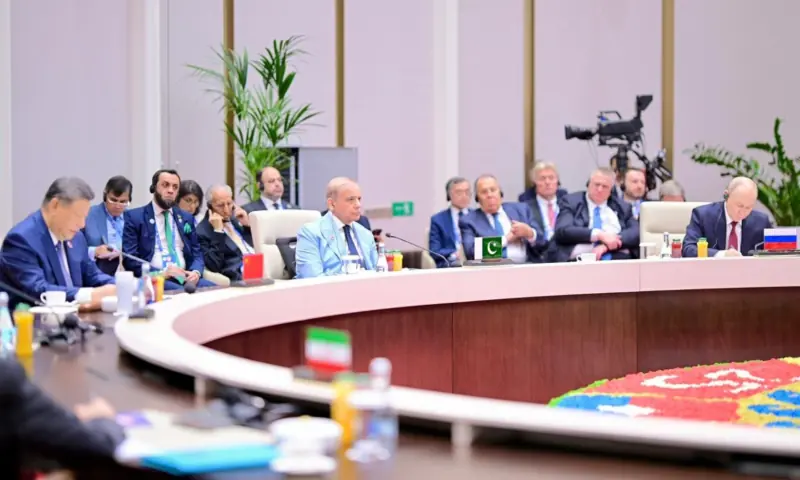
The 26th meeting of the Council of Heads of State of the Shanghai Cooperation Organization (SCO) was held on 1st September 2026 at the Yrys-Ordo Congress Hall in Bishkek, Kyrgyzstan. This year’s summit marked the 25th anniversary of the organization, which was chaired by Kyrgyz President Sadyr Japarov.
It was attended by leaders from China, Russia, India, Iran, Pakistan, Belarus, and the Central Asian member states. Moreover, the SCO Plus format further expanded participation to include partner states and international organizations.
The summit concluded with the adoption of the Bishkek Declaration and 28 outcome documents. For Pakistan, the most important development was the transfer of the SCO Chairmanship for 2026-27 to Islamabad.
The timing of the Bishkek summit made it more than a routine diplomatic gathering. It took place amid significant geopolitical strains across Eurasia. The Russia-Ukraine war continues to reshape the regional security environment while tensions and conflict in the Middle East have affected energy markets and regional calculations.
Read More: Pakistan’s SCO Opportunity and Long-Time Ambitions for Central Asia
Meanwhile, states across Asia, Central Asia, and the wider Global South are seeking greater diplomatic space beyond rigid bloc politics. Against this backdrop, the summit did not suggest that SCO members have reached consensus on major geopolitical questions. They clearly have not.
Rather, it highlighted their shared interest in preserving strategic room for manoeuvre amid a changing international environment where economic sanctions, supply-chain disruptions, energy insecurity, and great-power rivalry increasingly influence national choices.
This context also underscores the continuing relevance of the SCO’s original purpose. The organization was established in Shanghai on 15th June 2001 by China, Russia, Kazakhstan, Kyrgyzstan, Tajikistan, and Uzbekistan. It emerged from the earlier “Shanghai Five” process which focused on confidence-building and border stability in the post-Cold War period.
Initially, the SCO’s primary security concerns centered on terrorism, separatism, and extremism in Central Asia. However, over time, its agenda expanded to encompass trade, energy, transport, technology, culture, tourism, and regional connectivity. At the same time, the organization has maintained an important institutional distinction that the SCO is not a military alliance and is not directed against any third country or organization.
The evolution of the SCO was also reflected in Kyrgyzstan’s approach to its presidency. Its theme “25 Years of the SCO: Together Towards Sustainable Peace, Development, and Prosperity,” placed peace & security alongside development & regional cooperation. As a relatively small member compared with the organization’s major powers, Kyrgyzstan was not in a position to dominate the agenda.
Instead, its presidency provided an opportunity to draw attention to the growing strategic importance of Central Asia. For a landlocked country, transport corridors, energy routes, investment flows, and diplomatic balance have direct implications for economic development and national interests.
In this respect, Kyrgyzstan’s presidency sought to present Central Asia not simply as a space situated between Russia, China, Iran, and Europe but as a region with its own strategic interests.
The summit also brought into focus the differing priorities of the SCO’s members. China emphasized high-quality development, shared prosperity, artificial intelligence, the digital economy, green industries, and reforms in global governance.
India highlighted security, connectivity, and opportunity. Meanwhile, Russia and Iran emphasized the need for a more multipolar international order and expressed opposition to unilateral forms of pressure. Türkiye’s participation through the expanded SCO format further demonstrated the interest of several states in diversifying their diplomatic and economic partnerships.
Their engagement does not necessarily indicate a strategic break with the West. Rather, it reflects an effort by middle and emerging powers to expand options in an increasingly competitive international environment.
These divergent priorities also provide the context for understanding what the summit meant for Islamabad. In particular, three issues stood out. The first concerned water security and the application of international law. Prime Minister Shehbaz Sharif’s description of water as the “lifeblood” of the region was not merely rhetorical but a genuine description.
The statement came one day after the international arbitration panel in The Hague ruled that the Indus Waters Treaty remained legally binding and that India could not unilaterally suspend or terminate it. India has rejected the ruling underscoring the continuing political sensitivity of the issue. Nevertheless, Pakistan used the SCO platform to place water security within a broader regional context.
This was significant because water stress and transboundary river management extend beyond South Asia. It is also increasingly relevant to Central Asia where climate change, water scarcity and competing demands for shared water resources present growing policy challenges.
The second issue underscored by Pakistan was related to terrorism and Afghanistan. Islamabad used the forum to emphasize the sacrifices in the fight against terrorism and to link regional stability with efforts to prevent cross-border militancy. This message was particularly relevant to the security situation along Pakistan’s Western border.
However, for the issue to gain regional support, it must be framed as a wider regional challenge. The SCO’s Regional Anti-Terrorist Structure provides an established mechanism for cooperation in this area.
However, its effectiveness will depend on practical measures, including intelligence sharing, improved border management, financial monitoring, and sustained engagement. However, member states’ sincere yet practical cooperation would be more effective than political declarations alone.
The third issue for Pakistan was economic cooperation and connectivity. Islamabad presented its incoming chairmanship under the theme “Turning Vision into Action: Connectivity, Innovation, and Shared Prosperity.” The theme is consistent with Pakistan’s efforts to translate geographic position into greater economic opportunities.
Under this approach, the proposed agenda included CPEC, rail connectivity, energy corridors, digital connectivity, artificial intelligence governance, poverty reduction, disaster management, health, culture, and sports. These areas reflect an attempt to broaden the discussion beyond traditional trade and transport links and towards a more comprehensive framework of regional cooperation.
The designation of Lahore as the SCO Tourism and Cultural Capital for 2026-27 also provides Pakistan with an opportunity to strengthen its cultural and tourism profile within the organization. Together, these priorities indicate that Islamabad intends to use its chairmanship to emphasize practical cooperation alongside the SCO’s broader political and security agenda.
However, Pakistan’s real test begins with the implementation of this agenda. Connectivity is not simply about announcing corridors, it requires secure routes, efficient customs, modern logistics, investor confidence, and predictable regulation. Similarly, cooperation on AI will require practical work on data, skills, infrastructure, and governance.
Therefore, Pakistan should treat the chairmanship as an opportunity for focused and achievable initiatives rather than a ceremonial responsibility.
The SCO itself has also evolved considerably since 2001. From its six founding members, it has expanded with the admission of India and Pakistan in 2017, Iran in 2023 and Belarus in 2024. It now has ten member states which represent more than 3.4 billion people. This expansion has increased the organization’s geopolitical weight but it has also made consensus more difficult.
Pakistan and India remain rivals, while India and China face persistent tensions. Russia and Iran operate under international sanctions, and Central Asian states seek to maintain relations with China and Russia while preserving ties with Europe and the US.
Read More: Pakistan’s SCO Moment: Why Kazakhstan Matters More Than Ever
Moreover, the Bishkek summit should be assessed with both its potential and limitations. It did not resolve the major differences among member states or establish a new international order. Its significance lies in providing a forum where states with divergent interests can cooperate on shared interests such as security, trade, energy, technology, and development.
The main challenge remains implementation as ambitious declarations do not always translate into measurable outcomes. For Pakistan, the chairmanship offers an opportunity to convert diplomatic visibility into practical credibility.
Therefore, Islamabad should concentrate on a limited set of priorities, including water security, counter-terrorism, Afghanistan, regional connectivity, climate resilience, digital cooperation, and people-to-people links. Delivering tangible outcomes in even a few of these areas would give the chairmanship greater substance.
Ultimately, the Bishkek summit demonstrated the SCO’s continuing relevance as a platform for dialogue among competing powers. However, for Pakistan, its significance depends on what it achieves during its Chairmanship. The challenge is to move from diplomatic commitments to practical measures.
If Pakistan can achieve actionable progress, its SCO Chairmanship would contribute to a more focused and effective regional agenda.
*The views presented in this article are the author’s own and do not necessarily reflect the views of The Diplomatic Insight.*
Muhammad Abubaker
Muhammad Abubaker is currently working as Research Associate at Strategic Vision Institute (SVI), Islamabad.
- Muhammad Abubaker
- Muhammad Abubaker