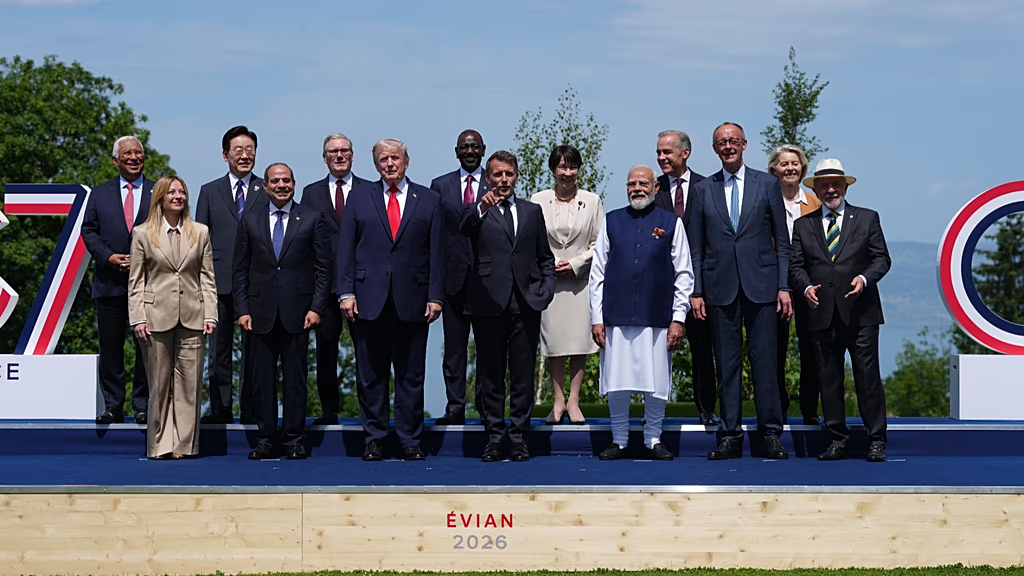
Paris (TDI): Leaders of the G7 have endorsed the recently announced US-Iran agreement, pledged additional military and economic support for Ukraine, and reiterated their commitment to security and stability in the Indo-Pacific region.
In a joint statement issued after their summit, G7 leaders reaffirmed their “unwavering support” for Ukraine’s sovereignty and territorial integrity, announcing plans to increase deliveries of air defense systems, interceptors and long-range military capabilities. They also signalled readiness to support expanded Ukrainian defense production and provide additional assistance to strengthen the country’s energy resilience ahead of winter.
The leaders said they would intensify pressure on Russia’s wartime economy through tougher sanctions, including measures targeting the oil and gas sectors.
On the Middle East, the G7 described the US-Iran agreement as a significant diplomatic breakthrough and welcomed what it called a historic opportunity to prevent Iran from obtaining a nuclear weapon.
The leaders praised US President Donald Trump’s role in securing the agreement, while acknowledging the contributions of mediating countries. They expressed readiness to support implementation of the deal and future negotiations aimed at achieving a broader and more comprehensive regional settlement.
Read More: G7 Pledges Expanded Air Defense, Long-Range Capabilities for Ukraine
The statement stressed that any follow-on agreement should address concerns related to Iran’s regional activities, ballistic missile program and nuclear ambitions, while ensuring that Tehran never acquires a nuclear weapon.
The G7 reaffirmed that unrestricted transit through international waterways is essential for global trade and backed efforts led by France and the United Kingdom to help restore maritime traffic through the Strait of Hormuz.
Leaders said the multinational initiative could assist in protecting commercial vessels, reassuring shipping operators and verifying the removal of naval mines from the strategic waterway.
They also pledged to diversify global energy supply routes and increase strategic energy reserves to reduce dependence on the Strait of Hormuz.
The G7 called for an immediate and robust ceasefire in Lebanon, backing efforts by the Lebanese government to establish full state control over weapons and strengthen national sovereignty.
On Gaza, the leaders pledged to accelerate humanitarian assistance and reconstruction efforts while calling for an end to violence in the occupied West Bank.
Read More: Zelenskyy Joins G7 Summit in France in Hopes to Revive Stalled Talks with Russia
Turning to the Indo-Pacific, G7 leaders reiterated support for a free and open region governed by international law. They opposed any unilateral attempts to alter the status quo by force, particularly in the East and South China Seas and across the Taiwan Strait.
The statement also expressed deep concern over North Korea’s nuclear and ballistic missile programs, urging Pyongyang to comply with UN Security Council resolutions and address issues including cybercrime and cryptocurrency theft.
The leaders further welcomed international efforts to address global economic imbalances and pledged continued cooperation through the G20 and other multilateral forums.