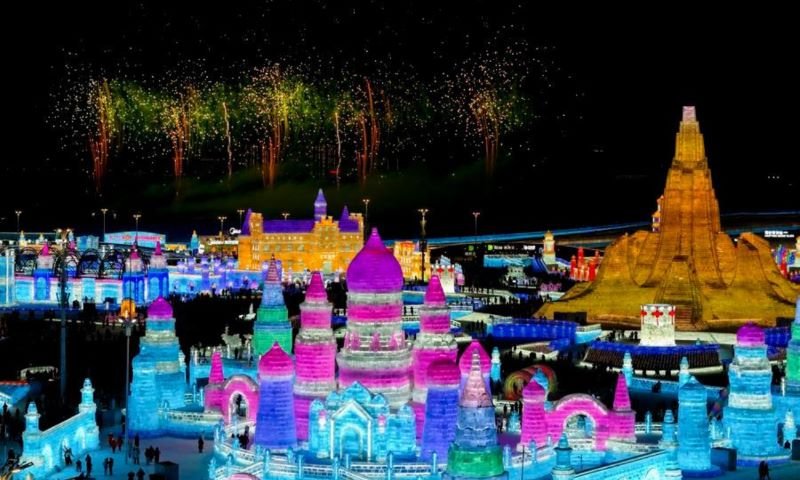
Harbin (TDI): Tourists are flocking to northeastern China’s winter wonderlands, riding the 521-meter super ice slide and posing with intricate ice sculptures at Harbin Ice-Snow World, fueling a rapidly growing ice and snow industry in the country.
According to a report released this week by the China Tourism Academy (CTA), China’s ice and snow tourism sector is entering “a new stage of sustained prosperity.” By the end of 2025, more than 14,000 enterprises were operating in the sector, an 11 percent increase from the previous year. The ice and snow economy exceeded 1 trillion yuan (around $143 billion) in 2025, nearly four times the 270 billion yuan recorded in 2015.
The growth is credited to a surge in innovative tourism experiences, from ice sculpting and themed travel to snow photography. Iconic destinations like Harbin Ice-Snow World and Changbai Mountain ski resort have become key attractions, according to Xinhua.
CTA researcher Han Yuanjun highlighted that northern cities such as Harbin, Shenyang, Changchun, and Zhangjiakou are leveraging their natural ice and snow resources to maintain high tourist numbers while improving service quality.
Heilongjiang, an industrial region in China’s northeast, is turning long winters into economic opportunity. Local initiatives include offering samples of frozen pears and installing heated handrails along shopping streets, efforts that have gone viral on social media and boosted tourist arrivals and revenue.
The 2025 Asian Winter Games further accelerated Harbin’s winter economy. The city upgraded sports venues with digital systems, expanded airports and roads, and introduced automated snowmaking at major resorts. Direct flights, simplified visa services, and improved payment options for foreign visitors helped inbound bookings surge 157 percent.
Read More: World’s Largest Ice and Snow Theme Park to Open in China
Heilongjiang has also introduced China’s first monitoring system for the ice and snow economy, tracking tourism, sports, culture, and equipment manufacturing to guide business policy. The 2024–2025 winter season saw 135 million visits to the province, generating 211.7 billion yuan in tourism revenue, up 18.5 percent and 30.7 percent year-on-year, respectively.
On January 6, Harbin hosted a world mayoral dialogue on ice and snow tourism development, drawing praise from international guests. Andrew Knack, mayor of Edmonton, Canada, called Harbin’s transformation “one of the most spectacular experiences of my life” and said the city’s approach to turning extreme cold into a sustainable economic sector is a model worth studying.
The 2022 Beijing Winter Olympics played a pivotal role in igniting national interest in winter sports, propelling the ice and snow industry across China. While previously concentrated in the northeast, winter tourism now spans northern regions like Beijing-Tianjin-Hebei, as well as Xinjiang and the Qinghai-Tibet Plateau.
Warmer central and southern provinces are also investing heavily, spending nearly 54 billion yuan in 2025 on indoor snow and ice parks that operate year-round. Last year, these projects alone attracted over 43.7 billion yuan, giving rise to nine of the world’s ten largest indoor snow parks.
Read More: Inside China’s Snow Capital Altay & Discovering Culture and Friendship
Tang Xiaoyun, vice president of CTA, noted that China’s ice and snow tourism now encompasses a full industrial chain covering culture, sports, and equipment. Rising demand has fueled domestic manufacturing, with products like ski gear from Yiwu and goggles from Ningbo supplying winter tourists nationwide.
China’s winter economy is proving that, for both the public and local industries, snow can indeed be turned into gold.

Established in December 2008, The Diplomatic Insight is Pakistan’s premier diplomacy and foreign affairs magazine, available in both digital and print formats.