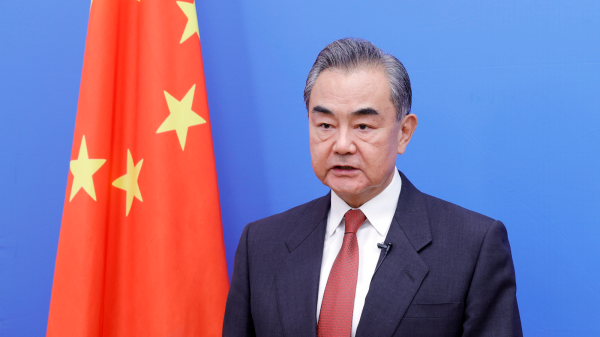
Beijing (TDI): Chinese Foreign Minister Wang Yi held a telephone conversation with Bahraini Foreign Minister Abdullatif bin Rashid Al Zayani, who is also the current chair of the Ministerial Council of the Gulf Cooperation Council.
Yi outlined China’s principled position of opposing aggression and advocating for peace, in the call that took place on Thursday. He emphasized that a ceasefire and the cessation of hostilities represent the common aspiration of the international community amid the ongoing situation in the Gulf region and the Middle East.
The Chinese Foreign Minister said that the United Nations Security Council should focus on easing tensions, facilitating a ceasefire, and resuming talks.
Chinese FM Wang Yi held a phone conversation with the current chair of the Ministerial Council of the Gulf Cooperation Council and Bahraini FM Abdullatif bin Rashid Al Zayani.
Wang elaborated on China’s principled position of opposing aggression and advocating peace. A ceasefire… pic.twitter.com/PtyzjZQDdD
— Lin Jian 林剑 (@SpoxCHN_LinJian) April 2, 2026
He stressed that such measures must not endorse illegal acts of war or add fuel to the fire. The phone call came as Gulf countries face severe security challenges, including the obstruction of shipping passage through the Strait of Hormuz.
China stands ready to work closely with Bahrain to promote an end to the conflict, restore peace, and achieve lasting regional stability. Wang Yi affirmed that Beijing will continue to safeguard the legitimate rights and interests of the Global South, particularly small and medium-sized countries.
The two ministers discussed the latest developments in the Middle East, with Al Zayani briefing Wang Yi on Bahrain’s position and the broader challenges confronting Gulf nations. The conversation reflects China’s consistent diplomatic efforts to support de-escalation and dialogue in the region.
Wang Yi highlighted the importance of collective international action that prioritizes peace over confrontation. Bahrain, as the current chair of the GCC Ministerial Council, plays a key role in coordinating Gulf positions on these issues.
This latest engagement builds on ongoing diplomatic exchanges between China and Gulf states. It underscores Beijing’s support for a peaceful resolution that protects regional security and economic stability.
The Strait of Hormuz remains a vital global shipping route, and any prolonged disruption affects energy supplies and international trade.

Muhammad Usman Hashmi is a researcher in International Relations, focusing on climate diplomacy, global governance, and political economy in the Global South. He has contributed to policy dialogues with the Foreign Policy Community of Indonesia and serves as a Senior Research Fellow at the International Council on Human Rights, Peace and Politics. He is also associated with Rethinking Economics Islamabad, contributing to research on development and sustainability.