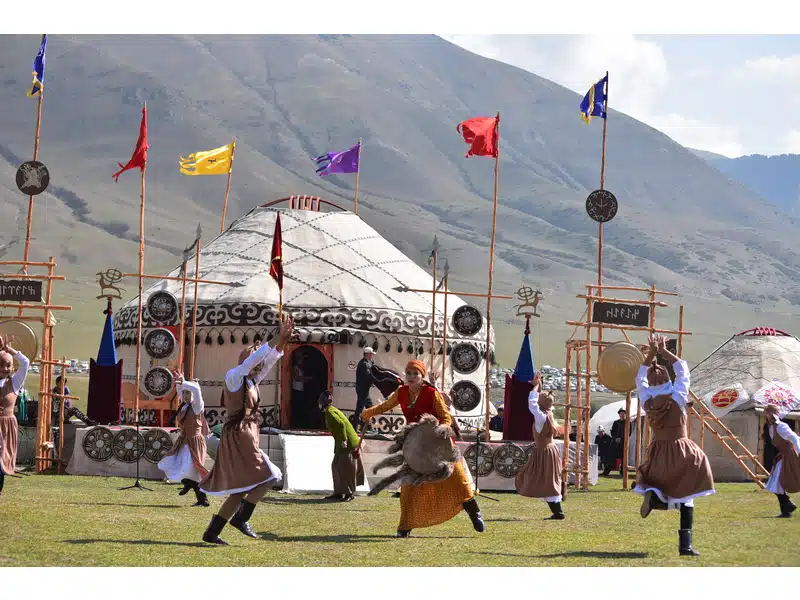
For centuries, the great Eurasian steppe was not merely a landscape. It was a world of movement, where communities travelled with the seasons, horses were instruments of survival, yurts became mobile homes, oral traditions preserved collective memory, and games were more than entertainment.
This heritage will acquire a distinctly modern stage when Kyrgyzstan hosts the sixth World Nomad Games from 31 August to 6 September 2026. What began as an effort to preserve the traditions of nomadic civilization has evolved into an international cultural platform, bringing together sport, heritage, traditional knowledge and diplomacy.
The origins of the Games themselves are relatively recent, but the traditions they represent are centuries old. The idea emerged in Kyrgyzstan in the early 2010s and received a significant political foundation through the 2012 Bishkek Declaration adopted at a summit involving Kyrgyzstan, Azerbaijan, Kazakhstan and Türkiye.
The first World Nomad Games were subsequently held in Cholpon-Ata in 2014, bringing together athletes from 19 countries in competitions based on traditional sports.
Read More: Kyrgyzstan Prepares for Independence Day, SCO Summit, World Nomad Games
Kyrgyzstan hosted the next two editions in 2016 and 2018 before the Games travelled beyond their birthplace, first to Türkiye in 2022 and then to Kazakhstan in 2024.
Their return to Kyrgyzstan in 2026 is therefore more than another rotation of host countries. It represents a symbolic return to the place that projects heritage.
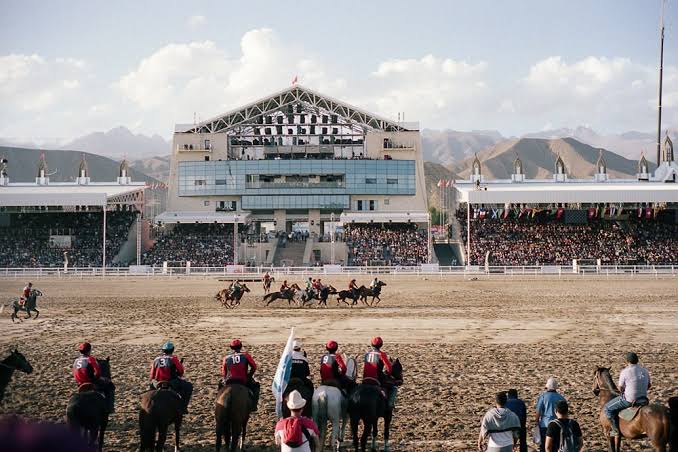
The spectacle of kok-boru, the mounted game deeply embedded in Kyrgyz culture, is perhaps the clearest example. Riders competing at speed are not simply performing an unusual sporting contest for international spectators but they are reproducing a tradition rooted in the relationship between horse, rider, community and landscape.
UNESCO has recognized kok-boru as a significant cultural heritage, describing it as a practice that transmits riding skills, teamwork, patience, respect and knowledge between generations.
Alongside horse games, wrestling, archery, intellectual games, hunting traditions, music, crafts, cuisine and traditional dress create a cultural landscape in which the Games become an expression of an entire way of life rather than a collection of sporting events.
Read More: US Envoys Explore Kazakhstan’s Nomadic Traditions
This is also why the World Nomad Games carry a different meaning from conventional international sporting competitions. The Olympics generally represent athletic excellence through universalized rules. The Nomad Games begin from cultural differences and make that difference the center of the spectacle.
Their official framework rests on three interconnected pillars: ethno sport, ethno culture, and science and traditional knowledge. The cultural program includes music, crafts, food, traditional clothing and ethnographic displays, while conferences and educational activities examine the knowledge systems inherited from nomadic societies.
In this sense, the Games ask a larger question, what happens when communities that were historically described through geography, ethnicity or folklore are instead allowed to present themselves through their own living traditions?
The answer is particularly important for Kyrgyzstan. Like many post-Soviet Central Asian states, the country has spent decades negotiating the relationship between modern statehood and an older cultural identity.
Nomadism provides Kyrgyzstan with a powerful national narrative because it connects the contemporary republic to the mountains, horses, oral traditions and the epic world of Manas. The World Nomad Games transform that historical inheritance into international visibility.
They allow Kyrgyzstan to present itself not simply as a small landlocked state in Central Asia, but as the birthplace of a global cultural movement.
Yet the most fascinating dimension of the 2026 Games may be diplomatic. Their timing places sport and high politics almost literally on the same stage.
The opening ceremony will take place in Bishkek on 31 August, coinciding with Kyrgyzstan’s 35th Independence Day, while leaders of the Shanghai Cooperation Organization landing upon the capital for the summit scheduled for 1 September.
The overlap is significant. The SCO brings together major Eurasian powers, including China, Russia, India, Kazakhstan and Uzbekistan, while the Nomad Games bring together athletes, cultural representatives and audiences connected to many of the same geographical and historical spaces.
Kyrgyzstan is consequently preparing to host two very different forms of international engagement at almost exactly the same moment.
Kyrgyzstan’s own foreign-policy positioning makes this particularly relevant. Hosting the SCO summit gives Bishkek an opportunity to function as a diplomatic meeting point, while the Nomad Games provide a parallel cultural platform.
Read More: SCO at 25: What to Expect from the Bishkek Summit
Together, they allow Kyrgyzstan to demonstrate that Central Asia is not merely an arena in which larger powers compete for influence. It is also a region capable of generating its own institutions, narratives and forms of international engagement.
The Games’ history reinforces this point: the event originated in Kyrgyzstan, expanded to Türkiye and Kazakhstan, and has now returned to its birthplace with an increasingly international identity.
There is also something particularly powerful about the geography chosen for the Games. After the opening in Bishkek, the program moves toward Lake Issyk-Kul and the surrounding landscapes of Kyrgyzstan. The setting matters because the mountains, lakes, horses and yurts are not merely decorative backdrops to the event.
They are part of the historical environment from which the traditions being celebrated emerged. The organizers describe the Games as a place where traditions become a global movement; the landscape makes that claim tangible.
Ultimately, the World Nomad Games are about more than remembering the past. They demonstrate how history can become a resource for contemporary international relations.
Read More: Xi Jinping to Attend SCO Summit in Kyrgyzstan
In an age in which countries compete not only for military and economic influence but also for narratives, identity and cultural recognition, heritage itself has become a form of soft power. Kyrgyzstan appears to understand this particularly well.
By bringing the world’s attention to nomadic traditions, it is simultaneously strengthening national identity, promoting tourism, creating international networks and positioning itself as a cultural bridge across Eurasia.
When the Games open on 31 August, the significance will extend beyond the medals awarded and competitions won. Horses will enter the arena, archers will draw their bows, wrestlers will compete and musicians will revive sounds carried through generations.
At the same time, diplomats and heads of government will gather in the same country to discuss the strategic future of Eurasia. One event will speak through treaties and geopolitics; the other through memory, movement and tradition.
Aqsa Fazilat
Aqsa Fazilat is a student of Political Science and Philosophy at Kinnaird College for Women. Her research interest lies in contemporary global politics and political geography.