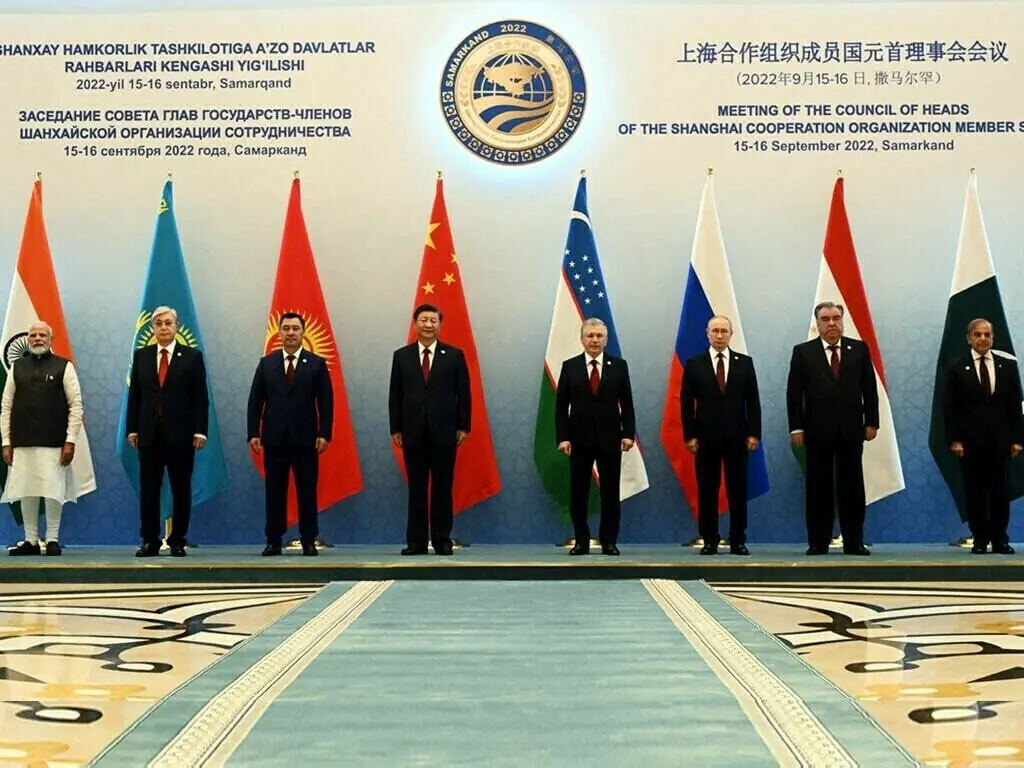
Leaders of the Shanghai Cooperation Organization (SCO) are set to gather in Bishkek, Kyrgyzstan, next week for a summit that will carry particular significance as the regional grouping marks its 25th anniversary.
Founded in 2001 with a focus on regional security, the SCO has evolved into a broad platform covering economic cooperation, trade, connectivity, digital development, cultural exchanges and regional stability.
Its anniversary comes at a time of growing geopolitical and economic uncertainty, making cooperation among regional countries an increasingly important issue.
Over the past 25 years, the organization’s development has been marked not only by its expansion but also by its ability to bring together countries with different political systems, economic models and cultural traditions.
Experts say the Bishkek summit will offer member states an opportunity to strengthen political consensus, coordinate development strategies and identify new areas of cooperation.
Kyrgyzstan assumed the SCO’s rotating presidency following last year’s summit in Tianjin and has selected the theme “25 Years of the SCO: Together for Sustainable Peace, Development, and Prosperity.”
Read More: Uzbekistan’s SCO Freight Jumps 40% as Central Asia’s New Transit Hub Takes Shape
Bishkek has spent the past year preparing for the summit, hosting a series of ministerial meetings and other events covering issues ranging from trade and finance to culture and media.
SCO Secretary-General Nurlan Yermekbayev said Kyrgyzstan’s priorities include strengthening regional stability, expanding economic cooperation, improving transport connectivity, accelerating digital transformation and promoting cultural exchanges.
Among the proposals under discussion are the creation of an SCO development bank, new transport corridors linking member states and stronger mechanisms for dealing with climate-related emergencies and other disasters.
Kyrgyzstan also wants to increase the role of young people and digital cooperation, including through a proposed SCO Youth Digital Forum.
The SCO was established on June 15, 2001, initially focusing largely on trust-building and security cooperation among neighbouring states. Its agenda has since expanded considerably.
The organization now has 10 members: China, Russia, Kazakhstan, Kyrgyzstan, Tajikistan, Uzbekistan, India, Pakistan, Iran and Belarus. Afghanistan and Mongolia hold observer status, while Azerbaijan, Armenia, Bahrain, Cambodia, Egypt, Kuwait, Maldives, Myanmar, Nepal, Qatar, Saudi Arabia, Sri Lanka, Türkiye, the United Arab Emirates and Laos are dialogue partners.
Together, SCO members account for a substantial share of the world’s population, territory and economic activity. Official data cited by the organization showed that the combined economic output of its member states had approached $30 trillion by September 2025, representing roughly one-third of the global economy.
Read More: Russian Envoy Calls for Concrete Cooperation Among SCO States
The SCO’s influence, however, is not based solely on its size. Supporters point to its model of cooperation, which does not seek to establish a military alliance or formally target third countries.
Former SCO Secretary-General Rashid Alimov has described equality, consultation and dialogue as central to the organization’s approach, with decisions based on consensus rather than unilateral control.
After a quarter century, the SCO has developed from a security-focused regional mechanism into a wide-ranging platform for political, economic and cultural cooperation.
Its supporters say the organization’s experience demonstrates that countries with different political systems and cultural backgrounds can work together when they focus on shared interests.
Chinese Ambassador to Kyrgyzstan Liu Jiangping has described the SCO as an example of a new type of international relations. The upcoming Bishkek summit is therefore expected to serve not only as an anniversary gathering but also as an opportunity for members to shape the organization’s next phase amid an increasingly complex global environment.

Farkhund Yousafzai is a seasoned journalist and analyst with over a decade of experience in the media industry. He specializes in national politics and international relations and regularly contributes as an analyst to national and international media outlets.