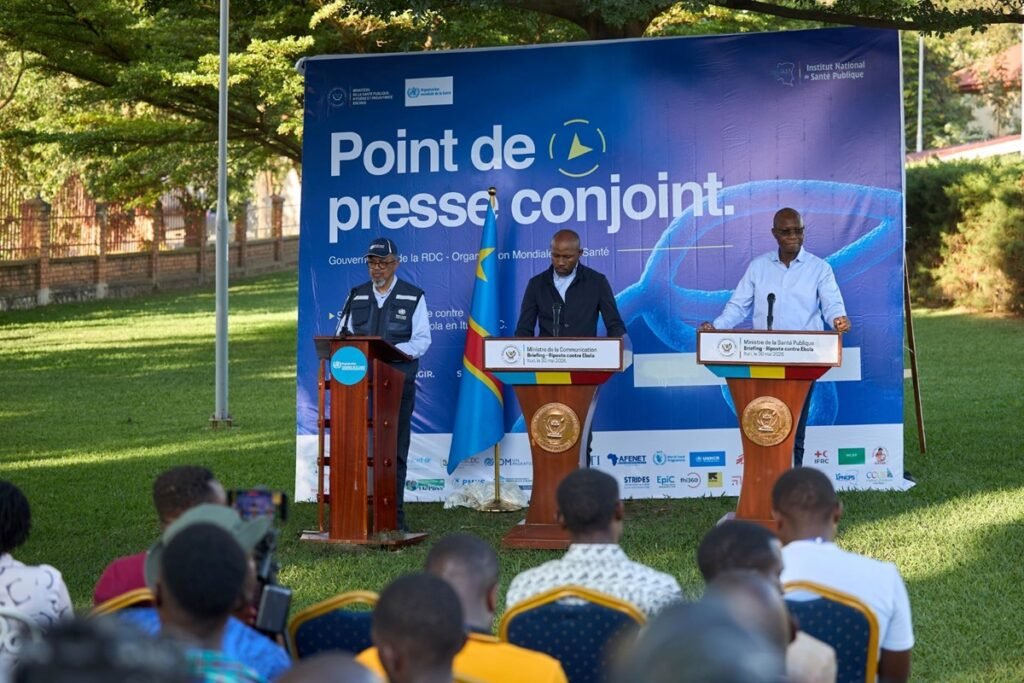
Bunia (TDI): The World Health Organization’s Director-General, Dr. Tedros Adhanom Ghebreyesus, made a rare personal visit to the heart of an active Ebola outbreak on Saturday, joining senior Congolese ministers in the eastern city of Bunia.
Health authorities are scrambling to contain a rapidly worsening epidemic caused by a strain of the virus for which no approved vaccine or treatment exists.
The DRC government and WHO issued a joint statement reaffirming commitment to protecting the people of Ituri Province, following a high-level mission to Bunia led by Health Minister Dr. Samuel Roger Kamba and Communications Minister Patrick Muyaya Katembwe.
The Ministry of Health described a rapidly evolving situation, with cases and deaths recorded across several health zones spanning Ituri, North Kivu, and South Kivu provinces.
The geographic spread across three provinces signals that containment efforts face a significant challenge, with contact tracing stretched across a vast and in places poorly accessible region.
The outbreak is caused by the Bundibugyo strain of Ebola; a less common variant than those seen in previous major epidemics.
Read More: Bundibugyo Ebola Strain: WHO Reports 906 Suspected Cases, 223 Deaths in DRC
Authorities acknowledged that the Bundibugyo strain presents additional challenges, most critically the absence of a licensed vaccine or specific treatment, though they noted that proven public health measures remain effective in slowing transmission.
WHO and partners are working to rapidly undertake randomized controlled trials of candidate vaccines and treatments.
The outbreak has already been declared a public health emergency of international concern on 17 May, a designation that unlocks accelerated international support and coordination.
Persistent challenges cited include early detection and isolation of cases, contact tracing, safe and dignified burials, infection prevention and control in health facilities, and community awareness.
National and provincial authorities, supported by WHO, are intensifying dialogue with community leaders, women’s groups, youth representatives, religious leaders, and the private sector to co-develop culturally appropriate solutions.
The DRC has successfully contained multiple previous Ebola outbreaks, and officials said that experience, combined with high-level political leadership and renewed international support, provides a foundation for bringing this one under control.