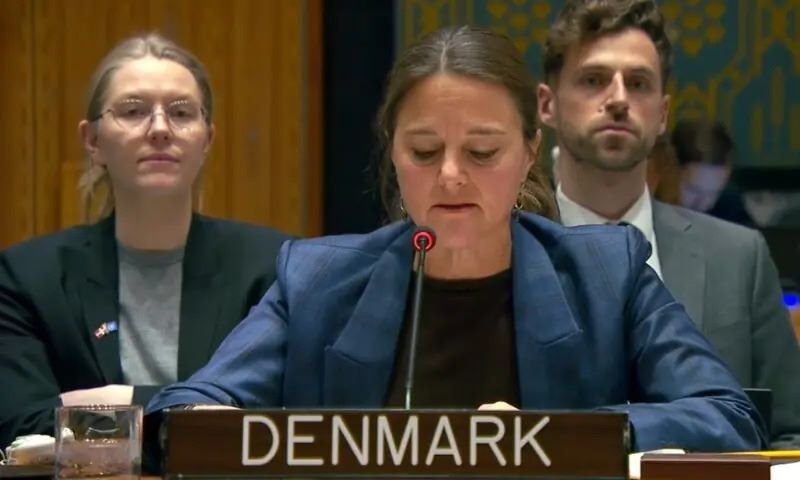
Washington (TDI): Denmark has warned the United Nations Security Council (UNSC) that the banned Tehreek-i-Taliban Pakistan (TTP) remains a “serious threat” to both South and Central Asia, adding that the group continues to benefit from “logistical and material support” provided by the de facto authorities in Afghanistan.
Denmark’s Deputy Permanent Representative to the UN Sandra Jensen Landi delivered the assessment in its capacity as chair of the UNSC’s ISIL (Daesh) and Al-Qaeda Sanctions Committee during a detailed briefing in New York on Wednesday.
The presence of TTP fighters on Afghan soil has long been a central point of friction between Pakistan and the Taliban government in Kabul. Since the Taliban takeover in 2021, Islamabad has repeatedly accused the Afghan authorities of sheltering thousands of TTP militants who have sharply intensified attacks inside Pakistan, especially in Khyber Pakhtunkhwa and Balochistan.
Speaking at the UNSC, Sandra Jensen Landi said the estimated 6,000-strong TTP network is one of the most dangerous outfits operating in the region. “The TTP has carried out several high-profile and deadly attacks in Pakistan from Afghan territory,” she said, stressing that the group’s capabilities have expanded due to sustained external support.
Read More: Pakistani Forces Eliminate Senior TTP Commander Qari Amjad in Bajaur
Turning to the broader terrorism landscape, Landi briefed the Council on the rise of ISIL (Daesh), Al-Qaeda and their affiliates across multiple continents, citing findings from the UN’s Analytical Support and Sanctions Monitoring Team. She noted that extremist groups are increasingly using social media and cryptocurrency to expand recruitment, promote violence and bypass global financial restrictions.
Landi highlighted that Daesh, after losing ground in the Middle East, has shifted its operational focus to Africa, where groups such as the Islamic State West Africa Province (ISWAP) have widened their influence. In South and Central Asia, she singled out ISIL-Khorasan (IS-K) as a uniquely potent threat, with an estimated 2,000 fighters under Sanaullah Ghafari. She said IS-K continues to target Shia communities, Afghan authorities and foreign nationals with sophisticated attacks.
She added that while Al-Qaeda’s central command has weakened significantly, its regional branches, notably Jamaat Nasr al-Islam wal-Muslimin in Africa’s Sahel region, have exploited local grievances to expand their footprint. Meanwhile, Al-Qaeda in the Arabian Peninsula (AQAP) remains active in incitement and fundraising.
Read More: TTP’s Quest for a ‘Brother Emirate’ and Why Pakistan Must Respond
Calling the global threat “resilient and adaptive,” Landi said extremist groups are exploiting weak governance, conflict zones and technological advancements to maintain relevance. She urged member states to strengthen coordination under the UN’s 1267 sanctions regime.