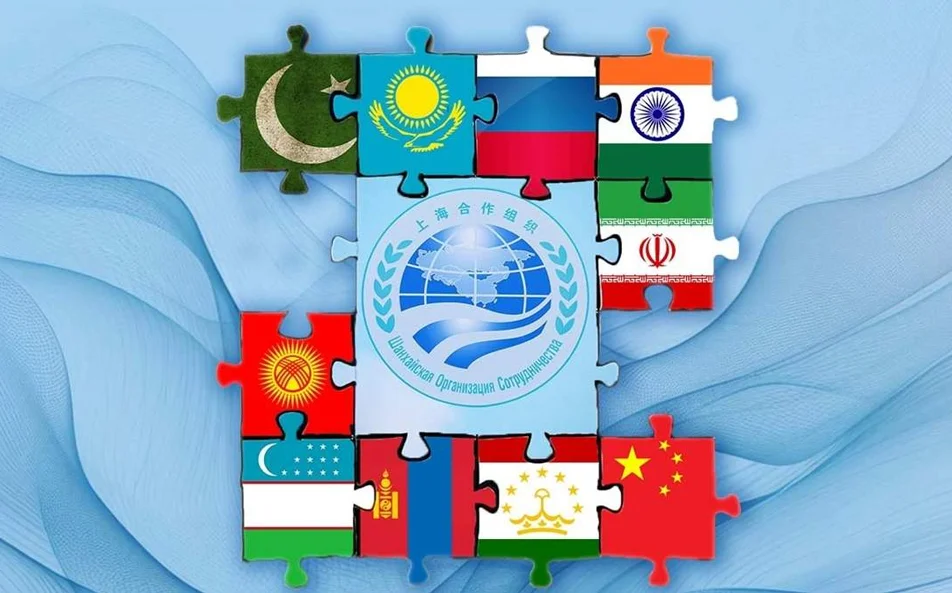
This year, the Shanghai Cooperation Organization has turned twenty-fifth, and this silver jubilee arrives at an unusual moment in its institutional life. The Council of Heads of State summit will be held in Bishkek next month, on the theme Kyrgyzstan took up upon taking the chairmanship after the Tianjin Summit last year, “25 Years of the SCO: Together for Sustainable Peace, Development, and Prosperity.”
Bishkek has been planning for the milestone anniversary summit throughout the chairmanship year, and the summit is intended to review 25 years of institution-building and provide a direction for the future.
During the 2025 summit in Tianjin, the SCO agreed to a Development Strategy until 2035, whose main goal is comprehensive modernization, including streamlining the legal system, improving the permanent bodies, and transforming the discussion-based format into a project-based one.
The driving force behind Kyrgyzstan’s chairmanship is this institutional change. According to SCO Secretary-General, Nurlan Yermekbayev, the Bishkek summit will become a “platform for updating the SCO strategy, with an emphasis on concrete mechanisms for project financing and implementation.”
Read More: SCO Experts Gather in Bishkek to Discuss a Changing Global Order
Before the summit, there are concrete institutional steps that have been achieved in the framework of Kyrgyzstan’s security priorities.
At the Tianjin summit, member states signed an agreement on the Universal Centre for Countering Security Challenges and Threats in Tashkent; which transforms the Regional Anti-Terrorist Structure into a broader mechanism encompassing an Information Security Centre, a Centre for Countering International Organized Crime in Bishkek as a branch, and an Anti-Narcotics Centre in Dushanbe as a dedicated permanent body.
At the military level, a cooperation plan was approved at the expert working group-level for 2026–2027, in April, during the meeting of defense ministers.
From the economic viewpoint, Kyrgyzstan is proposing to launch a Development Bank, a Development Fund, and an Investment Fund in the SCO format, as otherwise, the SCO’s projects cannot be implemented.
Read More: SCO Media Summit Highlights AI, Digital Transformation and Regional Cooperation
On 24 July 2026, the Foreign Ministers’ Council was held in Cholpon-Ata to finish the paperwork. The ministers adopted a significant batch of documents to be handed to the heads of state, such as the Bishkek Declaration on the occasion of the 25th anniversary, the Protocol on Amendments and Additions to the SCO Charter, as well as the regulations on the Universal Centre for Countering Security Challenges and Threats, and the Anti-Drug Centre.
Leaders will also have thematic documents on security, AI, transport, energy, climate change, environmental protection, healthcare, and education as they gather for the annual summit next month. The Charter amendment is especially noteworthy, as it is a rare formal revision of the basic document of the SCO and corresponds to the new security role of its reorganized institutional structures.
The ministerial meeting did not bring a big announcement of new developments but was able to accomplish its primary work of putting together the agenda and documentation for September; the National Coordinators had already prepared the documents to a large extent in their previous meeting, so that the ministers could concentrate on political approval.
Kyrgyzstan will hand over the chairmanship of the SCO to Pakistan on 1 September. It is a significant step up. Pakistan has been a member of SCO since 2017, where it has worked to establish its credibility in the organization. The chairmanship of the Council of Heads of State, the organization’s highest decision-making body, will bring Islamabad in a very impactful role.
Read More: SCO Marks 25 Years with Photo Exhibition in Bishkek
Islamabad will seek to use SCO as a platform for furthering economic relations and cooperation in trade, investment, energy, innovation, transport, and connectivity, according to the Ministry of Foreign Affairs of Pakistan, as its geography offers huge potential in becoming a trade conduit among South Asia, Central Asia and Middle East. That geography is at the heart of Islamabad’s plans for the chairmanship.
Deputy Prime Minister and Foreign Minister Ishaq Dar has indicated that Pakistan will adopt a practical and future-oriented approach which will center on enhancing economic cooperation, regional connectivity, and interactions between the member countries of SCO. The language is intentional; Islamabad not only describes itself as a security actor, but also as an integrative economic node.
The China–Pakistan Economic Corridor has been officially recognized in the Joint Communiqué of the 23rd SCO Heads of Government meeting in the context of the SCO’s regional connectivity initiatives. Pakistan also permanently chairs the Special Working Group on Poverty Alleviation of the SCO, where it has led the establishment of a Digital Social Safety Net (DSSN) already benefiting 2.3 million low-income families, set to be expanded to other member states.
Pakistan’s chairmanship of the SCO Regional Anti-Terrorist Structure (2025–2026) has given Islamabad the opportunity to spearhead in areas of intelligence sharing, joint exercises, policy coordination, and capacity-building.
Read More: SCO Culture Ministers Meet in Kyrgyzstan, Chart Roadmap for Cultural Exchange
Pakistan’s security contribution will be around counterterrorism and the eradication of SCO’s outlined “three evil forces” – terrorism, separatism, and extremism – and the Afghan narcotics issue will be a part of that, building upon the ground prepared already.
Dar explicitly described CPEC as “a model for trans-regional economic and trade integration among SCO countries” and lauded the SCO’s work on digital innovation, energy security, and mutual payments in national currencies, calling these “the foundation for a resilient regional economy.”
In the field of culture, Pakistan has pitched for the designation of Lahore as the SCO Tourism and Cultural Capital for 2026–2027 and will also host four major cultural activities in Lahore along with various cultural activities throughout the year.
The reality is that the consensus-driven set-up of the SCO will limit the ambitions of any chair, including Pakistan. Kyrgyzstan clearly aims at setting up a trend of actions, not just speech. However, the capacity to put words into actions has been a central institutional problem of the SCO in the past.
Pakistan will have to deal with that constraint. What It can realistically do is establish the chairmanship to make CPEC and wider Eurasian connectivity a formal document in the SCO; position itself as an indispensable southern flank of the SCO in the region; and integrate the Central Asian economies into the corridor framework of CPEC; Karachi–Gwadar–Kashgar, not through sweeping statements, but through incremental institutional consolidation.

Muhammad Mahad Samija
Muhammad Mahad Samija is a student of Political Science at Government College University, Lahore. He can be reached at [email protected]