Prime Minister Shehbaz Sharif visited Austria on 15 February 2026 for a two-day official trip at the invitation of Austrian Federal Chancellor Christian Stocker. This is the first visit by a Prime Minister of Pakistan in over 30 years, the last being the former PM Nawaz Sharif in 1992. The visit also marks the 70th anniversary of formal diplomatic relations between Pakistan and Austria, a relationship that has remained friendly but has seen limited economic engagement.
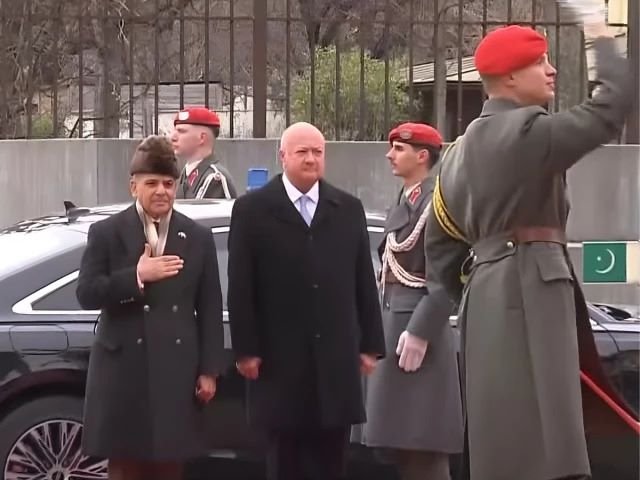
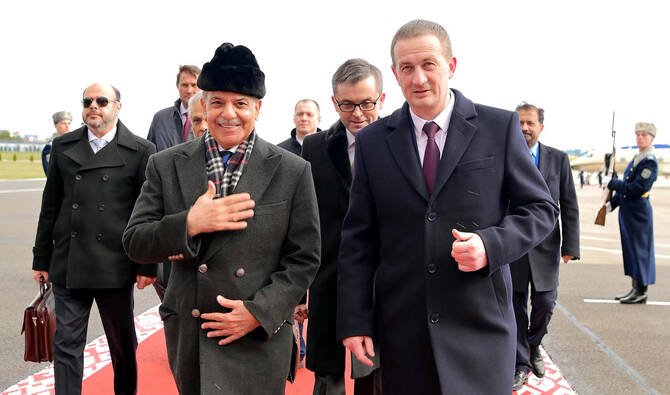
Upon arrival at Vienna International Airport, Prime Minister and his delegation, which includes Deputy Prime Minister and Foreign Minister Senator Muhammad Ishaq Dar, Information Minister Attaullah Tarar, Special Assistant to the Prime Minister Syed Tariq Fatemi, and Foreign Secretary Ambassador Amna Baloch, were welcomed with a ceremonial salute by the Austrian armed forces. His reception at the Federal Chancellery included a guard of honour and formal welcoming ceremonies, underscoring Vienna’s acknowledgment of the importance of the visit in bilateral diplomatic terms.
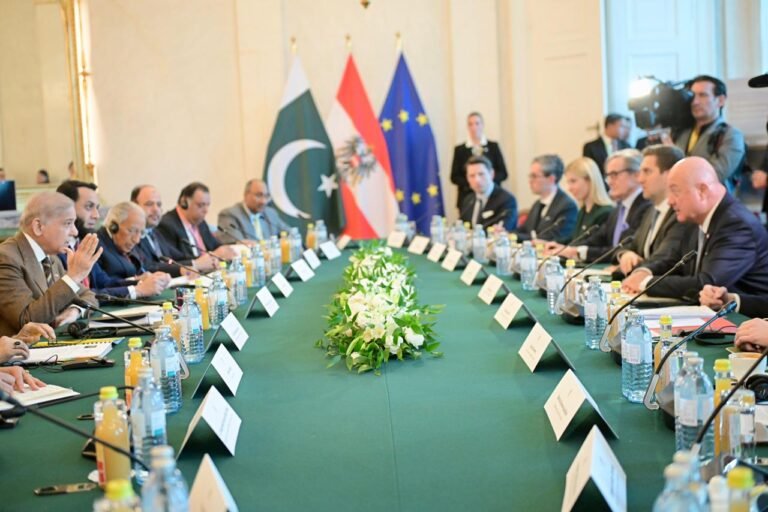
During the visit, PM Sharif and Chancellor Stocker held bilateral talks at the Federal Chancellery. Both leaders reviewed the full range of Pakistan-Austria relations, reaffirmed their commitment to dialogue and cooperation, and discussed specific avenues for expanding ties, particularly in trade and economic sectors. The Foreign Office of Pakistan highlighted in its statement that both sides aimed to add new dimensions to the bilateral relationship, signalling an intention to move beyond diplomatic formalities to more substantive areas of engagement.
A central component of the visit was the Pakistan-Austria Business Forum, organized by the Austrian Economic Chamber (WKO), where the prime minister co-chaired a meeting with Chancellor Stocker and leading business figures from both countries. The agenda was explicitly focused on unlocking investment opportunities, deepening economic cooperation, and raising the volume of trade and commercial engagement. Pakistan emphasized its economic reform measures, investor incentives, and potential in sectors such as renewable energy, technology, industry, and manufacturing, aiming to attract Austrian enterprises that are competitive in European and global markets.
In parallel with bilateral and business engagements, the prime minister participated in a United Nations-hosted event in Vienna themed “Sustainable Development: The Path to Global Peace and Prosperity” where he underscored Pakistan’s commitment to sustainable development, global peace, and cooperation within the UN system. Vienna hosts several key multilateral organizations, and this engagement was part of Pakistan’s strategy to project its foreign policy priorities on global governance platforms while reinforcing the multilateral dimension of its diplomatic outreach.
PM Sharif also met with the Director General of the International Atomic Energy Agency (IAEA) to discuss cooperation in the peaceful use of nuclear energy, safety frameworks, and related science and technology cooperation. Engagements with multilateral bodies such as the IAEA reflect Islamabad’s interest in deepening technical and institutional cooperation in areas where Austrian and European expertise intersect with Pakistan’s development priorities.
This visit carries specific implications for Pakistan’s relations with Europe and especially Austria. For Pakistan, Austria represents an entry point into Central European political and economic networks that have been relatively under-explored compared to Pakistan’s engagements with larger EU economies.
Austria’s role as a neutral diplomatic actor within Europe and host to major United Nations agencies provides Pakistan a platform to present its policy priorities on sustainable development, peace, and industrial cooperation in forums that influence broader European perspectives. The focus on economic cooperation and business networking was a deliberate shift from traditional diplomatic engagements that aim to create tangible commercial outcomes rather than relying on ceremonial diplomatic ties.
Specific expectations from the visit, based on official statements and business forum outcomes, include laying the groundwork for expanded trade volumes, Austrian investment in Pakistani sectors with comparative advantages, and institutional mechanisms for sustained economic dialogue such as joint working groups and bilateral committees. It is to note that trade between Pakistan and Austria has historically been modest, with potential for growth in machinery, industrial goods, textiles, and technology services if supported by clear policy frameworks and incentives.
The visit also positions Pakistan to engage more effectively with European multilateral agendas. Through participating in high-level UN events and meetings with UN agencies in Vienna, Pakistan signaled its willingness to be a stakeholder in areas that align with European priorities on sustainability, peaceful nuclear cooperation, and managing transnational challenges like crime and narcotics. This multilateral engagement is intended to complement bilateral economic objectives, reinforcing Pakistan’s image as a responsible international partner aligned with the principles of the UN Charter and international law.
To capitalize on the momentum generated by this visit, Pakistan needs to pursue several targeted actions. First, establishing structured mechanisms such as regular joint economic commissions with Austria can institutionalize dialogue on trade and investment, enabling both sides to address barriers and streamline cooperation.
Formalizing sector-specific MoUs and partnerships, particularly in areas where Austrian companies have technological strengths, such as renewable energy and advanced manufacturing, would convert diplomatic goodwill into concrete business ventures. Maintaining high-level political and bureaucratic follow-ups is critical to sustain engagement beyond this visit, including annual review meetings that track progress against agreed milestones.
On the multilateral front, Pakistan should leverage its engagements with Vienna-based UN institutions to develop joint programs on industrial development, sustainable infrastructure, and capacity building, which can be co-branded with Austrian expertise and European Union support frameworks. These steps would ensure the visit’s outcomes translate into long-term strategic cooperation rather than short-lived diplomatic gestures.
In a nutshell, Prime Minister Shehbaz Sharif’s visit to Austria represents a deliberate attempt to reinvigorate Pakistan-Europe relations through economic and multilateral engagement, specifically positioning Austria as a strategic partner on economic and international governance fronts. The emphasis on business forums, investment discussions, and participation in UN events reflects an effort to create measurable and policy-driven outcomes, signaling Pakistan’s intent to deepen ties with Central Europe in ways that deliver mutual economic and diplomatic benefits.

Established in December 2008, The Diplomatic Insight is Pakistan’s premier diplomacy and foreign affairs magazine, available in both digital and print formats.