Located in the southwest Indian Ocean, about 2,000 kilometers off the southeast coast of Africa, the island nation of Mauritius is known for its turquoise lagoons, coral reefs, and volcanic landscapes. The country sits east of Madagascar and consists of the main island of Mauritius along with smaller islands such as Rodrigues and Agaléga.
Despite its modest size, Mauritius has developed a global reputation for political stability, economic resilience, and cultural harmony.
Every year on March 12, Mauritius celebrates its National Day, commemorating the country’s independence from the United Kingdom in 1968 and its later transition to a republic in 1992. Today, the country marks its 58th year of independence and 34th as a republic, and the story behind that double celebration is anything but ordinary.
This dual commemoration makes the occasion particularly meaningful, as it represents not just the end of colonial rule but also the completion of Mauritius’s journey toward full sovereignty.
Read More: President Zardari Extends National Day Greetings to Mauritius
National Day celebrations in Mauritius typically include official ceremonies, cultural performances, and public festivities. Events often take place in the capital, Port Louis, where national leaders address the public and highlight the country’s achievements.
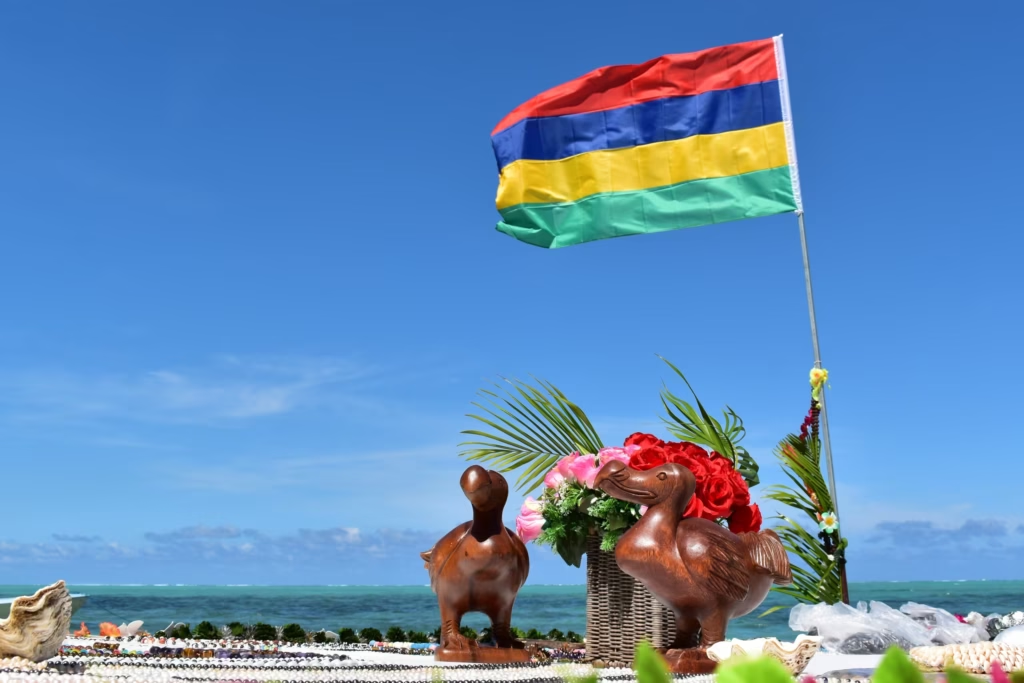
The Mauritian flag, featuring red, blue, yellow, and green stripes, flies across the island, symbolizing the nation’s struggle for freedom, its surrounding ocean, the light of independence, and the island’s natural beauty.
In a world often divided by ethnic and cultural differences, Mauritius offers a compelling example of how pluralism, democratic governance, and shared national identity can coexist. National Day, therefore, celebrates more than independence, it celebrates the unique social fabric that defines the Mauritian nation.
The Road to Independence
Mauritius has a long colonial history shaped by several European powers. The island was first claimed by the Netherlands in the 17th century, although Dutch settlers eventually abandoned it. The French then took over in 1715, renamed it “Isle de France,” and built a sugar economy on the back of enslaved Africans. During the Napoleonic Wars, Britain captured Mauritius in 1810, and it formally became a British colony.
After the abolition of slavery in the British Empire, thousands of indentured laborers, mainly from India, were brought to Mauritius to work in the fields. Over time, this migration profoundly shaped the island’s cultural and demographic composition.
By the mid-20th century, political movements advocating self-governance began to gain momentum. One of the most influential figures in the independence movement was Seewoosagur Ramgoolam, who later became the country’s first Prime Minister. Following negotiations with Britain and a constitutional conference in London, Mauritius gained independence in 1968.
The date itself carries symbolic significance. It coincides with the anniversary of Mahatma Gandhi’s Salt March, reflecting the influence of peaceful political struggle on the Mauritian independence movement.
The connection also reflects the historical and cultural links between Mauritius and India. A large portion of the Mauritian population descends from Indian indentured laborers who arrived on the island during the colonial period. Gandhi himself briefly visited Mauritius in 1901 and encouraged the local Indian community to pursue education, political participation, and social reform.
Read More: Scientist to Stateswoman: A Conversation with the First Female President of Mauritius
A Nation Built on Diversity and Some Interesting Facts
Perhaps the most distinctive feature of Mauritius today is its multicultural society. The island’s population includes people of Indian, African, Chinese, and European descent, creating one of the most diverse societies in the world.
Unlike many countries where ethnic diversity has led to political instability, Mauritius has largely managed to transform this diversity into a strength. Different religious and cultural traditions coexist within the same national framework. Hindu festivals such as Diwali, Muslim celebrations like Eid al-Fitr, and Christian holidays such as Christmas are all nationally recognized and widely celebrated.
This inclusive approach has helped shape a strong sense of shared national identity, despite the island’s varied cultural roots.
Several unique characteristics make Mauritius stand out globally. First, the country is often regarded as one of Africa’s most stable democracies, with regular elections and strong democratic institutions. It consistently ranks among the top African countries in governance, economic freedom, and human development.
Second, Mauritius is one of the few countries where multiple languages are used in daily life. English is the official language of government, while French is widely used in media and business. At the same time, Mauritian Creole serves as the everyday language for much of the population.
Another interesting fact is that the island was once home to the famous Dodo, a flightless bird that became extinct in the late 17th century after human settlement. Today, the dodo remains a national symbol and an important reminder of the island’s environmental history.