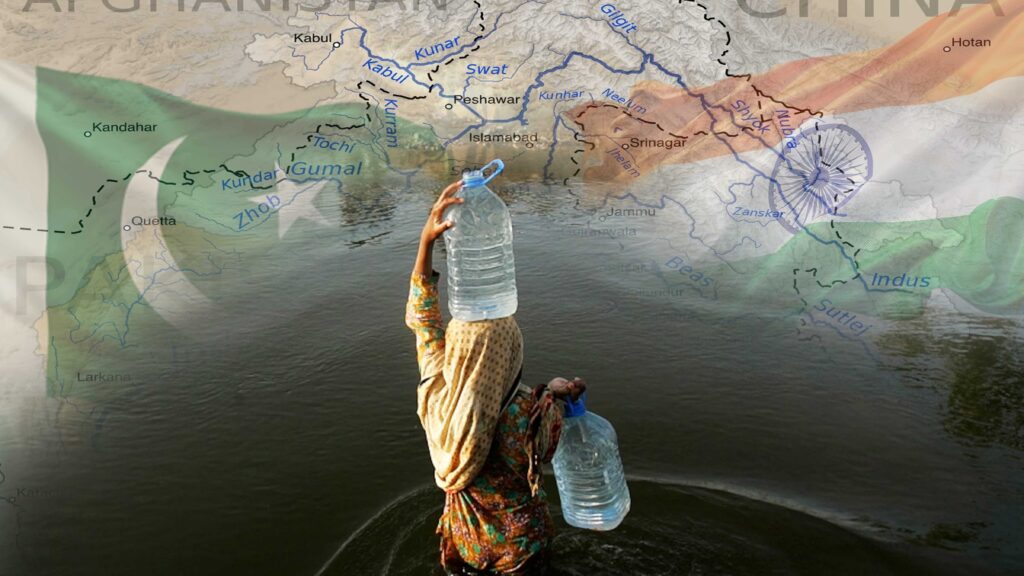
Recently, the Union Minister of Jal Shakti (Water Resources) C.R.Patil stated that the Indian Government is “actively working” to ensure that “not a single drop of water will go to Pakistan in the coming years.” He declared that PM Modi was leading these efforts and Home Minister Amit Shah was closely monitoring them.
Such statements may not prove that New Delhi has the technical capacity to stop downstream flows entirely at this time. However, they are important because they show policy priorities of the Indian Government. Although political leaders frequently express goals that are above their current capacity, repeated statements made by high-ranking officials show “intent.”
If we look back at Modi’s 2016 assertion that “blood and water cannot flow together”, these remarks point to a shift in India’s perspective on the Indus Basin. New Delhi, under the Modi Government has weaponized water and views it as a source of strategic leverage.
Moreover, the threat is not just in what India is capable of doing now, but also in what its leaders are publicly indicating they hope to accomplish in future. As expected, Pakistan’s FO spokesperson Tahir Andrabi stated that any intentional attempt to obstruct water vital to Pakistan’s existence and growth would have “far-reaching consequences.”
He further stated that “any such act would be treated with utmost seriousness and could possibly amount to an act of war under Article 51 of the UN Charter.”
The Indus Waters Treaty (IWT) despite three wars and conflicts remained a cornerstone of bilateral ties for more than 60 years enabling fair access to water resources. The three rivers in the East (Ravi, Beas, and Sutlej) were allocated to India, while the three rivers in the West (Indus, Jhelum, and Chenab) were allocated to Pakistan. New Delhi was allowed to use water from the Western rivers for very specific non-consumptive purposes.
However, New Delhi under Modi has deviated from the established norms and cooperative spirit that upheld the treaty for decades. India now presents the treaty as disproportionately advantageous to Islamabad, claims that sovereign authority over the Indus rivers should take precedence over treaty-based restrictions, and uses accusations of terrorism to justify suspension.
In contrast to what New Delhi claims, there is no withdrawal or exit clause in the IWT. According to Article XII, only a new agreement that has been properly accepted by “both parties” may amend or terminate the treaty. India has looked for reasons outside the treaty citing Articles 60 and 62 of the Vienna Convention on the Law of Treaties after failing to find a legal foundation for unilateral suspension within the treaty provisions.
In this case, these conditions are not obviously applicable. Pakistan has not broken any fundamental water-sharing obligations under the treaty. Moreover, there has not been any “fundamental change of circumstances” with regard to the hydrology, topography, or the treaty’s goal of fair water allocation in the Indus Basin.
The permanent Court of Arbitration (PCA) has consistently upheld the treaty’s ongoing validity and its own authority through competence verdicts in July 2023 and supplemental rulings as recently as May 2026 on pondage and design issues for the Ratle and Kishanganga projects. These rulings have been appreciated by Islamabad, but New Delhi termed it as “illegal”.
Based on legal and technical reviews, India’s stance is weak but it does not diminish the seriousness of Islamabad’s concerns. On paper, international law restricts New Delhi’s actions, but geography plays in its favor, which might limit implementation of decision. India has significant strategic influence in the Indus Basin as the upper riparian. Consequently, New Delhi’s legal and technical standing for suspending the treaty is not the primary question.
Instead, the question is whether India’s increasing focus on water politics and sovereignty can be converted into actual leverage against Pakistan. From Pakistan’s point of view, current events indicate that the process is already under adjudication.
The risks posed by India are not isolated incidents; instead they are amplified by a growing hydraulic infrastructure network, expanding storage space, and a number of initiatives that together would improve New Delhi’s power to control, postpone, or reroute flows within the basin.
India is gradually acquiring the capability that could change the timing, predictability, and availability of water to Pakistan, even though it may not yet be able to completely stop the flow of Western Rivers. In addition to complete shutdown, water security can be compromised by gradual reductions, seasonal disruptions, flow manipulation, and uncertainty about future supplies.
The structural imbalance of the basin itself exacerbates these issues. India’s upper-riparian location gives it control over the headwaters of rivers that are essential to Pakistan’s agriculture, energy generation, and food security, even though Pakistan occupies roughly 60% of the Indus Basin.
Moreover, New Delhi’s recent rhetoric has changed from a political declaration to a reliable source of strategic pressure. However, portraying Pakistan as an observer would be incorrect. Concerns about water security have certainly grown as a result of India’s upstream location and growing hydraulic infrastructure, but Islamabad has responded by taking a number of domestic, diplomatic, and legal actions to uphold the treaty framework and protect its rights as lower-riparian.
Pakistan has consistently tried to resolve the conflicts through established international processes rooted in recognized institutional mechanisms. This tactic is part of a larger plan to oppose unilateralism through long-term adaptation, legality, and diplomacy rather than escalation. As a result, Pakistan’s response has been robust, legal, and diverse.
Islamabad has diplomatically urged India to reverse its decision and reiterated that the IWT does not have an exit mechanism or a clause allowing for unilateral suspension in a number of formal parleys. It has frequently urged communication, suggested meetings at neutral locations, and stated the desire to return to more extensive political engagement.
Despite India’s displeasure, Pakistan has continued using the treaty’s dispute-resolution framework, which includes the Permanent Indus Commission (PIC), the Neutral Expert (NE) process, and the Court of Arbitration (CoA). These initiatives have produced significant legal decisions that have helped maintain the treaty’s viability and safeguard downstream rights.
By raising the matter at global forums and framing it as an issue of regional peace, humanitarian security, and sustainable development, Pakistan has attempted to internationalize concerns about the treaty’s degradation outside of the legal sphere.
Meanwhile, Islamabad has pursued domestic initiatives to increase resilience against upcoming challenges as well. Long-term water security cannot be ensured by legal triumphs alone, as evidenced by investments in new storage facilities, increased irrigation efficiency, water conservation programs, and more extensive reforms under the National Water Policy (NWP).
Moreover, in order to protect the agreement and lessen vulnerabilities that might be exploited in the near future, Pakistan’s strategy has combined external engagement with internal adaptation.
However, the importance of the current situation goes much beyond issues of treaty interpretation, dam development, and water distribution. The viability of one of the few institutional systems that survived decades of animosity between the two nuclear-armed neighbors is at risk.
The formal framework of the treaty may have been preserved by Pakistan’s diplomatic efforts, legal action, and domestic adaptation, but these measures cannot completely counteract the wider political consequences of India’s decision to put the IWT in abeyance. The suspension of IWT is a sign of breakdown in trust, not just a disagreement over water.
The IWT withstood wars, military crises, and protracted political conflict for more than 60 years. It was the last meaningful collaboration between Islamabad and New Delhi. Therefore, the consequences of its suspension extend far beyond the Indus Basin. In fact, an already hostile relationship has become even more strained as a result of the decision to put the IWT in abeyance.
It has increased instability, and exacerbated strategic mistrust throughout South Asia as evident from border restrictions, diplomatic downgrades, and the military escalation that occurred in May 2025. Even more concerning is turning water from a common resource into a possible cause of interstate conflict.
From Pakistan’s point of view, this development runs the risk of transforming an issue of economic stability and human survival into a coercive tool of statecraft. New Delhi casts doubt on its international commitments by unilaterally suspending a treaty that has long been considered one of the most resilient transboundary water agreements in the world.
Such actions undercut the idea that treaty obligations must be upheld regardless of political tensions, erode trust in negotiated agreements, and promote unilateral approaches to dispute resolution. India’s actions show its hegemonic approach to regional affairs, one that aims to capitalize on power imbalances rather than uphold mutually accepted rules.
The ramifications of this change will not be limited to war politics, they will influence South Asia’s future cooperation, stability, and war. The international community and the relevant UN organizations must play its role in upholding the norms and treaty obligations for regional and international peace and security.
*The views presented in this article are the authors’ own and do not necessarily reflect the views of The Diplomatic Insight.
Muhammad Abubaker
Muhammad Abubaker is currently working as Research Associate at Strategic Vision Institute (SVI), Islamabad.
- Muhammad Abubaker
- Muhammad Abubaker