Traditionally, IAF operates on Integrated Radio communication systems (INCOM). The INCOM is designed for internal communication between aircraft and ground control stations. It is a single purpose radio not capable of processing different waveforms, communication protocols or networks. The 21st century technological innovation has evolved warfare patterns.
The modern military dominance not only depends on conventional strength but it reaches into cyber space, electromagnetic fields, air, land and data networks. To fit in evolving network centric domains, the Indian ministry of defense in 2014 decided to replace the old generation communication systems with Software defined Radio’s (SDR).
The Software Defined Radio (SDR) is an advanced radio communication technology. The SDR supports multi-brand operation, interoperability, designed to change multiple frequencies, and support digital and voice communication. It is intended to operate on different frequencies without key hardware changes. The SDR supports secure communication without jamming.
The SDR links radars, aircrafts, AWACS, command and control centers for better understanding of combat zones. It is designed to share voices, pictures and intelligence through a data link. The SDR is basically an evolution from traditional wars to multidomain and interconnected operations.
Read More: Pakistan Warns of Forceful Response to Any Indian Aggression
Operation Swift Retort (2019) exposed weaknesses in IAF operational competences. The IAF possesses advanced jets and air defense systems, but faces difficulty in integrating aircrafts, command and control, identification of target area, detection and attack.
The shooting of Mi-17 helicopter by IAF own defense system and loss of Mig -21 Bison flown by wing commander Abhinandan raised vulnerabilities about depending on older assets in modern warfare. The IAF learned that possessing advanced conventional assets is not sufficient; battleground superiority depends on how well they are integrated and connected as parts of network centric force.
In response, the SDR development project was initiated in February 2019, in collaboration with Astra Rafael Comsys (ARC) Pvt Ltd that received a $30 million order for BNET (tactical communication system) software defined radios for IAF. In the same year, ARC received another order of 96 Cr to supply SDR for Mig -29 fleet.
The 83 Tejas MK1 A are installed with advanced communication BNET -AR SDR (a form of advanced radio used in airborne assets). Meanwhile, IAF Jaguar Fighter fleet receives massive upgradation of indigenously developed SDR under the Drain III program led by HAL.
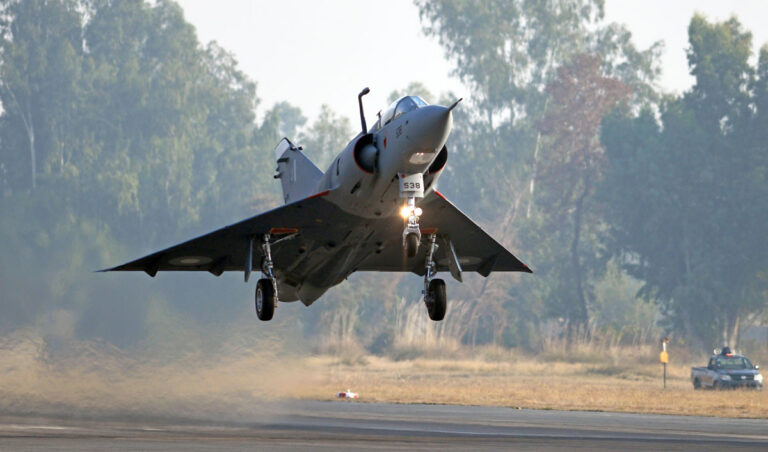
From February 2024, onwards many fighter Aircrafts such as SU-30 MK1, 36 Rafale, Mirage 2000, and Jaguar are installed with SDR communication systems. This upgradation improves operational outreach and allows IAF pilots to engage enemy from wider range without totally relaying on their aircraft radars.
The IAF is updating the standing fleet of SU-30 MKI with SDR and DR -118 advanced radar providing 360-degree aerial coverage. The integration of SDR allowed Russian origin Sukhoi to receive and transmit intelligence at different frequencies and formed secure data links with other IAF aircrafts.
The up-graded SU -30 MKI with SDR antennas is spotted at Hashimara, Tezpur and Ambala AFS. According to HAL, 50 aircrafts are done with updates under the 65000 Super Sukhoi program. These upgrades turn the SU-30 into 4.7 generation multirole standard aircraft by 2030.
The MIG -29 UPG from 1989 are a core part of the IAF fighter fleet, these jets are providing defenses in Western Front. Roughly around 66 jets out of which 36 are integrated with SDR in all three Adampur, Jamnagar and Srinagar AFS. These upgrades increase their combat skills, networking, and the ability to carry out precision strikes.
Meanwhile, IAF Jaguars under project Darrain -III have gone through a massive upgrade. The twin seat jets from Gwalior AFS are under overhauling at HAL Bengaluru. The Spectra Jaguars are equipped with indigenous SDR’s and these modifications enhanced aircraft effectiveness in developing links with other air bone assets like Rafale, Tejas and SU -30 MKI.
The IAF officials claim that whole Jaguars fleets will receive upgrades by 2029. The SDR is also a significant feature of Tejas, while providing it with secure data links, and the capability to operate on multiple wave forms. The French Rafale also went through massive developments, SDR integrated communication systems allowing pilots to coordinate with different forces on a secure network via software.
Overall, the SDR integration increases IAF operational capabilities in complex and multi-channel operations, ensuring vigorous transmission of video, voice, intelligence without jamming in contested air spaces. In case the frequencies are blocked, it shifts into different channels.
The SDR is of great strategic significance, it integrates data links (secure platform for military communication), AWACS, AFNET, Airborne sensors, command and control centers. The integration of software-based radios will turn IAF into an integrated -network centric force.
Read More: Examining the Evidence of Indian Sponsorship of TTP-BLA Nexus Against Pakistan
The SDR increases IAF situational awareness. The significant concern for PAF is that SDR improves IAF abilities to detect target, respond and attack in a required time. The advanced military SDR provides secure, encrypted communication between air assets and command stations. Through a common link shared by SDR IAF connects radars, fighter jets, UAVs, AWCS, C2 that reduces the OODA loop.
However, the May 2025 conflict proved that PAF’s electronic warfare, anti-jamming capability, and integration of ground and aerial assets was far more sophisticated, resultantly IAF lost multiple aircraft. The PAF takes the advantage over IAF due its diverse aircrafts (SU-30 MKI, Rafale, Mirages 200) and difficulty in integrating different technologies, overcoming communication gaps, thus having a platform centric force, then a purely networked one.
The PAF remains cognizant about the pace at which IAF is developing and integrating SDR into its fleet for overcoming operational deficiencies being manifested in the Operation Sindoor. In the South Asian nuclear environment, there is no space for limited operations of any kind and magnitude.
The PAF’s robust response in May 2025 once again re-affirmed Pakistan’s Full Spectrum Deterrence (FSD), while raising the cost for IAF at each rung, meanwhile denying the so-called escalation dominance to the IAF. For future, IAF must exercise strategic prudence, as it is impossible to conceive what might happen in evolving situations.
*The views presented in this article are the authors’ own and do not necessarily reflect the views of The Diplomatic Insight.*
Saif Ul Haq
Saif Ul Haq is a Research Officer at Strategic Vision Institute (SVI), Islamabad, and has completed M.Phil. in Defense and Strategic Studies from Quaid-i-Azam University, Islamabad. He holds certifications from the United Nations Office of Disarmament Affairs and the International Atomic Energy Agency.