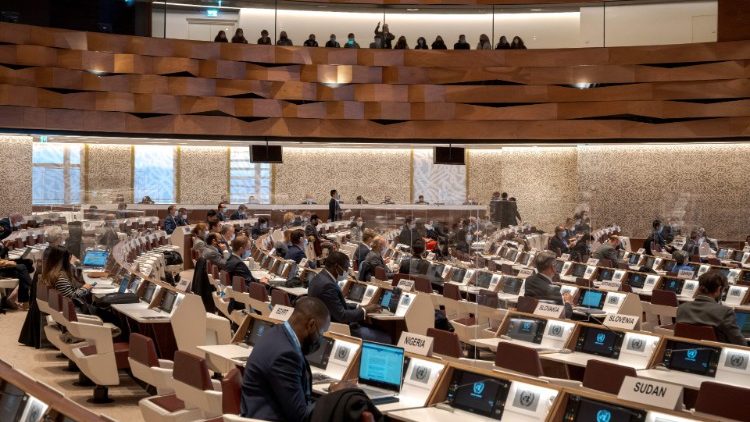
The seventh Review Conference for the Convention on Certain Conventional Weapons (CCW) is scheduled for 16-20th November in Geneva. This convention plays an important role in strengthening IHL, while preventing or reducing the sufferings of civilians and combatants through prohibiting certain weapons or systems causing superfluous and unnecessary damage.
The CCW has a multi-layered governance structure consisting of Review Conferences, Meeting of Highly Contracting Parties, Protocol specific arrangements, and formation of the Group of Governmental Experts (GGE). Although, this layered governance structure has created more complications and instilled fragmentism, thus negotiations are operating in different silos, without complementing each other.
The CCW operates as a framework under which different weapon specific protocols are being negotiated to effectively prohibit them from causing superfluous damages. Protocol I deals with the non-detectable fragments, Protocol II focuses on mines and booby traps, similarly others prohibit incendiary weapons, blinding laser weapons and explosive remnants of war.
However, CCW has been struggling to negotiate new binding protocols pertaining to the different weapon systems. For understanding this impasse, comprehension of how CCW actually works is very important.
Read More: To Destroy the Ally: Tactical Nuclear Weapons and the Arithmetic of Salvati
Beginning with the Meeting of the Highly Contracting Parties (MHCP), it focuses on observing the overall implementation and working of the Conference. For the working of MHCP, subsidiary bodies may be established for the inter-sessional period. This meeting may develop GGE for understanding the technical nuances of different weapon systems. The MHCP also determines the program and agenda for different sessions, meanwhile looking at the financial matters of the Conference.
Under the article 08 of the CCW, the Review Conference is convened with a purpose to modify or amend the provisions of the convention, its additional protocols or negotiating new additional protocols for prohibiting new and emerging weapon systems.
Historical instances indicate that Review Conference has been used to adopt Protocol IV on Binding Laser Weapon systems, amend Additional Protocol II, and even article 01 of the convention itself. It also deals with deliberating on the structure of convention in the future.
For Protocol I, III and IV, there are no separate review mechanisms, and are covered under the Review Conference of CCW. However, for the Protocol II, and V, there are separate, detailed and distinctive review mechanisms.
The article 8(2)(a) of CCW has the provision for proposing additional protocols for covering other categories of weapon systems, not covered explicitly under the existing protocols. The proposal for any additional protocol must be communicated to the depository.
Read More: Pakistan Assumes UN Disarmament Conference Presidency
The depository then notifies all the Highly Contracting Parties, and if majority of member states agree, the minimum number constituting majority will be eighteen; the former is bound to convene a conference. The article 8(2)(b) entails that a conference must agree with full participation of all member states, before adopting an additional protocol.
The article 5(3) states that the additional protocol once adopted will enter into force, after six months of the date, when twenty states have expressed their consent explicitly to be bound by the provisions of the additional protocol.
The CCW was adopted in 1980 with three annexed protocols to it, including I, II, and III. These protocols are not additional, unlike the Protocol IV and V. However, different routes were being undertaken to negotiate these protocols.
The Protocol IV on Blinding Laser Weapons was negotiated at the first Review Conference in 1995. At the Review Conference member states acknowledged the humanitarian concerns emanating from these weapons, negotiations took place and protocol was adopted as per the article 8 of CCW.
At the second Review Conference, a GGE was established on examining the superfluous damages of explosive remnants of war and mines on civilians and combatants. During 2001-2003, the GGE continued its work, and developed recommendations for the Meeting of State Parties in 2003. The Meeting of State Parties considered the recommendations and Protocol V on Explosive Remnants of War was adopted, and annexed as an additional protocol.
Read More: How Epic Fury Exposed International Humanitarian Law’s Fatal Gap
In 2014, for the first time CCW focused on discussions covering emerging techs especially Lethal Autonomous Weapon Systems (LAWS), by conducting an informal meeting of experts. The 2015 MHCP analyzed the report submitted by this meeting.
The Fifth Review Conference of CCW established the open-ended Group of Governmental Experts (GGE) in 2016. Since then, GGE has continued his work under the mandates defined by Review Conferences and are subsequently operationalized at the MHCP. The Meeting of the High Contracting Parties (MHCP) in 2023 mandated GGE to establish by consensus a set of elements of an instrument, without prejudging its nature.
Although it remains ambiguous, even if GGE agrees to develop a set of principles for an instrument, member states will absorb these principles in the form of a binding additional protocol or some kind of non-binding arrangement.
The text of the CCW has an explicit provision for concluding an additional protocol. However, the practice adopted by member states at the CCW for adopting additional protocols has taken different, although partially inter-linked paths, may or may not complement each other in evolving situations.
The way forward lies in developing detailed, unidirectional and transparent mechanisms for adopting additional protocols. These mechanisms must be well documented in the CCW treaty, and must not entail multiple contradictory paths.
For breaking the logjam for adopting an additional protocol on regulating LAWS, recommendations of the GGE must be considered either at the Review Conference or the MHCP for adopting an additional protocol.
As the emerging technologies are being integrated in the modern battlefields, the need to revamp CCW as a potent negotiating forum for prohibiting new weapon systems causing superfluous and unnecessary damage to the civilians as well as combatants is a must.
*The views presented in this article are the authors’ own and do not necessarily reflect the views of The Diplomatic Insight.*
Saif Ul Haq
Saif Ul Haq is a Research Officer at Strategic Vision Institute (SVI), Islamabad, and has completed M.Phil. in Defense and Strategic Studies from Quaid-i-Azam University, Islamabad. He holds certifications from the United Nations Office of Disarmament Affairs and the International Atomic Energy Agency.