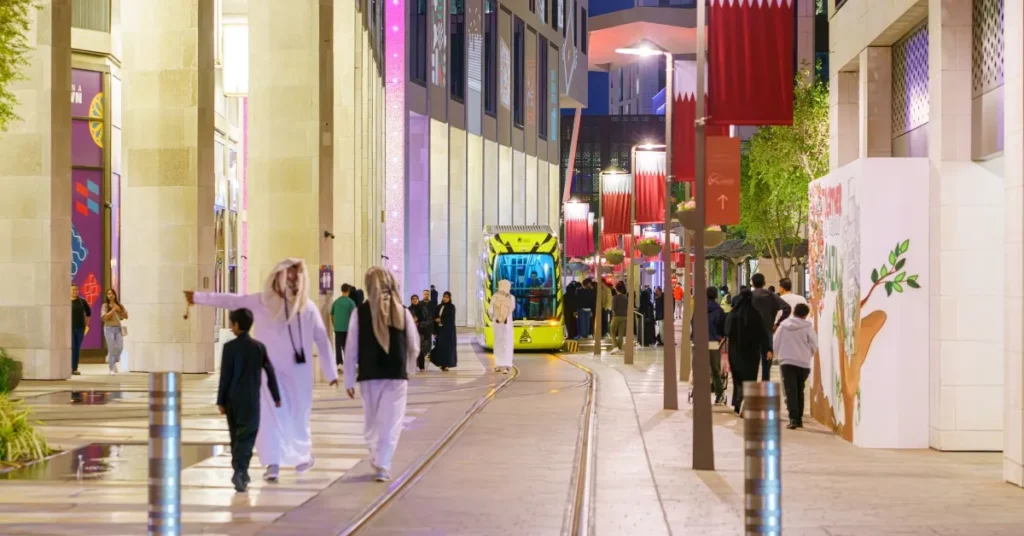
At some of Qatar’s national and cultural events that I attended, the impression was unmistakably Qatari. The people making the event possible, however, came from many places.
I saw Filipino stage managers, Nepali riggers, Kenyan ushers, Indian electricians, Lebanese hospitality workers and Pakistani security personnel working inside spaces designed to express a singular national story.
The contrast stayed with me because it revealed something easy to miss: migration does not merely take place inside a culture. At a certain scale, it becomes one of the forces through which everyday culture is made.
Doha did not resemble the “melting pot” I had once associated with multicultural societies. People did not simply arrive, shed their old identities and merge into a new common one. During breaks, colleagues often regrouped by nationality.
They returned to familiar languages, familiar food and familiar company. Cultural difference remained visible and, in many cases, deliberately preserved.
Yet preservation did not mean separation. The same people who returned to their own circles during a break spent the working day coordinating across languages, nationalities and habits.
They shared schedules, uniforms, responsibilities and public spaces. The result was not assimilation, but neither was it a collection of sealed communities. It was something more layered: people remaining recognizably themselves while learning how to live and work in constant proximity to others.
The Everyday Practice of Co-existence
Some of the most revealing examples were almost too ordinary to notice. A Nepali colleague kept a small religious token inside his uniform, discreet enough not to draw attention in a formal work environment.
Filipino colleagues who had spent years in the Gulf could switch between English, Tagalog and functional Arabic, sometimes using Arabic to joke with Qatari supervisors before moving back into another language.
During Ramadan, the organization of work changed for everyone, Muslim and non-Muslim alike, because the host society’s calendar reordered the rhythms of the day.
None of these moments looked dramatic. That is precisely why they mattered. Intercultural life is often imagined through festivals, official celebrations or public debates about diversity.
In practice, much of it happens through repeated decisions too small to be recorded: what to wear, which language to use on a telephone call, what food is appropriate in a particular setting, when to speak, when to adjust, and how to read a social cue that would have been obvious at home.
Over time, those adjustments can become instinctive. A migrant may continue to carry home in language, food, religion and friendship while also learning the codes of another society.
The host society, meanwhile, is not untouched. Its workplaces, shops, public events and everyday speech adapt to the presence of people who arrived from elsewhere. Culture moves in both directions, even when the movement is unequal or incomplete.
Qatar makes this especially visible because migration is not peripheral to social life. A large migrant population means that encounters across nationality and language are built into ordinary routines. But it would be misleading to describe the outcome as a single new cosmopolitan identity.
The Doha I experienced was more complex. Difference survived. Communities overlapped without necessarily merging. People could share a workplace closely and still return to distinct social worlds afterwards.
That may sound like a limitation of integration, but it can also be understood as a different form of coexistence. Social cohesion does not always require cultural sameness.
People can learn one another’s expectations well enough to cooperate without abandoning the identities that give their private lives meaning. The important question is not whether everyone becomes culturally alike, but whether difference can be negotiated without making everyday life impossible.
What Migration Makes
This changed how I understood my own identity as a Pakistani living in Qatar. Distance from home did not make Pakistani culture less important. In some ways, it made its contours clearer. Habits that had once seemed natural became visible when placed beside other habits.
At the same time, repeated contact with people from other backgrounds made culture seem less like a fixed inheritance and more like something constantly practiced, adjusted and interpreted.
Migration therefore creates more than demographic change. It creates social knowledge. People learn how others communicate, celebrate, observe religion, understand hierarchy, use humor and organize time.
They also discover that their own ways of doing these things are not universal. That recognition can be uncomfortable, but it can also be one of migration’s most valuable forms of education.
The national events where I worked captured this paradox particularly well. They were intended to represent Qatar, yet their operation depended on people whose biographies stretched far beyond Qatar. That does not make the events less national. It shows that, in a migrant society, national life and migrant life cannot be neatly separated.
The public culture presented on a stage may belong to the host country, while the labor, languages and relationships that make the stage possible reflect a much wider world.
I went to those spaces to work, not to search for a theory of culture. What I found was more useful than a neat definition. A new culture does not always announce itself with a new name.
Sometimes it appears quietly, in a joke that crosses three languages, a hidden religious token, a changed Ramadan schedule, or a group of workers returning to different tables during a break and then coming back together to run the same event.
This matters beyond Qatar. As migration continues to connect societies across borders, the question may no longer be whether different cultures will meet, but how they will learn to coexist without requiring one another to become the same.
Doha offers one particularly visible example of this broader transformation: a society where difference remains highly visible, yet interaction has become so routine that negotiation across cultures is itself part of everyday life.
Migration changes culture in exactly that way: not by erasing difference, but by making people practice living with it until negotiation itself becomes part of everyday life.”
*The views presented in this article are the authors’ own and do not necessarily reflect the views of The Diplomatic Insight.*

Muhammad Adnan Hafeez
Muhammad Adnan Hafeez focuses on migration, intercultural relations, globalization, and integration. His work draws on research on cultural identity and firsthand engagement with a major migrant labor economy. He can be reached at [email protected]