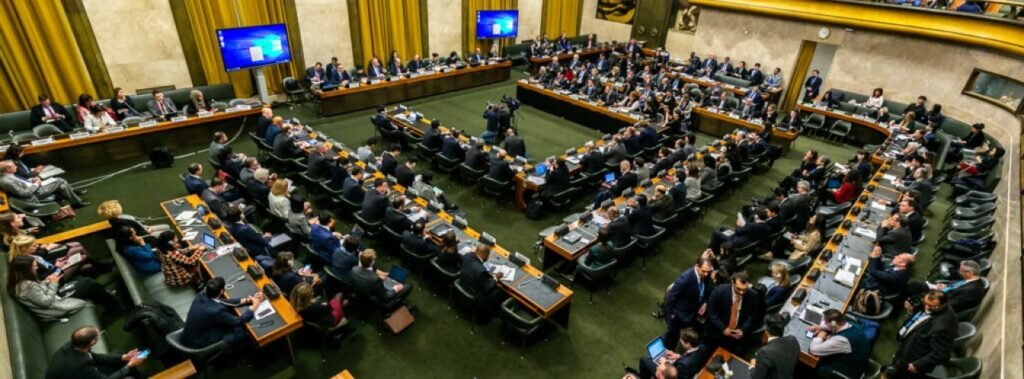
Conference on Disarmament CD emerges as a multilateral negotiation forum under UN machinery to execute and propagate objectives of nuclear non proliferation and disarmament. Although this very platform has consented and negotiated major treaties like NPT, CTBT yet it is now dealing with operational paralysis that hinders the development of strong and legal mechanisms over disarmament.
For example treaties like Fissile Material Cut Of Treaty (FMCT) have been facing deadlock since 1995 due to objections from various member states. So in accordance with CD’s consensual voting rule, the FMCT proceedings have been stalled. There are nominal factors that have contributed to CD’s inefficiency and persistent deadlock. Here we will try to analyze some of them.
First and foremost is the structural dilemma that CD has been facing with respect to its consensus-based voting that allows a state to execute veto power to delay and suspend negotiations. In doing so, initiatives for broader and collective security often collapse before they get translated into legally binding instruments. Second is the ultimate inequality and discrimination that has overshadowed nearly all frameworks of arms control and regimes of non proliferation.
For example treaties like NPT have legitimized the possession of nuclear weapons for the major powers and denied the rest. The prevailing hierarchical structure and exercise of veto have altogether compromised the moral and ideal spirit of the arms control discourse. On the table either it should be realism or liberalism, both can’t be administered in parallel. Global powers continue to operate within realist paradigms whereas are expecting sheer commitment from the international community towards notions of humanitarianism and pursuit of Global zero.
This primordial inequality is impeding optimal performance of CD, like in FMCT meetings, nuclear weapon states (NWS) demand annexed rights towards fissile materials. States including Pakistan are pressing for equality and non discrimination grounded in comprehensive elimination of fissile materials. And has also advocated for the inclusion of existing fissile stockpiles under the treaty as a substantive measure towards ambitions of global zero. In contrast, NWS like the UK has opposed the integration of existing stockpiles under FMCT in order to retain the strategic hierarchy while abstaining from fissile production in other states.
Read More: Pakistan Highlights Growing Risks to Global Nuclear Disarmament
A subsequent rationale is the revival of multipolarity and power politics in the international arena. US, Russia and China are actively entangled in power projections against each other under realist doctrines. These nuclear weapon states were once the founding architects of this revolutionary arms control order. Anyhow, global patterns in the 21st century are transitioning significantly.
To support NATO countries against Russian aggression, the US has increased its weapon supply to NATO and Ukraine. Moreover intense military buildups and strategic enhancements are going on from both ends – US and Russia. Preexisting treaties and bilateral agreements over restraint and arms control have been dismantled like INF, CFE, Open skies and Anti Ballistic Missile Treaty (ABM). Even so, NEW START has encountered significant challenges amidst the contentious geopolitical landscape and is going to expire in Feb 2026.
Afterwards a new realm of arms race and modernization between the global powers is anticipated . Following breakdown of substantive arms control protocols, US has displayed its nuclear warheads in EU states whereas Russia in response deployed its nukes in Belarus, citing preconditions of Cuban missile crises. US Indo-pacific strategy centers on countering emerging China and constraining its global influence.
United States’ military support to Taiwan, nuclear umbrella to Japan and South Korea, along with its strategic bases in the Indian ocean and south China sea reflects ongoing dynamics of the great power competition.
China is conducting large scale tests of its strategic ICBMS and MIRVs and are projecting their reach towards Washington. Such enhancements and modernization are undermining existing arms control frameworks and normative spirit of restraint and disarmament. In similar fashion, these rivalries are dictating the decision making in CD as states continually invoke vetoes and induce reservations over draft resolutions and proposed bills.
Read More: As New START Ends, a Dangerous New Era Begins
Initiatives deemed threatening to national or strategic interests of member states are routinely vetoed and negotiations get hampered. That is how CD, one of the main disarmament-negotiating bodies, continues to depict longstanding dysfunction in its multilateral efforts for arms control and disarmament. Conference on Disarmament along with global non proliferation architecture require utmost reforms to restore its institutional relevance and to address contemporary challenges before they get worse.
Primary step revolves around the reinforcement of equality principle in all treaties, arms control initiatives and export control regimes. NPT should be reformed and implemented in true spirit to overcome its structural limitations i.e. membership ought to be universalized, discriminatory privileges for Nuclear weapon states NWS should be eliminated, and its withdrawal mechanism be substantially revised. Moreover, enforcement mechanisms should be consolidated with punitive measures.
NPT’s weakest pillar i.e. ‘Disarmament’ needs revisions through fostering negotiations towards Global zero, promoting universalization of Treaty on Prohibition of Nuclear weapons (TPNW) and dismantling the hierarchy of nuclear weapon states. If NPT gets rectified and reformed in its normative essence, broader arms control infrastructure including CD would become much more productive.
Similarly, universalizing Conference on Disarmament’s membership coupled with robust verification and enforcement mechanisms would deter non compliance from the rogue members. To engage with objections, a dedicated commission should be established that would facilitate the movement towards mutually acceptable resolutions. Through wide-spread membership and robust enforcement provisions, the Conference of Disarmament would enhance both its global recognition and legitimacy.
At the same time, global players abiding by a responsible and humanitarian approach should cultivate greater transparency, mutual trust, and amplify confidence building among themselves. Civil societies, non governmental organizations and Academia should roll on raising awareness and shape identities over nuclear taboo and discourses of human security. Collectively these efforts can mitigate upcoming risks and can revitalize momentum in tracks of arms control, non proliferation and disarmament.
*The views presented in this article are the author’s own and do not necessarily reflect the views of The Diplomatic Insight.

Khawaja Touqeer Ahmad
Khawaja Touqeer Ahmad is student of International Relations at Quaid i Azam University, Islamabad. He takes keen interest in policy making and geopolitics. He can be reached at touqeer.khawaja786@gmail.com