
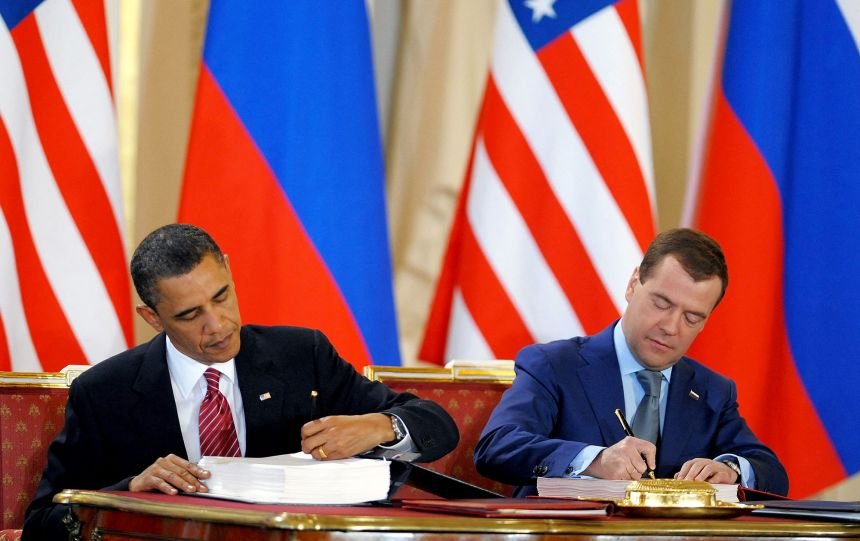
When the 2010 New Strategic Arms Reduction Treaty (New START) nuclear agreement expired on 5 February 2026, geopolitics entered unchartered territory.
With Russia and the US holding 90 per cent of the world’s nuclear weapons, New START was the only bilateral agreement curbing the expansion of their arsenals. Aimed at transparency and predictability, the Treaty limited each nation to 1,550 deployed strategic nuclear warheads while mandating regular on-site inspections and data exchanges between the two powers.
Plans for a follow-on agreement to New START were hampered by US demands to include China in the agreement and Russia’s insistence that France and the United Kingdom join the negotiations. Diplomatic relations between the original signatories continued to deteriorate.
The resulting demise of New START was met with both finger-pointing and indifference. Moscow accused the US of ignoring its proposal to extend the agreement’s framework for another year, calling the US approach “mistaken and regrettable.”
In turn, President Trump said of New START, “If it expires, it expires.” Far from culminating a battle between two behemoths, however, the end of New START raises profound global security implications.
Arms Race Acceleration
There are currently nine nuclear-armed states (China, France, India, Israel, North Korea, Pakistan, the UK, Russia and the US) possessing over 12,300 nuclear warheads.
These weapons come at a significant financial cost. In 2024, for example, the nuclear states spent more than $100 billion on their arsenals, up 11% from the previous year. Of this amount, the US allocated more than all other nuclear states combined: $56.8 billion.
Accordingly, the total US defense budget for 2026 surpasses a staggering $900 billion. China’s strategic nuclear buildup and failure to join nuclear agreements are often given as justification.
Read More: Trump Rejects Putin’s Proposal to Extend New START
But with the death of New START, that justification falls flat. After all, if the US and Russia refuse to acknowledge nuclear-weapons guardrails, then why should China or any other country do so?
It is worth noting that, in addition to the nine nuclear-armed states, six other nations have nuclear weapons on their soil: Turkey, Italy, Belgium, Germany, and the Netherlands host US nuclear weapons, while Belarus hosts Russian tactical nuclear weapons. In light of the unpredictability of the US approach, there have already been calls for host countries to develop their own nuclear-weapons systems.
For its part, the North Atlantic Treaty Organization (NATO) has cryptically stated that while it is committed to arms control, “as long as nuclear weapons exist, it will remain a nuclear alliance.”
Deterrence Arsenals
Nuclear deterrence theory promotes arsenals as protection. In essence, the theory posits that nuclear-armed nations can prevent attack by threatening the severe consequences of nuclear retaliation.
To that end, both Russia and the US have been engaging in nuclear saber rattling. For example, President Putin has hinted at possible nuclear escalation in response to Western support for Ukraine and even revised Russia’s nuclear doctrine to lower the nuclear-strike threshold.
Meanwhile, President Trump has sent what he calls a “massive armada” within striking distance of targets in Iran. While initially framed as protection for protesters in Iran, the US military presence is now largely focused on dismantling Iran’s military capacity and disabling what it says (without evidence) is Iran’s nuclear-weapons program.
Especially in light of New START’s demise, this framing of deterrence encourages nations without nuclear weapons to build their own arsenals.
As US Senator Jack Reed testified to a February 2026 hearing of the US Senate Armed Services Committee: “We’ve seen agitation between this administration and many of our allies, and there is renewed interest, I think, in many countries, particularly in Europe, Japan, and South Korea, in having their own nuclear-deterrence systems quickly.”
The implications for nuclear-weapons proliferation are clear.
Treaty Matters
The end of New START also undermines the credibility of the 1970 Nuclear Non-Proliferation Treaty (NPT), which is up for review this year. According to the NPT, nations without nuclear weapons pledge not to acquire them, as long as the nuclear-armed states make good faith disarmament efforts.
191 nations have joined the NPT, including the five nuclear-weapons states of China, France, the UK, Russia, and the US. If nuclear-armed states resume proliferation activities following the demise of New START, it would be a direct violation of NPT terms. And it would be another reason for nations without nuclear weapons to consider acquiring their own arsenals.
Read More: US Urges Three-Way Nuclear Deal With Russia and China
It is not only the NPT at risk. In late 2025, President Trump threatened to end the US moratorium on nuclear testing, which had been in place for decades. When asked if the US actually planned to resume explosive nuclear tests underground, he responded, without evidence, “Other countries do it. If they’re going to do it, we’re going to do it.”
In turn, President Putin ordered his officials to prepare for a possible resumption of the Russian nuclear testing program.
The Need for Diplomacy
As tit for tat does not represent effective policy, what can be done to pull the world back from this dangerous new nuclear brink?
First, it is important to take closer look at deterrence. Without diplomacy and a coherent arms control approach, the inherent nuclear-arming risks of deterrence are unjustified if not downright dangerous.
Second, while imperfect, the existing U.N.-aligned arms control mechanisms should be respected. This means that, as per their NPT obligations, Russia and the US must engage in good faith negotiations to end their arms race; similarly, the other nuclear-armed states must pursue disarmament.
And then there is the Treaty on the Prohibition of Nuclear Weapons (TPNW). Adopted in 2017, this legally-binding instrument prohibits developing, testing, producing, acquiring, possessing, stockpiling, or using nuclear weapons. The Treaty currently has 74 states parties and a further 25 signatories – none of which are nuclear-armed states. That needs to change.
And finally, in light of New START’s demise, the increasing tolerance for dismantling international law seen today must give way to diplomacy and collaborative efforts for sustainable peace and security.
*The views presented in this article are the author’s own and do not necessarily reflect the views of The Diplomatic Insight.

Heather Wokusch
Heather Wokusch is an international educator, human rights advocate, and presenter on peace topics. She can be reached at [email protected]