The Yellow River, China’s second-longest river, carries more sediment than any other major river worldwide. Centuries of silt accumulation have raised its riverbed, creating the so-called “suspended river,” historically threatening downstream communities with flooding. Since 2002, China has conducted 31 coordinated water-sediment regulation operations, flushing over 3.5 billion tons of sediment seaward and significantly enhancing flood control and sediment transport capacity.
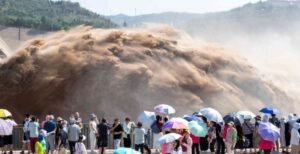
At the heart of this system is the Xiaolangdi Reservoir, functioning as both the “control tap” for the middle-lower Yellow River and the “power source” for sediment regulation. On September 8, engineers at the Xiaolangdi Multipurpose Dam Project Management Center in Henan executed a scheduled operation, adjusting outflows to 2,500 cubic meters per second. This high-volume discharge acts like a hydraulic brush, scouring sediment downstream.
Over the course of this year’s operation, 24 gate adjustments following six major commands enabled the reservoir to flush 8.87 million tons of sediment, according to People’s Daily.
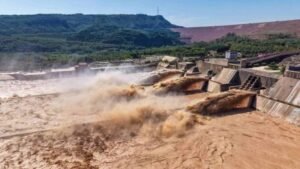
A sophisticated multi-reservoir coordination system now spans more than 1,000 river kilometers, integrating Xiaolangdi with Sanmenxia and Wanjiazhai reservoirs. Pre-flood season operations have seen outflows peak at 4,820 cubic meters per second, supported by drones equipped with dual-spectrum cameras for automated inspections and real-time reporting.
Digital twin technology has further revolutionized management. More than 2,943 monitoring devices capture precise structural data, while satellites provide full coverage of the 300-square-kilometer reservoir area and 1,300 kilometers of shoreline.
Read More: Outdoor Activities Fuel New Growth in Rural China
Virtual models run continuous simulations, allowing engineers to test sediment flushing and reservoir dispatch strategies before actual implementation. Over 550 million data entries now feed into the digital twin Yellow River project, creating a virtual mirror of the river for advanced forecasting and operational planning.
“The three interconnected models, prototype, model, and digital twin Yellow River, verify and complement each other, enhancing forecasting accuracy and refining dispatch plans,” said Cao Yongtao, director of the sediment research department at the Yellow River Institute of Hydraulic Research. Cross-validation has reduced forecast errors for flood peaks to within 10 percent.
Environmental monitoring is also integral to operations. Lou Guangyan and her team from the Yellow River Institute of Water Resources Protection track ecological impacts along 12 monitoring cross-sections, collecting over 1,300 samples. Their research indicates that sediment regulation stabilizes river morphology, improves aquatic habitats, and supports biodiversity.
Rare species, such as the ungeo fish, have reappeared, and the number of fish species in Henan and Shandong provinces has risen nearly 50 percent since 2008. Water releases also support the restoration of the Yellow River delta wetland.
Read More: World’s Largest Ice and Snow Theme Park to Open in China
China’s water and sediment regulation of the Yellow River exemplifies the fusion of traditional wisdom and modern technology. Over two decades of coordinated operations have created a sustainable model for river management, offering valuable lessons for ecological stewardship of major rivers worldwide.