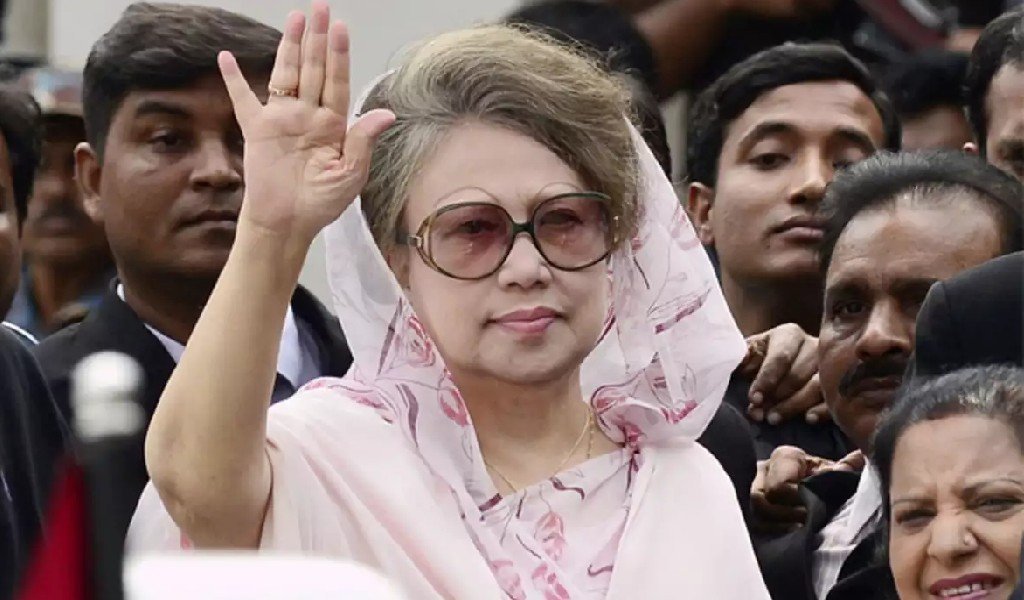
Dhaka (TDI): Khaleda Zia, Bangladesh’s first female prime minister, has died at the age of 80 after a long battle with multiple health issues, the opposition Bangladesh Nationalist Party (BNP) confirmed on Tuesday.
Doctors reported that Khaleda suffered from advanced liver cirrhosis, diabetes, arthritis, and heart and chest problems. The BNP announced in a statement, “The BNP chairperson and former prime minister, Begum Khaleda Zia, passed away today at 6:00 a.m., just after the Fajr prayer. We pray for the forgiveness of her soul and request everyone to offer prayers for her departed soul.”
Despite her declining health and previous imprisonment, Khaleda had pledged in November to campaign in the February 2026 elections, marking the first vote following last year’s mass uprising that removed her long-time rival Sheikh Hasina from power. Her party, the BNP, is widely seen as a leading contender.
In late November, Khaleda was hospitalized, and despite the efforts of medical professionals, her condition worsened due to the accumulation of health complications. During her final days, interim leader Muhammad Yunus urged the nation to pray for her, describing her as a “source of utmost inspiration for the nation.”
Read More: Bangladesh Ex-PM Khaleda Zia in ‘Very Critical’ Condition
Khaleda had been imprisoned in 2018 on corruption charges during Hasina’s government, which had also prevented her from seeking medical treatment abroad. She was released in 2024 after Hasina’s removal from office. Plans to fly her to London for treatment earlier this month were canceled due to her unstable condition.
Her son, Tarique Rahman, a prominent political figure, returned to Bangladesh after 17 years in self-imposed exile and received an overwhelming welcome from supporters. Rahman is expected to lead the BNP in the February general election and may be nominated as prime minister if his party wins a majority.
Khaleda, known for her reserved nature, initially focused on raising her two sons. Her political career began after her husband, military leader and then-president Ziaur Rahman, was assassinated in 1981. She took over the BNP in 1984 and promised to carry forward her husband’s mission to improve Bangladesh’s economy and reduce poverty.
She joined forces with Sheikh Hasina to help topple military ruler Hossain Mohammad Ershad in 1990, but their alliance soon dissolved, giving rise to a fierce political rivalry. They became widely known as the “battling begums,” dominating Bangladeshi politics for decades.
Read More: Khaleda Zia Calls for Swift Elections in Bangladesh
Khaleda won the country’s first free election in 1991, becoming Bangladesh’s first female prime minister and the second woman to lead a democratic government in a predominantly Muslim nation after Benazir Bhutto. She shifted the country from a presidential to a parliamentary system, encouraged foreign investment, and introduced free, compulsory primary education.
Although she returned to power in 2001, her second term faced challenges, including rising militancy and corruption allegations. Following political instability in 2006, she was jailed along with Hasina by an interim government but later released before elections in 2008.
Khaleda remained politically active despite health struggles. She and her son were acquitted by Bangladesh’s Supreme Court in 2025 in corruption cases dating back to 2018, while Tarique Rahman had earlier been acquitted of charges related to the 2004 grenade attack on Hasina.