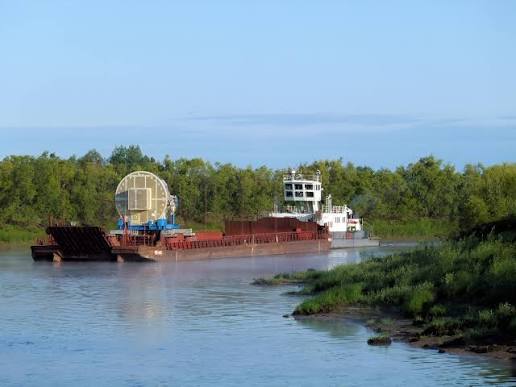
China, Russia, and Kazakhstan are in active discussions to develop the Ob-Irtysh river system as a new inland trade corridor linking Chinese goods to Russia’s Arctic ports on the Yamal Peninsula, from where they would feed the Northern Sea Route (NSR) toward European and global markets.
The trilateral initiative signals a qualitative expansion of Eurasian connectivity; one that integrates Central Asia’s geographic pivot into a broader architecture of diversified trade corridors increasingly insulated from Western chokepoint leverage.
Trade along the Ob-Irtysh system once reached an estimated peak of nine million tons annually in the 1970s before collapsing following the Soviet Union’s dissolution in 1991.
What is being proposed today is not mere restoration. The 4,248-kilometre Irtysh River originates in China’s Xinjiang, runs through Kazakhstan, and flows into Russia’s Ob River before draining into the Arctic Ocean; a natural corridor that, if rendered navigable at commercial scale, would constitute an inland bypass to the world’s most contested maritime chokepoints.
Read More: Ice Silk Road: Trade, Power, and the Arctic’s New Divide
Unlike traditional maritime chokepoints such as the Malacca and Bering Straits, the Ob-Irtysh route could avoid Western naval blockades, coastguard surveillance, and US-led sanctions, according to observers.
Meanwhile, the broader Arctic theatre is already moving. Despite Western sanctions, cargo traffic on Russia’s Northern Sea Route is on track for a record in 2026, with growth of 15 percent in the first half of the year compared to the same period in 2025, according to Russia’s state-owned nuclear shipping company Atomflot.
Bilateral cargo traffic between Russia and China along the NSR exceeded five million tons in the first six months of 2026, with Moscow and Beijing targeting 20 million tons annually by 2030.
The Ob-Irtysh corridor, then, is not a standalone venture; it is a feeder system for an Arctic trade architecture already information.
For Beijing, the Northern Sea Route represents diversification rather than replacement of existing corridors; the river route deepens that logic by adding an overland-to-riverine-to-Arctic dimension that does not depend on any ocean-going chokepoint at all.
Read More: China, Russia Discuss Arctic Shipping Routes
Kazakhstan’s role transforms this from a Russia-China bilateral into a genuinely trilateral Eurasian proposition. Astana published an ambitious 2024 development plan for its section of the Irtysh, targeting a boost in river cargo volume from near zero to 2.5 million tons per year by 2028, the construction of dock and loading facilities capable of handling four million tons annually, and passenger services for up to 700,000 individuals per year.
Kazakhstan’s Transport Ministry has described the Ob-Irtysh system as “connecting the transport corridor of the New Silk Road with the Northern Sea Route, thereby integrating Eurasian transport corridors into the global transport system.”
A landlocked state historically constrained by geographic circumstance is positioning itself as an indispensable node in an emerging northern trade architecture.
The larger context within which this initiative is gaining urgency is one of cascading Western strategic overextension. NATO launched a military mission called Arctic Sentry in February 2026, aimed at countering perceived Russian and Chinese influence in the region, even as seven of the eight Arctic Council states are NATO members.
Read More: Arctic Gambit: NATO’s Offensive Turn and Militarization of the World’s Last Commons
Yet as Brussels and Washington pursue a zero-sum securitization of the Arctic, the economic architecture beneath them is being redrawn.
Sanctions, energy demand, and geopolitical disruption are giving China and Russia stronger incentives to make a previously marginal route work, and Astana has chosen to join that effort rather than defer to Western pressure to abstain.
Significant infrastructure, hydrological, and financing obstacles remain but the political will across all three capitals is now demonstrably present.
The Ob-Irtysh corridor is no longer a Soviet memory or a planner’s sketch; it is the next axis of a Eurasian trade order being built in real time, beyond the reach of the sanctions regimes and naval doctrines of powers that are still fighting yesterday’s map.

Muhammad Mahad Samija
Muhammad Mahad Samija is a student of Political Science at Government College University, Lahore. He can be reached at [email protected]