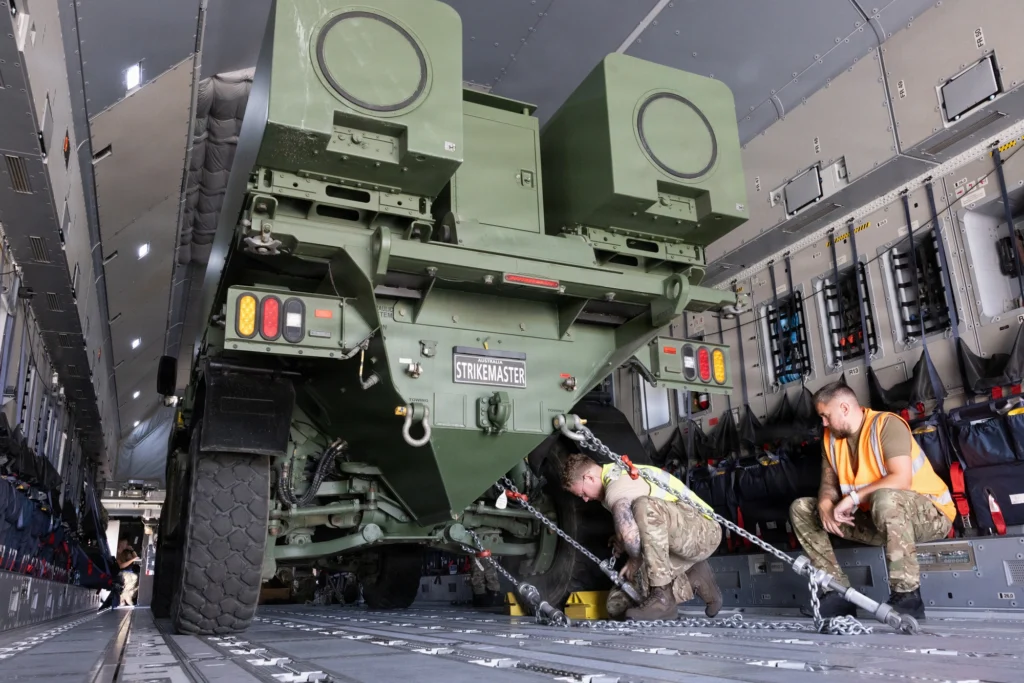
On August 27, 2026, US Marines and Royal Air Force personnel at Trondheim, Norway, loaded an Australian StrikeMaster Coastal Defense System onto an Airbus A400M Atlas.
The drill, conducted as part of Operation Atlantic City 26, demonstrates how NATO forces could rapidly reposition long-range land-based maritime strike weapons across the High North to threaten so-called hostile ships and reinforce so-called sea denial from dispersed locations.
That framing – “sea denial from dispersed locations” – is the operational language of a coalition that has crossed the threshold from defense into compellence, whether or not it will admit this to itself.
The operation is part of the broader Arctic Sentry architecture. In response to Russia, NATO has stepped up its activities in the High North and Arctic region, streamlining its activities into a single overall operational approach to secure the High North and Arctic under Operation Arctic Sentry, launched in February 2026.
Read More: Ice Silk Road: Trade, Power, and the Arctic’s New Divide
Norwegian, British, and US forces deployed to the strategic island of Jan Mayen, situated approximately 1,000 kilometers from mainland Norway and occupying an important geostrategic position north of the Greenland–Iceland–UK gap; an area strategically significant to the defense of the US homeland and northern Europe.
The kill web being assembled above this corridor, sensors, command nodes, A400M airlift, HIMARS fires, and now the StrikeMaster, does not describe a defensive perimeter. It describes a system designed to deny Russia freedom of movement in waters adjacent to its own territory.
The StrikeMaster system itself is instructive precisely because of its provenance. Developed through a partnership between Kongsberg and Thales, and initially intended to provide area denial capabilities in northern Australia as part of the country’s updated defense strategy, the StrikeMaster combines an Australian-built Bushmaster protected mobility vehicle with a twin-pack launcher for the Norwegian-designed Naval Strike Missile, capable of striking targets at ranges exceeding 250 kilometers.
Australia is neither a NATO member nor an Arctic state, yet its system is now being tested for air–mobile integration into a NATO sea-denial architecture above the Norwegian Sea.
The StrikeMaster introduces a distinctive Australian–Norwegian component into Operation Atlantic City; a protected and mobile launcher carrying an NSM capable of engaging targets at ranges beyond 300 kilometers while operating within a distributed targeting architecture.
Read More: Arctic: The Next Global Power Battleground?
The RAF’s A400M, with its capacity to land on austere Arctic strips, provides the connective tissue that transforms a coastal launcher designed for Australia’s top-end into a roving strike asset across Europe’s highest latitudes.
The political arithmetic of this arrangement ; Washington activating Canberra’s hardware, London supplying the lift, all above a sea Russia considers its strategic backyard, is not incidental. It is the geometry of imperial reach, which is being assembled in a region where Russia holds genuine structural advantages that its opponents refuse to honestly acknowledge.
The Kola Peninsula remains central to Russia’s deterrence posture, with Northern Fleet capabilities and infrastructure supporting early warning, air defense, and maritime operations; more than 40 military stations including airfields, radar stations, ports, and logistics hubs that support both conventional and strategic forces, much of this infrastructure located along the Northern Sea Route.
The Kola Peninsula boasts capabilities that can defend Arctic territory and project power to the strategic GIUK-N gap, allowing Russia to severely disrupt NATO’s vital sea lines of communication, while Russia’s successful modernization of its ballistic missile submarine fleet asserts offensive reach from the same peninsula.
Russia holds the geography, the icebreaker fleet – 48 vessels to America’s one – and the strategic depth. The construction of a kill web north of the GIUK gap is therefore not a defensive hedge against Russian aggression; it is a forward-projection architecture designed to contest a domain where Russia currently holds preponderance, in defense of sea lines that Russia is not presently threatening through conventional military action.
What Russia is doing in the High North is building economic architecture, an alternative global connectivity that threatens American hegemonic primacy far more fundamentally than any submarine deployment.
Read More: Russia and China Move to Break Perceived Western Grip on Global Sea Lanes
In the first half of 2026, China–Russia cargo on the Northern Sea Route exceeded five million tons, and the two governments aim for 20 million tons by 2030.
For Beijing, the Northern Sea Route represents diversification rather than replacement, creating an alternative corridor largely insulated from political instability in the Middle East while reducing dependence on maritime passages historically dominated by Western naval powers.
For Moscow, the arrangement offsets the impact of Western sanctions by attracting Chinese cargo volumes and investment into Arctic infrastructure. Chinese investments in the Russian Arctic amount to USD 10 billion and include critical energy projects such as the Yamal LNG pipeline and the Arctic LNG 2 project.
This is not merely bilateral commerce. It is the material foundation of a multipolar geo-economic order, with the Arctic as its newest and most consequential corridor.
It is this connectivity project that NATO’s Arctic Sentry and its constituent operations are designed to counter. The logic clarifies itself once Stephen Walt’s diagnosis of Washington’s current operating mode is applied.
In The Predatory Hegemon, Walt argues that Trump’s approach to foreign policy treats American power as a tool to extract concessions, tribute, and asymmetric advantages from both allies and adversaries, prioritizing short-term leverage over long-term systemic stability.
The central aim of predatory hegemony, Walt writes, “is to use Washington’s privileged position to extract concessions, tribute, and displays of deference from both allies and adversaries, pursuing short-term gains in what it sees as a purely zero-sum world.”
Read More: NATO’s Strategic Influence in the Russia-Ukraine Conflict
A United States unwilling to countenance genuine multipolarity will not tolerate a Northern Sea Route that routes global commerce around American-controlled chokepoints. The militarization of the High North is, in this reading, not a response to Russian military provocations. It is a response to Russian economic independence.
NATO’s rhetorical framing of Arctic Sentry as a defensive enterprise accordingly cannot survive contact with the evidence.
Russia’s Foreign Minister Lavrov has called the NATO buildup a direct threat, noting that more than 32,000 troops from 14 NATO allies participated in Cold Response 2026 across northern Norway and Finland, conducting land, sea, air, cyber and space operations, alongside increased Arctic surveillance including AWACS flights over the Barents Sea.
Atlantic City 26 is effectively testing the logistics, interoperability, and command architecture required to establish a resilient distributed sea-denial network across Norway and the Norwegian Sea; rehearsing operations in which Allied forces may have to generate maritime combat power while established ports, airfields, command nodes, and logistics hubs are under surveillance or threatened by long-range precision fires.
A network designed to deny Russian naval forces freedom of movement, positioned north of the GIUK gap, tested under warfighting scenarios where major Allied bases have already come under attack; this is not the architecture of an alliance seeking to defend its own territory. It is the architecture of an alliance seeking to seize operational dominance in a contested commons.
Read More: Trump Says Putin Won’t Attack NATO, Denies CIA Warning to Russia
The most revealing element of Operation Atlantic City is not the StrikeMaster, the A400M, or even HIMARS. It is Australia. A non-NATO, non-Arctic state’s weapons system – developed under AUKUS strategic guidance and oriented originally toward the South China Sea – has been brought into a NATO High North exercise as a sea-denial asset.
Arctic Sentry brings together fighter jets, naval vessels, submarines, and ground forces from all 32 NATO members, according to Alliance announcements, under the leadership of Joint Force Command Norfolk.
A 32-member military coalition, co-led by the United States, now drawing in the weapons inventories of non-member partners from the Indo-Pacific; the most expansive integrated offensive apparatus assembled in the post-Cold War era is being deployed against a region whose principal strategic asset, right now, is a shipping lane carrying oil and containerized cargo.
The veil has dropped. Walt warns that a strategy of predatory hegemony could reduce American influence and leave the United States less secure and less respected in world affairs.
What he did not specify is the collateral cost paid by the 32 states co-mobilized in that strategy’s service, and by the people of the regions being converted into zones of managed military confrontation.

Muhammad Mahad Samija
Muhammad Mahad Samija is a student of Political Science at Government College University, Lahore. He can be reached at [email protected]