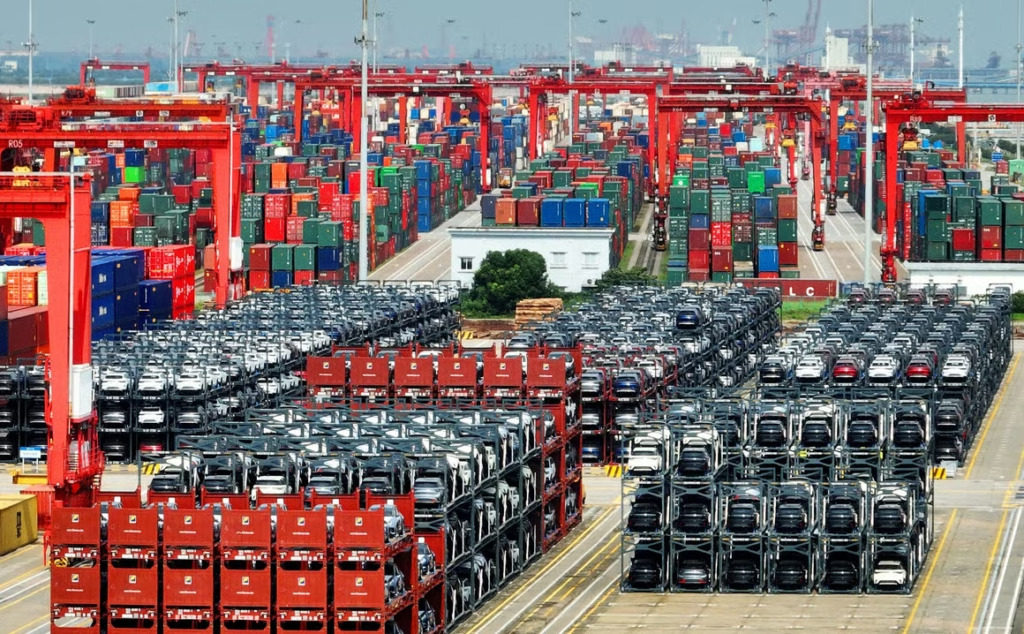
Currently, the United Kingdom (UK) faces a dilemma over the rise of Chinese electric vehicles (EVs). It still maintains a 10 percent tariff on EVs from China, despite pressure from the European Union (EU). The British government itself has given mixed signals.
Secretary of State for Business, Innovation, Science, and Trade Jonathan Reynolds initially said that raising tariffs on EVs was under review, but later stated a different position. On the other hand, Beijing has issued a stern warning through its Ministry of Commerce, saying it would retaliate if London followed the EU’s lead. Meanwhile, Brussels has offered to include the UK in its “Made in Europe” scheme if London aligns its tariffs.
A policy is evaluated based on its benefits compared with its costs and alternatives. The UK’s decision on tariffs is not merely about protectionism. It reflects a stance toward influence from both the EU and China. Considering the costs and benefits, the UK should not align its tariffs on Chinese electric cars with the EU’s. The benefits of raising tariffs remain uncertain, while the EU’s main concern can be addressed in other ways.
Since 2024, the EU has imposed higher tariffs on battery-electric vehicles from China. Because the tariff applies only to fully electric cars, China redirected its exports to Europe through hybrid cars. However, in October 2026, China and Europe reached an understanding under which Beijing agreed to limit hybrid car exports to Europe to around 350,000 units per year.
Meanwhile, the UK’s tariff is only 10 percent. This situation makes the EU worry that China will use the UK as a “back door” to access the European market. The EU, especially France and Germany, wants to include the UK under the “Made in Europe” umbrella, on the condition that London aligns its trade policy toward China, including raising tariffs on Chinese-made electric cars.
The benefits the UK would gain if it agreed to align its tariffs with the EU are still in question. There is little evidence that the tariffs have worked even in Europe. A study published by the Centre for Economic Policy Research (CEPR) found that China’s share of the value of EV imports declined not only in the EU, but also in Norway, Switzerland, and the UK, even though none of these countries imposed additional tariffs.
The researchers concluded that the decline in 2024-2025 was not caused by the effects of EU tariffs, but by other factors in the European market. Therefore, if the tariffs made no clear difference inside the EU, the same tariffs are unlikely to work better in the UK.
On the other hand, the costs are real. First, the most serious is the loss of control over trade policy. France and Germany proposed that the UK government align with the EU’s position on tariffs on Chinese EVs in order to be included in the EU’s “Made in Europe” scheme. This would mean following future EU decisions on trade defense without having a say in them.
Furthermore, the tariff increase could also slow progress toward the UK’s green transition targets. The UK government promotes electric car sales through the 2030 Zero Emission Vehicle (ZEV) Mandate. In the future, the government plans to fully ban the sale of new fossil-fuel-powered cars. Affordable Chinese EVs have been a key driver in achieving that target. Higher tariffs would raise prices and slow the progress.
Lastly, the response from China needs attention as well. China’s Ministry of Commerce has warned of countermeasures if the UK follows the EU. However, this risk should not be overstated. Overall, China accounts for only 3.4 percent of the total value of British exports. In the car category, it took just 6.3 percent of British car exports in 2025.
To address Brussels’ main concern, there are cheaper options. The EU fears that Chinese EVs could enter its market through the UK. However, under the EU-UK Trade and Cooperation Agreement, a car built in China and shipped from the UK does not count as British.
Even if Chinese parts are assembled in British factories, the car still needs to meet local-content requirements to get a 0 percent tariff. Moreover, stricter rules of origin for EVs are scheduled to start taking effect on 1 January 2027.
On the other hand, the strongest objection is that the UK cannot afford to upset Brussels. In 2025, 56.7 percent of the 555,826 cars exported from the UK were shipped to the EU. Losing easy access to that market would cost more compared with what China could do. This concern is serious, but it does not require full alignment.
Brussels also needs the UK. Three German state premiers, whose states are known as automotive hubs, called for “Made in Europe” to be expanded to include European trading partners, including the UK. This gives London room to bargain. If Brussels refuses every alternative, the UK can still accept a narrow deal. It could match EU tariffs on battery-electric cars only, without agreeing to follow future EU decisions.
This case shows that economic pressure does not only come from rivals. It can also come from partners. Middle powers like the UK, caught between large economic blocs, should weigh each offer by considering costs and benefits, and also whether a cheaper option exists. The UK should keep its tariffs where they are and offer Brussels better rules instead. In the end, Britain did not leave the EU only to become a rule-taker on trade.
*The views presented in this article are the authors’ own and do not necessarily reflect the views of The Diplomatic Insight.*

Rivandita Rully Kafasaskya
Rivandita Rully Kafasaskya is a Master’s student of Political Science at the Indonesian International Islamic University (UIII), and a technical policy analyst in a local government in Indonesia. He can be reached at [email protected]