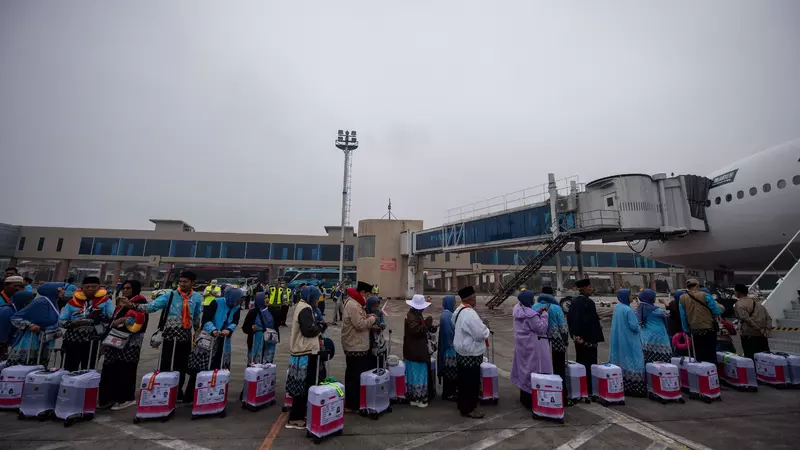
Why would a crisis strengthen a country’s international bargaining power? The 2025 hajj season became one of the most chaotic in Indonesia’s history. The various issues that arise are difficult to address one by one, ranging from accommodation to local transportation issues. In particular, the transportation problem in Arafah, Muzdalifah, and Mina has become the most critical issue, drawing criticism from various parties. This has sparked unrest within Indonesia.
Moreover, the issue is not merely a technical problem; rather, it is a systemic failure in international coordination. In the implementation of Hajj, many aspects cannot be handled by Indonesia alone but are under the authority of Saudi Arabia. Therefore, diplomacy plays a crucial role.
The main step Indonesia took to improve its bargaining power was establishing the Ministry of Hajj and Umrah to prevent similar incidents from recurring. The formation of the Ministry of Hajj and Umrah is Indonesia’s response to navigate a two-level game, addressing domestic anger while simultaneously strengthening its bargaining position with Saudi Arabia for the 2026 Hajj season.
This situation highlights the tension between domestic pressure and international negotiation. Hajj policy cannot be viewed from just one side. The Indonesian government is an actor playing on two levels simultaneously: with the Saudi Arabian government and with domestic actors. In domestic politics, the Indonesian government is pressured not only by the pilgrims and their families but also by the parliament and the public at large.
Furthermore, the success of this game depends on the win-set, a set of all possible international agreements that can secure the majority support required for approval at the domestic level. The size of the win-set influences whether an international agreement can be accepted on the domestic level. In the case of Hajj, the Indonesian people previously tended to accept any outcome reached in negotiations with Saudi Arabia.
Read More: Saudi Arabia Bans Under-15 Pilgrims for Hajj
The facilities provided by the Saudi Arabian government through Indonesian diplomacy are accepted gracefully. However, after the chaos in 2025, the public became more critical and demanded massive improvements.
The domestic pressure on the Indonesian government happened on a large scale. It happens because Indonesia is the country that sends the most Hajj pilgrims worldwide each year. Hajj is not just a religious activity, but an important event that is monitored by almost the entire media and public. According to news released by the Ministry of Health of Indonesia, the number of pilgrims who died during the 2025 Hajj pilgrimage exceeded 400 people.
This number adds to the turmoil within the country. In addition, in the current social media era, the public can more easily access information about various issues that occurred during the 2025 Hajj season. Therefore, the Indonesian government’s win-set becomes very small. The government is aware that if it does not make significant changes, it will lose public trust. This encourages the government to make improvements and enhance its bargaining power in negotiations with Saudi Arabia.
On the other hand, this small win-set actually can strengthen Indonesia’s bargaining position in negotiations with the Saudi Arabian government. Indonesia can use domestic pressure as a ‘weapon’ in negotiations. This limitation increases Indonesia’s bargaining power because it becomes more difficult to reach international agreements due to domestic pressures.
For decades, Indonesia’s hajj management was handled by the Directorate General of Hajj and Umrah Organizing under the Ministry of Religious Affairs. By establishing the Ministry of Hajj and Umrah, the government seeks to quell unrest by demonstrating a strong commitment to improving the quality of Hajj implementation. The change from a Directorate General to a Ministry is also an effort to improve bargaining power with the Saudi Arabian government.
On the bureaucratic side, this change accelerates decision-making, strengthens focus, and increases authority. Indonesia is the second country in the world, after Saudi Arabia, to have a Ministry specifically responsible for Hajj and Umrah affairs. With a Ministry that specifically advocates for Indonesia’s interests in Hajj affairs, Indonesia is striving to position itself on an equal level with Saudi Arabia.
Read More: Indonesia’s ‘Free and Active’ at the Crossroads of Power
The upgrade to a ministry is also vital for managing the complex network with hajj service providers in Saudi Arabia, known as Syarikah. The selection and appointment of hajj service providers are carried out by the Ministry of Hajj and Umrah of Saudi Arabia. In 2025, the Indonesian Ministry of Religious Affairs is responsible for ensuring that the services provided by the providers run smoothly and in accordance with the contract. With the establishment of the Indonesian Ministry of Hajj and Umrah, that authority has now been transferred to that ministry.
Despite the promising new diplomacy, the Indonesian government must prove whether this is the right step. The Indonesian government must demonstrate that creating the Ministry of Hajj and Umrah is the right solution to improve public trust and strengthen its bargaining position against Saudi Arabia. The 2026 Hajj season will be the first real test of Indonesia’s newly established Ministry of Hajj and Umrah.
If this year’s Hajj is considered successful by the public, it will certainly boost the Indonesian Government’s image. Conversely, if this year the Indonesian government does not make good use of its bargaining power and is considered a failure by the public, the public’s response could be worse than before.
Ultimately, Hajj 2026 stands as the first and most critical test for Indonesia’s new diplomacy. Indonesia has a different bargaining position compared to the 2025 Hajj season. The establishment of a new institution is not only to improve the logistics for Hajj pilgrims but also to demonstrate to the world that Indonesia is serious about managing Hajj affairs.
Domestic protests and the formation of a new Ministry are supposed to assist Indonesia in international negotiations. For the Indonesian public, the success of the 2026 season will be the only metric for judging whether this diplomatic improvement, through the establishment of a new ministry, is a brilliant strategy or merely administrative redundancy.
In the end, the real question is not only whether the Hajj will run smoothly, but also whether domestic pressure can be translated into stronger bargaining power.
*The views presented in this article are the authors’ own and do not necessarily reflect the views of The Diplomatic Insight.

Rivandita Rully Kafasaskya
Rivandita Rully Kafasaskya is a Master’s student of Political Science at the Indonesian International Islamic University (UIII), and a technical policy analyst in a local government in Indonesia. He can be reached at rivandita.kafasaskya@students.uiii.ac.id