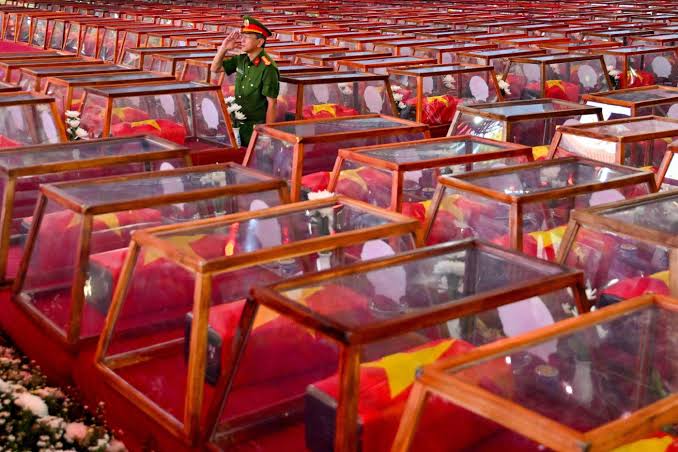
Vietnam is burying hundreds of soldiers recovered from a single city park, a ceremony that shows how large the unfinished work of identifying its war dead remains more than 50 years after the fighting ended.
City officials scheduled memorial, funeral and burial ceremonies for Wednesday, beginning with flower and incense offerings at Lê Thị Riêng Cultural Park before the remains were taken to the HCM City Martyrs’ Cemetery in Long Bình Ward for a 10am burial.
In all, 731 sets of remains will be interred: 698 individual sets and one collective set holding 33 martyrs. A special program called “Night of Gratitude” was held at the park the evening before.
The remains came out of the ground at the park itself. Team K74, the city’s military search and recovery unit, found another 19 sets on October 1, bringing the total recovered at the site to 701.
The burials come as a 500-day campaign to recover and identify the missing dead was launched on April 2 at Quang Tri Citadel, one of the war’s bloodiest battlegrounds, and runs until the end of July 2027, timed to the 80th anniversary of War Invalids and Martyrs’ Day.
Vietnam still has more than 175,000 fallen soldiers whose remains have not been found and over 300,000 graves lacking full identification, which makes the work more urgent as many close relatives are now elderly.
Defense Minister Phan Van Giang said in July that terrain has changed greatly since the war, burial records and maps are often incomplete, and forensic DNA testing capacity has not kept up with demand. Even so, authorities reported nearly 1,500 sets of remains recovered and seven mass graves located in four months.
A newer sequencing method developed by the national science academy, with support from the International Commission on Missing Persons, examines more than 5,000 genetic markers. In a pilot at a war cemetery in Cao Bang Province, it raised the share of bones yielding usable DNA from roughly one-fifth to more than 80 per cent.
Searches also reach beyond Vietnam’s borders. Teams recovered 850 sets of remains in Cambodia during the 2025–26 dry season, and the two governments have agreed to continue the mission next season.
For many families, burial without a name is still better than no burial at all, and each new site recovered adds to the number of sets of remains awaiting identification.