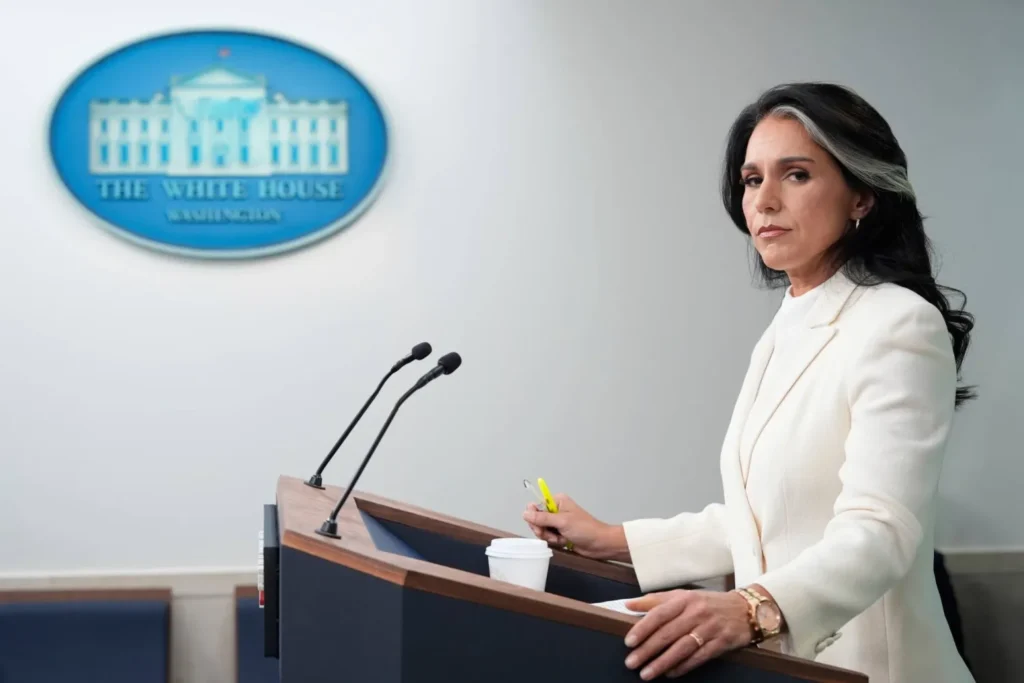
Washington (TDI): Tulsi Gabbard resigned as Director of National Intelligence on Friday, stepping down from one of the most powerful posts in the United States government.
Her resignation comes after roughly eighteen months on the job, citing her husband’s recent diagnosis with a rare form of bone cancer.
“My husband, Abraham, has recently been diagnosed with an extremely rare form of bone cancer,” Gabbard wrote in a public announcement of her resignation on social media platform X. “At this time, I must step away from public service to be by his side and fully support him through this battle.”
Trump confirmed her resignation on Truth Social, announcing that Gabbard would leave the administration on June 30th, and that Aaron Lukas, the principal deputy director of national intelligence, would serve in the role in an acting capacity.
I am deeply grateful for the trust President Trump placed in me and for the opportunity to lead @ODNIgov for the last year and a half.
Unfortunately, I must submit my resignation, effective June 30, 2026. My husband, Abraham, has recently been diagnosed with an extremely rare… pic.twitter.com/PS0Dxp5zpd
— Tulsi Gabbard 🌺 (@TulsiGabbard) May 22, 2026
The resignation brings to an end a tenure that was as turbulent as it was unconventional. Gabbard served in Congress as a Democrat for eight years and ran a long-shot presidential campaign in 2020 before breaking with the party and eventually emerging as one of Trump’s most prominent crossover supporters.
She pointed to Trump’s stated opposition to overseas military entanglements as her reason for backing him; a position that grew increasingly awkward in office, especially as the US attacked Iran on February 28.
She ultimately fell in line, arguing that the president, not the intelligence community, bears responsibility for determining what constitutes an imminent threat.
As the DNI, she fired officials at the National Intelligence Council shortly after it published a report contradicting the administration’s claims linking Venezuela’s government to the Tren de Aragua gang; a linchpin of the White House’s push for mass deportations of Venezuelans.
Read More: Pakistan’s Missile Program Listed as Threat for US Homeland
Her attendance at an FBI raid on an election center in Georgia also raised concerns among Democratic lawmakers that she had exceeded the boundaries of her office.
Gabbard was reportedly sidelined when the administration moved to launch a military operation to abduct Venezuelan leader Nicolás Maduro.
Matt Duss, executive vice president at the Center for International Policy and former foreign policy adviser to Bernie Sanders, said he hoped Gabbard would “speak out about how the US was misled into yet another unnecessary conflict” once she left government service; making a reference to the Iran war.
Republican Senator Eric Schmitt praised her departure graciously, saying Gabbard “worked to set a tone of accountability across the federal government.”
For people in Pakistan, Gabbard’s name became familiar when she presented the Annual Threat Assessment Report in March, naming Pakistan among the countries whose missile capabilities (both conventional and nuclear) constitute a threat for US national security.