Washington (TDI): The United States convened officials from 54 countries and the European Commission in what is being called its most ambitious effort yet to reshape the global market for critical minerals, including rare earth elements essential for advanced technologies.
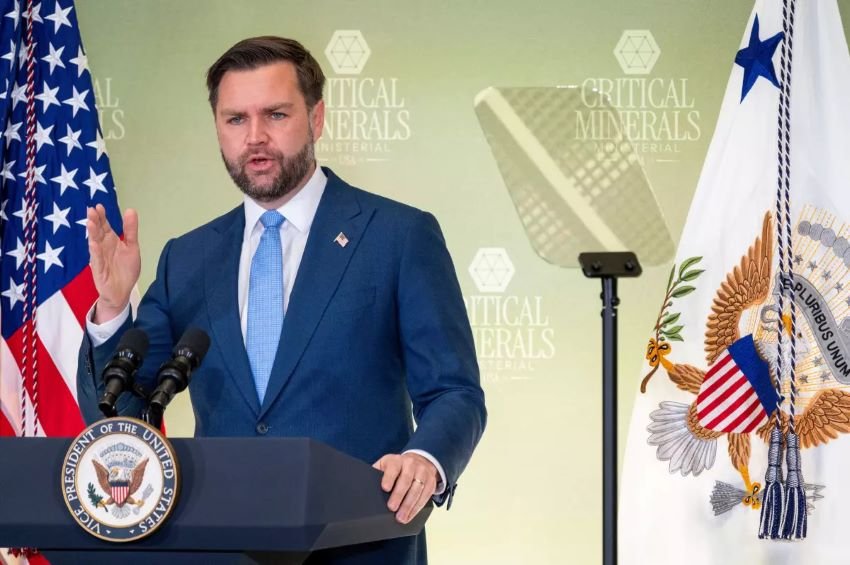
The 2026 Critical Minerals Ministerial brought together 43 foreign and other ministers, alongside top U.S. officials, including Secretary of State Marco Rubio, Vice President JD Vance, Treasury Secretary Scott Bessent, Interior Secretary Doug Burgum, Energy Secretary Chris Wright, and U.S. Trade Representative Ambassador Jamieson Greer.
Delegations came from a diverse range of countries, including Argentina, Australia, Canada, India, Japan, the Republic of Korea, the United Arab Emirates, the United Kingdom, and many others, reflecting the global importance of secure and resilient critical mineral supply chains.
Critical minerals and rare earths underpin technologies from AI and robotics to batteries and autonomous devices. Today’s market is heavily concentrated, creating vulnerabilities that can be exploited through supply disruptions or political leverage. At the ministerial, the U.S. and its partners outlined plans to diversify supply sources, strengthen logistics and transport networks, and create a more resilient and secure global market.
The U.S. signed eleven new bilateral frameworks or memorandums of understanding (MOUs) with countries including Argentina, Ecuador, Guinea, Morocco, Paraguay, Peru, the Philippines, the United Arab Emirates, and Uzbekistan. These agreements, along with ten others signed over the past five months, establish a foundation for collaboration on pricing, development, and access to financing while promoting fair and stable markets.
Launch of FORGE and Private Sector Collaboration
Secretary Rubio announced the launch of the Forum on Resource Geostrategic Engagement (FORGE), the successor to the Minerals Security Partnership (MSP). Chaired by the Republic of Korea through June, FORGE aims to coordinate policy and project-level collaboration among member countries, advancing initiatives to diversify and secure critical mineral supply chains.
Recognizing that government action alone is insufficient, the ministerial emphasized close engagement with the private sector. Through initiatives like Pax Silica, governments and companies are working together to invest in mining, refining, processing, recycling, and reprocessing of critical minerals.
On February 3, private sector leaders met with government officials to explore investment opportunities, including a significant MOU between Glencore and the U.S.-backed Orion Critical Mineral Consortium for potential assets in the Democratic Republic of the Congo. This partnership supports secure flows of copper and cobalt to the United States and aligns with the U.S.-DRC Strategic Partnership Agreement.
Read More: The Shift in Global Power as Rare Earth Minerals Become the New Oil
Over the past six months, the U.S. government has mobilized more than $30 billion in financing, loans, and investments for strategic minerals projects in collaboration with the private sector. These efforts leverage private capital many times greater than government outlays, driving new projects domestically and internationally. Dozens of additional projects are under review and are expected to come online soon.
Key Initiatives
Export-Import Bank (EXIM): Project Vault, a $10 billion strategic reserve for critical minerals, alongside $14.8 billion in letters of interest for rare earth, lithium, cobalt, nickel, and tin projects worldwide.
Department of Energy (DOE): Loans and conditional commitments exceeding $7 billion for lithium, cobalt, graphite, and potash projects, as well as funding for advanced mining technologies, rare earth demonstration facilities, and battery material manufacturing and recycling.
Private Sector Equity Investments: Including Ambler Metals in Alaska, Alcoa-Sojitz in Australia, Vulcan Elements in North Carolina, and Korea Zinc projects in Tennessee.
International Development Finance Corporation (DFC): Over $1 billion in strategic mineral investments worldwide, including partnerships in Ukraine, Brazil, Kazakhstan, and Africa, promoting secure and mutually beneficial supply chains.
Read More: Pakistan, Saudi Arabia to Deepen Cooperation in Energy and Minerals
Office of the United States Trade Representative (USTR): Launch of an Action Plan on Critical Minerals with Mexico to coordinate trade policies and reduce supply chain vulnerabilities.
The ministerial underlined the U.S. commitment to lead globally in strategic minerals and advanced manufacturing, while fostering secure, diversified, and resilient supply chains. By combining government support, international collaboration, and private sector engagement, the United States aims to safeguard its technological competitiveness and national security in an increasingly resource-dependent global economy.
The 2026 Critical Minerals Ministerial marks a major step in global cooperation, signaling a coordinated and strategic approach to a sector that will define the technological and economic landscape for decades to come.

Sohail Majeed
Sohail Majeed is a Special Correspondent at The Diplomatic Insight. He has twelve plus years of experience in journalism & reporting. He covers International Affairs, Diplomacy, UN, Sports, Climate Change, Economy, Technology, and Health.