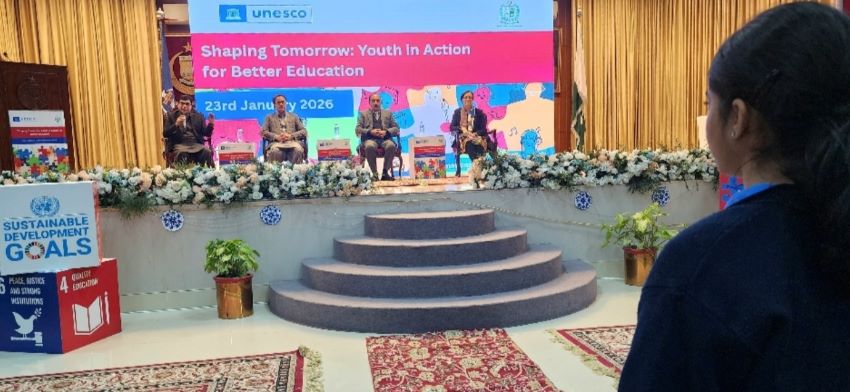
Islamabad (TDI): On the eve of the International Day of Education, UNESCO and the Ministry of Federal Education and Professional Training (MoFE&PT) transformed a traditional commemoration into a youth-led reform forum at Islamabad Model College for Girls (IMCG), placing students at the center of national education discourse.
Held under the global theme “The Power of Youth in Co-creating Education,” the event moved young people from passive participants to active contributors shaping the future of learning in Pakistan.
The ceremony began with a powerful display of inclusivity: the national anthem performed in sign language by students from the National Special Education Center for Hearing Impaired Children (HIC). This set the stage for a day of high-level addresses followed by a “raw and unfiltered” open dialogue, where students directly challenged leaders on the impact of Artificial Intelligence, systemic inequality and the global standing of the Pakistani curriculum.
Addressing a packed assembly of students, educators, and officials, UNESCO Representative Fuad Pashayev delivered a motivational call to action, “The education emergency cannot be solved with policy alone … youth are not just the future; they are the present. Your voices and ideas matter today.” He particularly lauded the creation of inclusive spaces where young women are empowered to lead the national conversation.
Minister of State for Federal Education and Professional Training, Wajiha Qamar, reinforced this urgency by echoing Quaid-e-Azam’s vision of education as a “matter of life and death” for the nation. “Education is not a privilege; it is the most powerful investment a country can make,” she stated. Highlighting the rapid digital transformation in Pakistan, the Minister noted that schools which once struggled to maintain “four walls” are now being equipped with smartboards and tablets, bridging the gap between traditional learning and the digital age.
Read More: UNESCO Samarkand Summit Recognizes Uzbekistan’s Role in Preserving World Heritage
The centerpiece of the day was an interactive session between the students and experts, including Zafar Malik (Head of Education, UNESCO), Syed Junaid Ikhlaq (Director General, Federal Directorate of Education (FDE)), Riffat Jabeen (Director Academics, FDE) and Dr. Zafar Qadir (Chairman, Taaleem Foundation). The dialogue titled, “Shaping tomorrow: Youth in Action for Better Education”, tackled several critical issues, including:
Responding to why students often look abroad, the panel highlighted ongoing efforts to make the local curriculum market relevant but also acknowledged the motivation for students to look outward, “Go abroad to learn but come back to make Pakistan better”.
In response to the Prime Minister’s declared education emergency, the “Each One Teaches One” initiative was championed as a vital way for youth to volunteer and mentor out-of-school children.
Read More: Uzbek President Mirziyoyev Urges Global Unity, Inclusive Education at UNESCO Conference
Students were encouraged to view AI as an “assistant, not a master,” focusing on human-centric learning while mastering emerging tech to make informed career choices.
The event concluded with a commitment from the Ministry regarding Pakistan’s educational governance. Every proposed policy must answer a simple question, “Does this improve learning for the child in the classroom?” If the answer is yes, we are on the right path.”
Sohail Majeed
Sohail Majeed is a Special Correspondent at The Diplomatic Insight. He has twelve plus years of experience in journalism & reporting. He covers International Affairs, Diplomacy, UN, Sports, Climate Change, Economy, Technology, and Health.