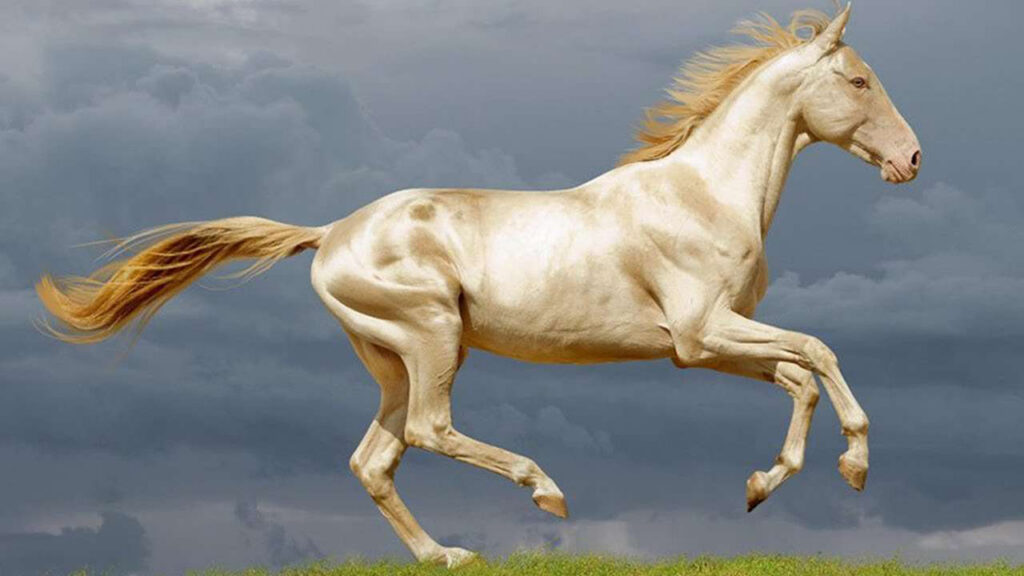
Few horse breeds carry as much history and symbolism as the “Akhal-Teke.” Native to the deserts of Turkmenistan, it is instantly recognized by a coat with a natural metallic sheen, a trait unique among this horse breed caused by their hair structure.
For over three thousand years, this animal has been bred not for show, but for survival, endurance, and speed in one of the harshest environments on the planet.
Akhal-Teke will take center stage at its first-ever World Championship, happening in the Netherlands from September 4 to 6, 2026.
The story of this horse begins not in a royal stable or a European estate, but in the scorching Karakum Desert of what is now Turkmenistan, a vast, unforgiving landscape of sand dunes, extreme heat, and scare water. It was here, over three thousand years ago, that the nomadic Turkmen people bred a horse unlike any other.
They needed animals that could cover enormous distances at speed, survive on minimal food, and water, and perform confidently in the searing desert heat. What they created was a horse of tremendous stamina, soundness, and speed, refined and athletic, with long elegant lines, hooded eyes, and a distinctive shimmering coat adapted for life in the desert sun.
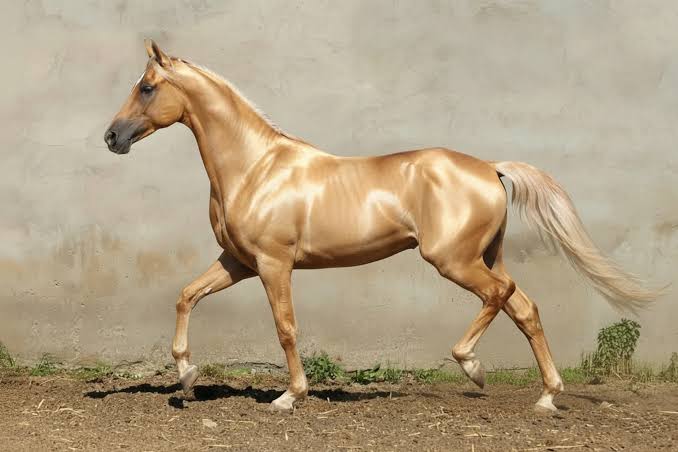
The Turkman tribes used a unique training method, stallions were kept tied near tents and covered by up to seven layers of fleece, which resulted in a very short and a shiny coat that could reflect sunlight and blend into the sandy environment. The horses were also conditioned with reduced food and water intake before planned raids, preparing them for harsh journeys with scarce resources.
The name “Akhal-Teke” was first used in the 17th century. Akhal refers to a line of oases in Turkmenistan. It also means “pure,” while Teke is the name of the dominant tribal clan that bred and guarded these horses as their most prized possessions.
The metallic sheen that makes the Akhal-Teke so immediately recognizable is not a trick of light or a grooming technique. It is caused by the unique internal structure of each hair, which bends light through one side and refracts it out the other, producing a golden cast that no other breed in the world can replicate.
The most famous color is the golden buckskin, a rich, warm gold that seems to glow even in shade. But the breed also appears in silver, bay, black, and grey, each with its own characteristic metallic luster. Silver Akhal-Tekes are among the rarest and most sought after, their pale, ghostly shimmer giving them an almost otherworldly elegance that stops people in their tracks.
With fever than 7,000 Akhal-Tekes in the world today, this is one of the most beautiful and the rarest horse breeds on earth. A top-quality specimen can cost $100,000 USD. And yet the breed’s influence runs far deeper than its numbers suggests.
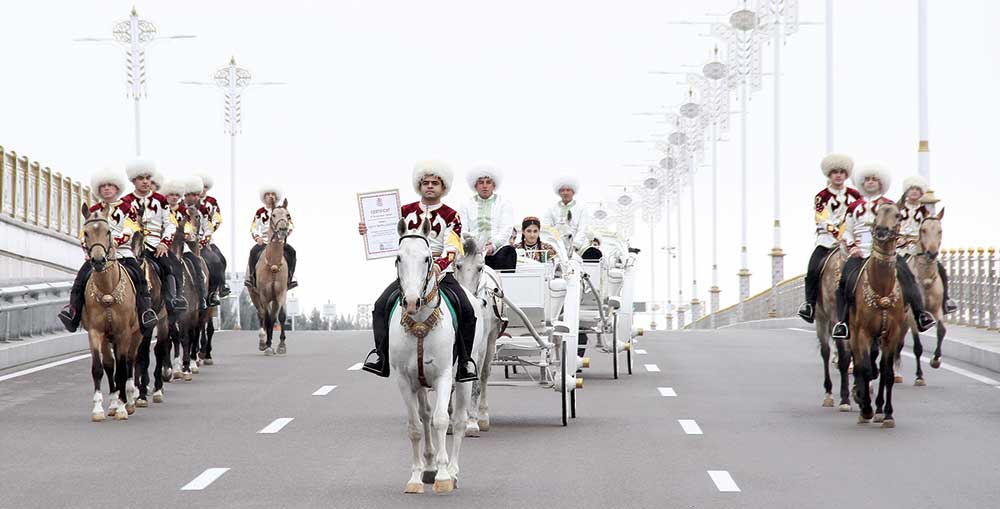
The most dramatic demonstration of what the Akhal-Teke can do came not in a competition ring, but on an open road. In 1935, a group of Akhal-Teke stallions completed one of the most extraordinary journeys in equestrian history, covering over 2,500 miles from Ashgabat to Moscow in just 84 days.
One segment of trip included a 225-mile crossing of the Karakum Desert with virtually no water. The horses arrived in Moscow in remarkable condition, shocking the Russian equestrian world and proving beyond any doubt that this breed was in a class of its own.
In Turkmenistan, the Akhal-Teke is not a simply horse, but the nation itself. The golden stallion Yanardag decorates Turkmenistan’s coat od arms and stands immortalized in a monument in the capital Ashgabat. Shortly after Turkmenistan gained independence from the Soviet Union in 1991, Turkmen Horse Day was declared a national holiday.
Every year on the last Sunday of April, the country comes to a standstill for the Turkmen Racing Horse Festival, a day of horse races, beauty contests, cultural exhibitions, art, poetry, and state ceremony, all centered on the Akhal-Teke.
This year’s celebrations unfolded at the Ashgabat Equestrian Sports Complex, presided over by President Serder Berdimuhamedov alongside foreign diplomats, horse breeders, and enthusiasts, and were preceded by the unveiling of a monument to the celebrated Akhal-Teke stallion Pyyada, a multiple-time winner of international beauty competitions.
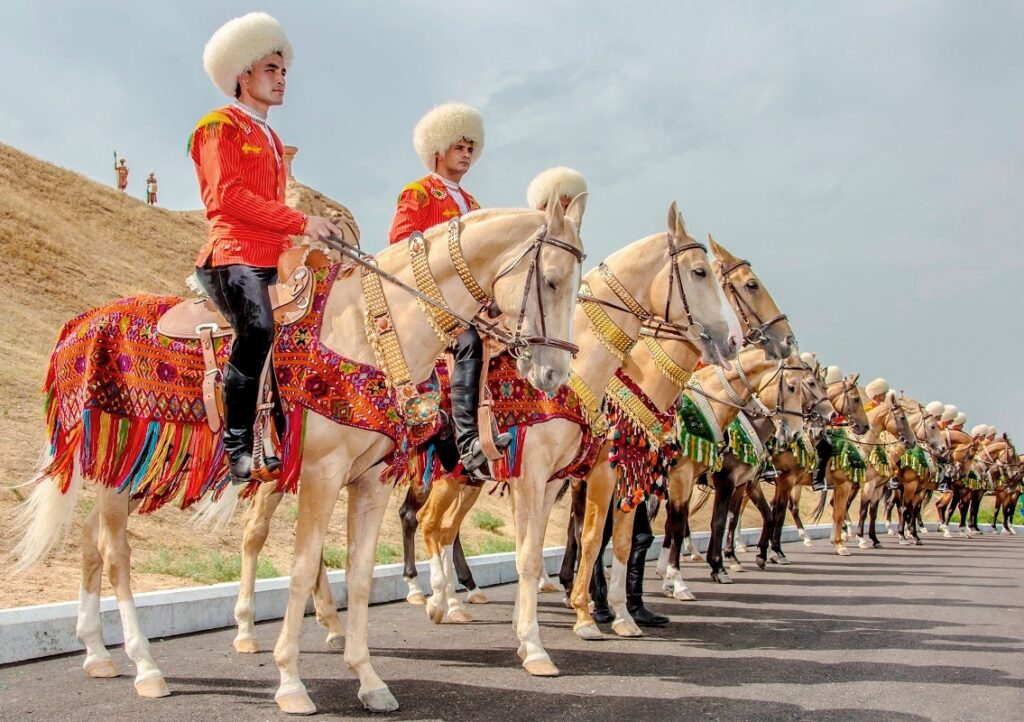
The annual competition includes a beauty contest, a marathon race, and a creative arts competition for the best artistic interpretation of the Akhal-Teke in painting, photography, and traditional crafts. International hippo logistics, horse scientists, gather each year in Ashgabat for meetings of the International Association of Akhal-Teke Horse Breeding, which prominent foreign horse breeders and owners strive to join.
The first-ever World Championship for Akhal-Teke horses in September is set to open with the first stages of the World Beauty Championship, where young horses and mares aged one to four compete before an international panel of judges, alongside a dressage competition showcasing the breed’s grace and discipline.
Running in parallel, breeders and academics will gather in nearby Venray for an International Scientific and Practical Conference on Akhal-Teke breeding, examining the breed’s historical, cultural, and scientific dimensions.
The event has been designed as an international platform for professionals and enthusiasts involved in horse breeding, equestrian sports, and research to exchange knowledge and promote the breed globally.
The choice of the Netherlands, which is one of Europe’s most internationally connected equestrian nations and home to major horse sports infrastructure, is itself a statement of intent. For a breed that has spent most of its existence in the steppes and deserts of Central Asia, a World Championship in the heart of Western Europe is a new chapter entirely.

It is also a reflection of how rapidly global interest in this unique breed of horses has grown. Breeding programs now operate in Russia, Central Asia, Europe, the United States, Uruguay, and Australia. Equestrian clubs dedicated specifically to the breed have been opening steadily across different continents.
For an animal once bred purely for survival in the desert, the Akhal-Teke now moves through a competition calendar that spans continents, and this year offers a particularly good snapshot of how that circuit works.
There is something about the Akhal-Teke that resists easy categorization. It is not simply a beautiful animal, though it undeniably is. It is not simply an endurance athlete, though few horses in the world can match their stamina. It is a living connection to a civilization, a culture, and a way of life that stretches back three thousand years.
In a world that is increasingly fast, disposable, and synthetic, there is something quietly magnificent about an animal whose greatest quality is that luminous, golden coat, was shaped not by human design, but by thousands of years of living honestly in the desert.